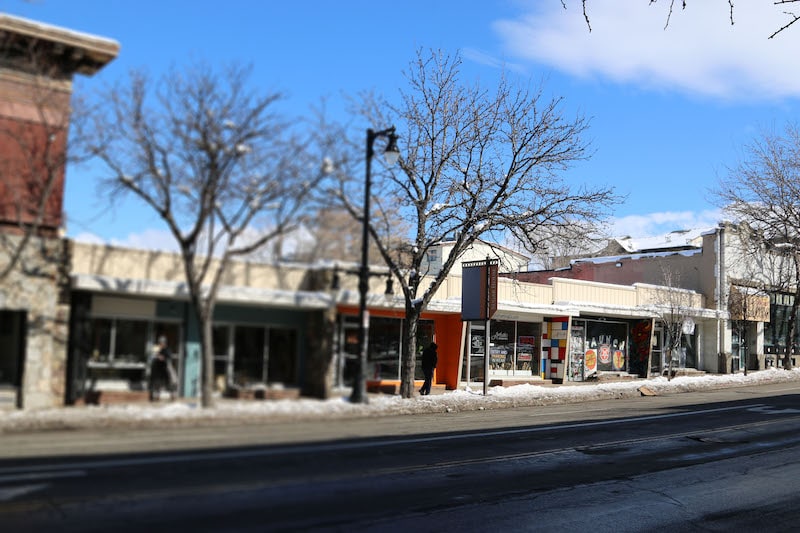
Whenever I dine in Park City I always think about the servers at the restaurant and think they definitely don’t live out here. I do think about how the commute from Salt Lake might be worth it for the higher tips, but is it?
According to The Tribune, Caroline Amick moved out of Park City last fall, after the owner of the house she was renting with two others said they had to leave so it could be rented out to seasonal winter workers. Now, she commutes from Salt Lake City up Parleys Canyon to her property management job, fighting through ski traffic and commuter congestion that, on the worst days, can make the 25-mile drive last an hour.
Kara Cook, a public school teacher, moved away from Park City in 2013, searching for housing she didn’t have to share with six other adults. She was able to move back to her hometown in 2018, when she and her family won a literal lottery — with a “ping pong ball and a machine spinning around” — for affordable housing in town. If not for that, she said, she couldn’t live where she grew up.
There are many other examples of workers who cannot live in Park City. Park City has an estimated 8,500 residents, and it’s one of the only cities in Utah where the number of workers “considerably outnumber[s]” residents, according to the housing report. About 11,000 workers commute to Park City every day, with an estimated 8,000 of them making less than $40,000 a year and living outside Summit County.
Senator Mitt Romney has decided he will not run again after serving one term in the Senate saying he wanted to pass the opportunity to the next generation, according to KSL.
Now ten Republicans are fighting to replace the Senator. All the Republicans are attempting to differentiate themselves in this race.
According to KSL, at the beginning of Senate candidate and current Congressman John Curtis’ introductory ad, a booming voice says, “John Curtis has done more for Utah than anyone.” Curtis makes a face, and says, “Hold it, that sounds too much like a typical politician. Start over.” The ad goes on to introduce voters to his family, his resume, and the issues he’s running on, like wasteful spending, energy independence, border security and standing up to the federal government.
Who do you think Utahns will vote for? Comment down below.
Gallup polling data from 2023 shows that 39% of respondents said pornography is morally acceptable, according to KSL. That’s up from 30% in 2011 when Gallup first started asking the question. Other survey data shows 37% of baby boomers (people born from 1946 to 1964) think pornography is “very bad” for society. By comparison, 14% of young adults hold that same view. Fifty-one percent of respondents said they disagreed with the idea that pornography was morally wrong.
Governor Cox proposed allocations of $193 million, and $66.2 million got approved, is this enough?
The proposed allocations included $130 million for emergency shelter; $8 million for behavioral health professionals; $7 million focused on prevention, including affordable housing; $50 million for the first-time home buying program and a $10 million one-time investment to establish a diversion court pilot program called HOME Court, according to KSL.
Only a fraction of each allocation, if at all, was approved by lawmakers, despite approval falling short of the proposal, the governor applauded the approved budget Saturday. “Our homeless friends need our help, and I’m grateful to live in a state where we take care of each other and our most vulnerable,” Cox said in a statement. “This comprehensive approach will help keep all Utahns safe, improve our cities, counties and businesses.”
Members of the Faith and Advocacy Coalition to End Hunger and Homelessness penned a letter to lawmakers on Monday, ahead of final approval.
“Evidence of the prosperity of our state have come to light during the final weeks of the legislative session as bills have come forward to dedicate at least $60 million per year, for 30 years, to enabling the production of two new major sports venues,” the letter says, in part. “A state that can afford to dedicate at least $60 million a year to two projects that are appealing, but not necessary, can also find a way to make comparable new investments in efforts to address our state’s two highly-related crises of homelessness and skyrocketing housing costs.”
Comment what you think down below.
According to Moab Times, Legislature is on track to grant $1 million to Kane Creek developer. Weston, one of the three business partners of Kane Creek Preservation and Development commented on their agenda as an organization, describing the organization’s goal as “nothing short of a complete overhaul of housing policy in Utah.”
He said the organization, which is registered under the political consulting group Election Hive, has bipartisan support and aims to both shape land use processes and help the public “better understand the underlying issues and challenges.”
*Content for this article curated from other sources.