Utah Stories

A New Chapter for Sugar House’s Original Fiddler’s Elbow

New owners take over a Sugar House long-standing establishment. While they are making changes, they are also keeping the things people have always loved. Fans will still find favorite pizza and pasta dishes.

|


Sitting down with Lynn Katoa to talk about what Sugar House looked like a few decades ago is like a high school reunion — but happily situated in a sports bar on the corner of 2100 S. and 1100 E. (Highland Drive and Wilmington Avenue).

Katoa, along with Sean Rawlings and silent partner Dan Prins, are the new owners of Fiddler’s Elbow and what was previously Salt Lake Pizza & Pasta. In the short two months they’ve owned these long-time Sugar House establishments, they’ve made some significant changes — perhaps most notably renaming the bar portion of the business, previously called Fiddler’s Elbow, to The Locker Room. The Fiddler’s name has been moved to the restaurant that was always Salt Lake Pizza & Pasta. And The Locker Room is now Utah’s only gay sports bar.

It’s a niche that’s been unfulfilled in the LBGTQ community, as none of the other gay bars in the city are focused on sports. “We want to have this space be a gay space so our legacy will be something that we brought here,” Katoa explains. “We’re here for what we’re going to be able to create for the [general] community and for our community.”

Fiddler’s has been a mainstay in Sugar House, and even with all the changes, the new owners are adamant about preserving and growing the establishments’ rich history and legacy. 

Katoa and Prins both grew up in the area, attending Highland High just up the road. Rawlings and Katoa are diligently meeting with other long-time Sugar House business owners to form a powerhouse team of small businesses that will celebrate and preserve the Sugar House vibe residents and visitors have always flocked there to enjoy.

Yet change is always difficult, say Katoa and Rawlings, from a table near the patio at The Locker Room. Gone are the college flags that lined the rafters. Upgraded are all-new TVs and an advanced sound system so customers feel like they are practically in the sports stadium of their choice, or able to clearly hear the live music frequently on tap. A kitchen renovation and brightening of the restaurant will be completed by mid-November, enabling Fiddler’s to begin serving breakfast — a meal that’s sorely lacking in the area.

Fans of many of the pizza and pasta dishes that have been coming out of the kitchen since 1992 will remain on the Fiddler’s Elbow menu. Fear not to those who love the black and bleu garlic burger — it’s a staple. New are daily flatbread offerings and a selection of crumpets topped with savory choices such as lox or pesto, and sweet offerings like banana and Nutella with slivered almonds and caramel not seen anywhere else in the city. 

They’ve also teamed up with Dented Brick Distillery to stock as many local spirits as possible in an effort to support a fellow local business. “Mark is a good human,” says Rawlings. “We have a mission that aligns and we can be successful together.”
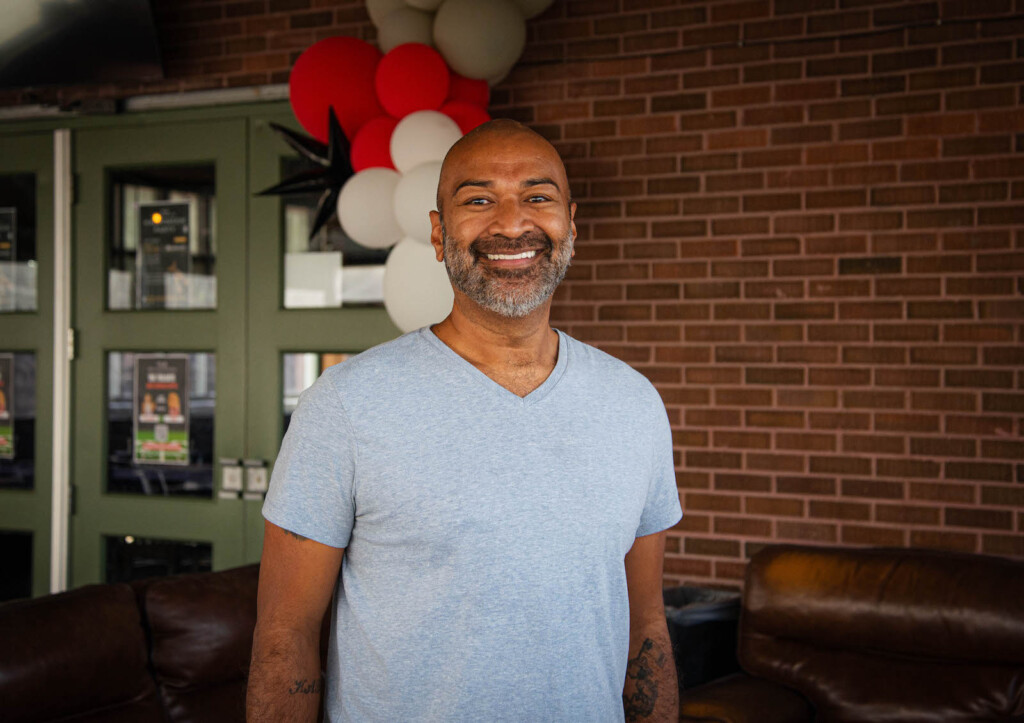
Lynn Katoa, one of the new owners of Fiddler’s Elbow and The Locker Room.

The Locker Room will soon debut a late-night menu of pizza and snacks served from 1-3:30am, and the tailgate drag brunch buffet on Saturdays from 10am-2pm has been a huge draw. “We have a really good sports following,” explains Rawlings. “We are making a point of planning events around Utah football games.”

The goal, says Katoa, is to be able to sit down with friends and enjoy a game and be able to chat over drinks and bar food in a safe and welcoming space.

They’re also focused on bringing both old and new customers back to the neighborhood with events that bring people in every night of the week — from NFL and other professional sports to DJs and live entertainment.

With potential seating for 200 in The Locker Room, the new owners also plan to build a new stage area for live music performances and expand the patio further in preparation for a Sugar House Pride celebration they intend to centralize in their parking lot and the restaurant and bar.

It’s all part of building an inclusive community, say Katoa and Rawlings. And that “chosen family” dynamic starts with the employees of Fiddler’s Elbow and The Locker Room. They retained as many of their 31 employees that wanted to stay with the restaurant and bar, and offered everyone raises.

“We want the best employees so we want to treat them the best,” explains Rawlings. 

“We want them to come and stay.” Katoa continues, “We’re giving them PTO and looking into health insurance in the next year. We want to take care of our people. This industry is hard.”

While Katoa and Rawlings had just 29 days between seeing Fiddler’s for sale and becoming the new owners, their plans for the restaurant and bar are both grand and comforting. Their desire is to bring the vibe and soul of SugarHouse back to the area through their welcoming brand of hospitality is commendable.

Fiddler’s Elbow has been an integral part of the SugarHouse community for decades, and this new chapter is sure to be filled with great food, drinks, and a welcoming ambiance where all voices can be heard in a safe space.

Feature Image: The Black & Bleu Garlic Burger. Photo by Kaelyn Korte.

, , , ,


Join our newsletter.
Stay informed.


  • Artist Kate Kilpatrick Brings Utah’s History to Life Through Murals

    “I think we’re all interconnected; as individuals as well as societies,” Kilpatrick notes. Her work showcases those connections exuberantly, and whatever scale she’s working on, you can bet that in terms of energy and spirit, she’s painting large.


  • Utah Youth Ice Climbers Win World Championships Thanks to Millcreek Common Wall

    Utah is home to two new World Champion youth ice climbers, and the ice climbing wall at Millcreek Common is getting credit for helping them win. 


  • Penny Ann’s Cafe Opens Sandy Location, Mazza Updates Menu, and U of U Food Classes

    Penny Ann’s Cafe opens its newest Sandy location, Mazza expands its menu with new and returning dishes, and the University of Utah rolls out a fresh lineup of food and wine classes.


  • Why Most People Stay Stuck in Business and What It Takes to Move Forward

    Every so often, you meet an immigrant who came here with almost nothing and managed to build something exceptional.

    Prakash Shah is the kind of man who has spent enough time around risk that he no longer treats it like an interruption.

    Today, he works in business brokerage and advisory, helping owners sell companies, helping buyers decide whether they should step in, and, when the fit is right, helping connect those buyers with private equity. He works in a world of valuations, leverage, due diligence, and hard questions that most people would rather postpone. He also operates in Utah real estate and has built a career around seeing value before it is obvious to everyone else. That is who he is now. What makes him interesting is how early that instinct started to form, and how little his life resembles the way most Americans are raised to think about comfort, career, and security.

    He grew up in Nepal in a boarding school system that would feel severe to many Americans. He was an only child, yet he saw his parents only twice a year for twelve straight years, until high school graduation. He lived inside routine. He shared space with boys from different social classes and different family circumstances. The school was structured enough that money did not buy you any special standing once you were inside. Everyone followed the same rules. Everyone was subject to the same discipline. In his case, it was an army school. Everything was measured. Everything was scheduled. In that kind of environment, you do not build your life around preference. You build it around adaptation.

    That contrast matters.

    A lot of American children are raised to search for what fits them. What are you passionate about? What do you enjoy? What feels right? Those are not bad questions, but they can create a habit of waiting for life to align itself before action begins. Prakash learned something else much earlier. He learned that life often does not align itself first. You enter the room as it is, you deal with the people in it, and you figure out how to function without making your comfort the center of every decision. He said that one of the biggest lessons from those years was tolerance, the ability to live with people from all walks of life and genuinely learn to get along with them. That is not a soft value. In business, it turns into resilience. In negotiation, it turns into patience. In career terms, it turns into range.

    When he came to the United States over 25 years ago, he did not arrive with the kind of runway that allows for a prolonged identity search. He came with two suitcases and enough money for one semester. He went to Hunter College in New York City, then to NYIT near Central Park, studying media and then media and technology management. He also studied psychology. Those details matter because they show something about his mind. He was interested in people before he built a career around deals. Even then, what attracted him was not technical prestige. It was understanding motives, behavior, and how people reveal themselves.

    But New York is merciless toward vague ambition. It demands payment in rent, transit, food, and time.

    Prakash worked constantly. He took multiple jobs. He paid tuition, paid rent, and skipped most of what Americans imagine as college life. There were no romantic years of drifting from café to concert to self-discovery. He talked about not having the luxury of dates, travel, or finding himself. He was working. Even laundry was not a small detail. In New York, he pointed out, you do not just throw clothes in a machine at home. You haul them to the laundromat, count quarters, and measure what is necessary. He also described distraction in a way that most native-born Americans probably do not think about. For immigrants, distraction is not always pleasure. Sometimes distraction is the constant pressure of competing needs. Tuition or rent. Food or savings. A better coat or another month of making do. He was not romanticizing the struggle. He was describing the arithmetic of it.

    That arithmetic did not make him cautious. If anything, it did the opposite.

    While in college, he had the option of safer analytical work. Instead, he took a sales job with Time Warner Cable that sent him into the South Bronx from 6 p.m. to 10 p.m. to knock on doors. He is not a physically imposing man. He knew exactly what kind of neighborhoods he was walking into. He described apartment buildings where people kept pit bulls, where tension was normal, where one mistake in tone or timing could end a conversation immediately. For most people, that kind of job would have been something to survive and forget. For him, it became a school in human behavior. “It’s not about talking… it’s about listening,” he said.

    One story from that period says almost everything about how he operates. He knocked on a door one night around 8:45 and found himself facing a huge man with a gun on the table, pit bulls nearby, and a half-eaten pizza in front of him. It had all the ingredients of a very bad scene.

    Continue reading and support independent Utah journalism with a purchase of Utah Stories (Digital + Print) or 3 month free trial (Digital).