

Video

Can Vans & Campers Solve the Affordable-housing Crisis?

Brandon Zinninger owner of Reparadise comes on the podcast to discuss if vans and RVs can solve the affordable housing crisis, and the major success of his camper company.

|


Brandon Zinninger owns and operates Reparadise, one of Utah’s most prominent companies dedicated to helping more people live “the van life.” But Zinninger says that despite his vans and trailers being now a tremendous off-grid alternative to paying high rents, it’s difficult for folks who buy trailers or vans to find places where they can live long-term. 

For example, Los Angeles is littered with homeless people’s Vans and RV’s and there is nowhere to put them. “Now they have to figure out what to do with all these units; I mean, we’re talking about tens of thousands, not just a few or a few hundred,” Zinninger said. 

Zinninger’s custom Airstream remodels feature a new system allowing owners to charge a battery wall from the engine and get solar energy to operate an air conditioning system and a small refrigerator in the summer; life in a van or a trailer has never offered so many amenities. But the price tag on a van with all of the top amenities and features can easily surpass $100,000. 

This might sound steep, and indeed it is, but with home prices approaching $500,000 for even a small house in Utah, living in a van or trailer is beginning to look much more attractive, especially for those who want to live in tourist destinations.

Utah Stories reported back in April how even middle-class residents in Moab are resorting to living in trailers due to housing scarcity. Chloe Wilson and Kieffer Smith moved to Moab with their dog only to discover that they would need to come up with a $10,000 deposit to move into a small condo. Unable to cover the deposit, they decided to live in their RV until they could rent. 
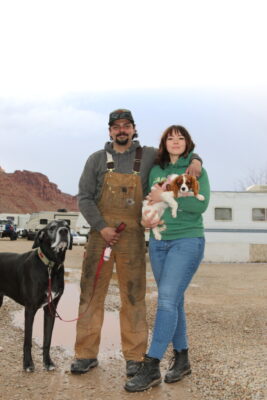
They appreciate that they can save money rather than putting around $2,300 per month into rent, which is now the going rate for a two-bedroom unit in Moab, which has become one of the top tourist destinations in Utah.

Zinninger reflected on how the van industry has changed.

“Starting around 2020, the tone changed quite a bit, and it became now I can’t afford a home, and I’m also scared of what’s going to happen from political points of view to the economy.” Zinninger said. As a result he realized a surge in business.

Over the past three years, from March 2019 to 2020, according to a Forbes article, Utah’s median sale price for a home has increased by 10.7%, then 27.7%, and 23.7% the following year. 

It’s not just homes that are increasing in price in Utah. So are rents for apartments. 

Utah has seen a 22.2 percent increase in rent since 2019, according to a KSL article. The rent increased 10.1% from 2020 to 2021, the second-highest increase on record. Zenninger chimed in on this trend as well.

“In 2016, how many sprinters did you see down in Moab? A couple a week, now you throw a football across the street, and you’re going to hit eight of them as it bounces between them,” Zinninger said. 

Based on these statistics and Reparadise’s quality products, van life looks increasingly attractive, but could we solve Utah’s housing crisis with vans and trailers, if so Zinninger says, “Repairadise is ready to help!”

,

Join our newsletter.
Stay informed.


  • When Main Street Burned: The Aftermath of the Salt Lake City Fire That Hit Downtown Bars

    Fire doesn’t respect zoning, property lines, or even the most popular block on Main Street. On the evening of Monday, August 11, 2025, a blaze that began around 8:40 p.m. on Main Street. It moved quickly through a row of aging, interconnected buildings that had become the heart and soul of Salt Lake City’s fledgling bar district. By the time firefighters brought it under control, multiple businesses were damaged, dozens of workers were displaced, and one of the city’s most active stretches went dark.

    The fire started at London Bell and spread into neighboring structures, severely damaging Whiskey Street. White Horse never caught fire, but smoke, water, and a partial roof collapse caused extensive interior damage, forcing a full rebuild. Other nearby businesses were affected as well, including some that had helped turn this part of Main Street into one of its most active and economically stable stretches.


  • Whiskey, Bullets & a Buried Town: Archaeologists Reveal Alta’s Wild Past

    Before Alta was known for powder days and lift lines, it was a silver mining town clinging to the side of a narrow canyon. In the late 1800s, men lived at 8,000 feet, went underground each day, and endured winters that regularly buried buildings in snow. This past summer, that mining town resurfaced — literally — during construction at the Alta Ski Area.

    To understand what Alta really looked like, you don’t begin with legend. You begin with its trash — and this time, that happened almost by accident.

    Alta Ski Area was installing underground water reservoirs to support snowmaking. Because the project sits on Uinta-Wasatch-Cache National Forest land, an archaeologist was required to monitor the excavation. No one expected the trench to produce much.

    But, It did.

    Artifacts began surfacing almost immediately. Enough that the Forest Service contacted the Utah State Historic Preservation Office for help. Lexi Little, who coordinates the Utah Cultural Site Stewardship Program, helped mobilize nearly 30 volunteers to assist with what quickly became a focused two-week excavation.

    Winter deadlines were approaching. The pipes for the reservoirs had to go in the ground. There wasn’t time for a slow, extended dig.

    “It was two weeks of digging in the dirt and helping figure out exactly what we were looking at,” Little said.

    Most of the people screening soil weren’t professional archaeologists. They were trained stewards from around Utah — part of a statewide volunteer network that now approaches 500 people. They poured dirt through shaker screens, scanning for fragments that could piece together a town long buried.

    “Archaeology is human trash,” Little explained. “Archaeologists are very into trash.”

    Alta had left plenty behind.

    https://youtu.be/hzIHzx3OGoo?si=dKcl2CEz-t6FZzYw

    Victorian-style ceramics appeared first — the kind typically used in hotels. Medicine bottles followed. Ink bottles. Hand-blown glass. A porcelain doll’s foot surfaced from the soil, a small detail that shifted the mental image of the town. Families were here. Children were here. This wasn’t only a camp of miners.

    The bottles helped establish time. Manufacturing details — whether glass was hand-blown or mold-made, whether a maker’s mark appeared on the base — allowed archaeologists to date many of the artifacts to the 1870s through the 1890s, when Alta was booming as a silver mining town.

    “That gives you that range of dates for when Alta was really booming,” Little said.

    One reusable soda bottle clearly stamped “Salt Lake City” connected the canyon to the valley economy below.

    Then something unusual rolled out of a dirt pile.

    A corked bottle. Intact. Liquid still inside.

    To access this post, you must purchase Utah Stories (Digital + Print) or 3 month free trial (Digital).


  • The Only Full Bottle of Alcohol Ever Found in Utah Was Unearthed in Alta

    When a backhoe rolled a corked bottle out of the dirt at Alta this summer, no one immediately grasped what they were holding. It wasn’t empty. It wasn’t shattered. It was full. “The bottle that was discovered up at Alta is the only bottle of alcohol ever discovered in an archaeological excavation in the state…


  • How Horses Help Kids Heal: Inside Utah’s Equine Therapy World

    Kelty Johnson trains horses for a living, but her deeper work happens in the quiet space between animal and human. On the Utah Stories podcast, she explains how equine therapy helps children regulate emotions, build confidence, and reconnect through presence rather than pressure.