Best of Utah

Salt Lake City Boxer Seeks to Win WBC Latin Championship

Brandon Douglas, at age 30, is a contender in the World Boxing Commission (WBC) featherweight division (127 pounds). He turned pro six years ago and after a qualifying match on May 13 in the Bahamas, he seeks to win the WBC Latin Championship Belt later this year in Mexico.

|


“Everybody has a plan until they get hit in the face.”

                                                         ―Mike Tyson 

For Brandon Douglas of Salt Lake City, those words ring true.  Brandon, at age 30, is a contender in the World Boxing Commission (WBC) featherweight division (127 pounds). He turned pro six years ago, has a 9-1 record, and after a qualifying match on May 13 in the Bahamas, he seeks to win the WBC Latin Championship Belt later this year in Mexico.

Boxing has grabbed our attention for 3,000 years, beginning with the ancient Olympians and continuing through to the recent Rocky/Creed movie franchise. It is simple enough for anyone to understand. There are no fancy plays. “You want to hit and not get hit. That’s the formula,” Brandon says.

But it resonates on a deeper level because boxing strips away any semblance of a comfort zone. A glaring spotlight shines on the 18×22 foot canvas ring. 

“There is nowhere to hide. You cannot lie. Every one of your strengths and weaknesses will show. You have no excuses whatsoever. It is a chance for a man to free himself,” Brandon explains.
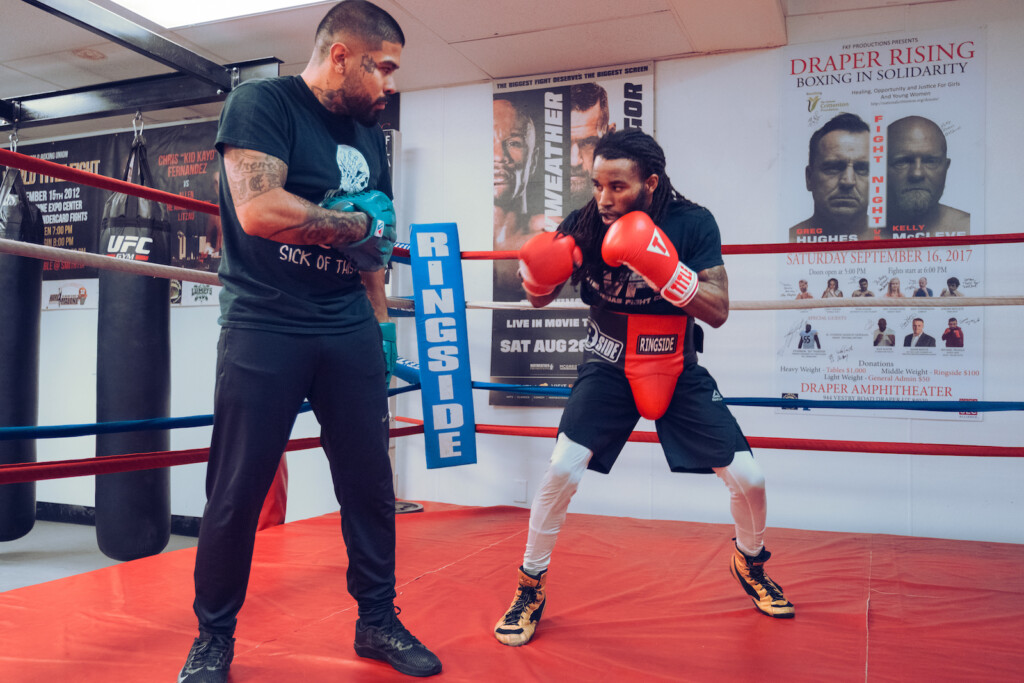
Brandon Douglas training at the Flash Academy. Photos by Dung Hoang.

Brandon has accepted this brutal freedom for 15 years. As a teen in Oklahoma, he set his sights on becoming a professional athlete. He originally pursued football until fate intervened. “I was in a fight and got kicked off the high school team. The next day, my mother drove me to the gym and I never looked back.”

After amateur bouts that included Golden Gloves and the quarter-final tryouts for the 2016 Olympics, he decided to turn pro. But it was not an easy transition. “I could not get a fight,” Brandon recalls. “The day I was going to join the military I got a call from Eddie. ‘You’ve got a fight,’ he said.” 

Eddie “Flash” Newman, himself a four-time world kickboxing champion, owns the Flash Academy in Holladay and trains Brandon for his pro bouts. Promoters arrange matchups and Brandon has received between $4,000 and $30,000 for a fight. This equates to $4,000 for a three-minute round, or more realistically, 37 cents per hour when factoring in the training schedule.

Brandon’s day begins at 8am. Breakfast consists of two eggs. Chicken and rice are lunch and a salad is dinner. A morning five-mile run is followed by 200 pushups, 240 squats, 400 sit ups and 80 pull ups. The evening workout includes shadowboxing, pummeling the light and heavy bags, jumping rope and actual sparring. Six days a week. Fifty-two weeks a year. As for how he spends his afternoons? Brandon just completed an HVAC degree from Fortis College.

This intense self-discipline creates the will to win. “It is really lonely,” he says. “I have to 100 percent believe in my own ability and become my own best friend.”

Brandon’s quiet demeanor belies a competitor’s heart. When he enters the ring he sizes up his opponent. “If I see someone acting tough, I know I have him. A true fighter knows this will not work.”

His two corner men, retired fighters themselves, analyze every round.  During the one-minute break between rounds, they coach him on the strategy to follow.

But for those three minutes, Brandon fights alone. The square circle warps time. If a boxer lands on the ropes, those three minutes stretch into eternity. “The fundamentals of jabbing, head feints and footwork will carry you through to the end. I train so much so as to not tire. About the fifth round I get a second wind.”

He likens a round to speed chess with fists. “You have to act and react instantly.” Hit and not get hit. Brandon has nine KOs in his pro career.  A moment of fatigue, a missed feint, and an opponent lies on the canvas not hearing a referee’s 10-count. “It’s exhilarating and I get caught up in the adrenaline rush of ‘I won!’ But you want the other boxer to be okay.”

Some boxers are not okay. They do not get up. They die in the ring.  “You can’t play at boxing,” Brandon says.Brandon has strong backing from his friends and family and is devoting his prize purses to getting his mother a house. But there is more to it than money. “Nobody can make you do this.You have to love it and make the journey beautiful.” He is climbing a mountain that has a name ― The Champ. “A lot of people have called me this,” he says. “Now I’m out to earn it.”

, ,


Join our newsletter.
Stay informed.


  • The $7 Million Recruit: How NIL Changed College Athletics Forever

    In 2012, Jabari Parker, a top high school prospect and member of the Church of Jesus Christ of Latter-day Saints, was facing his biggest decision to that point in his life: where to play college basketball. 

    Fans of BYU athletics hoped and perhaps prayed that Parker would pick the school owned by the church he was raised in. BYU was listed as one of his final choices. But he ultimately chose to spend his college years at Duke before attempting a career in the NBA. BYU fans were disappointed, but no one was truly surprised. Duke over BYU was the best choice for a young prospect in 2012. 

    A.J. Dybantsa.

    What changed between 2012 and 2024 when A.J. Dybantsa, the number one high school prospect, chose BYU over every other school? The answer is roughly $7 million dollars. That is what Dybantsa is reportedly making to play basketball at BYU. 

    The deal was supported by Utah Jazz owner Ryan Smith, who met multiple times with the Dybantsa family in multiple attempts to bring the young player to Provo. 

    According to Smith, he had no financial role in bringing Dybantsa to BYU, but the influence of Utah’s most famous billionaire acting as a “booster” or unofficial recruiter certainly swayed the decision.

    Prior to 2021, boosters acting as recruiters was taboo to the NCAA governing body. It was called improper recruiting. But in 2021, California began the modern era of NIL, or the ability of a college athlete to benefit from their name, image, or likeness, when they passed the “Fair Pay to Play Act.” 

    This new law gave college athletes in California the ability to benefit from their NIL, something that was banned in the rest of the country to that point. The NCAA saw that this law would create an unfair advantage for California schools that could now give young athletes the chance to make money off their talent and image while still in college. 

    The NCAA knew they needed to do something quickly, so they rushed through a policy that opened up NIL to all college athletes in the country, and it has been expanding and evolving over the last four years. 

    Grant Duff, who has coached at the University of Utah, Weber State University, and is now the defensive coordinator for Idaho State University, says, “The best part of NIL is that athletes have an opportunity to make good money. The downside comes with the free-for-all that money causes.”

    Dybantsa confers with BYU Head coach, Kevin Young.

    One of the biggest current examples of what a school can do when the boosters are willing to pay for success is Texas Tech University. From 2020-2024, Texas Tech had 34 wins, which works out to 6.8 wins per year with a low of 4 wins and high of 8. Then Texas Tech’s boosters got involved, led by Cody Campbell, an oil industry businessman and Chairman of the Texas Tech board. The football program was given 28 million dollars for NIL with a simple message attached to the large pile of money: Win. And win now. And win they did. 

    By signing NIL deals with athletes in the transfer portal, Texas Tech went from a middle-of-the-pack school in their conference to one of the top 12 teams in the country. They didn’t just win games in 2025, they made many of their opponents look like they didn’t belong on the same field, including the University of Utah and BYU twice. That is what money can buy.

    Continue reading and support independent Utah journalism with a purchase of Utah Stories (Digital + Print) or 3 month free trial (Digital).


  • Nine Mile Ranch: Preserving Utah’s Historic Nine Mile Canyon

    Nine Mile Canyon is famous worldwide for its Fremont and Ute rock art panels, some of which are pecked ‘petroglyphs,’ while others are painted ‘pictographs.’ The canyon, home to the Fremont people and a seasonal pass-through for the Utes, preserves prehistoric pit houses, rock shelters and granaries. It’s the most concentrated rock art spot in North America.