Utah Stories

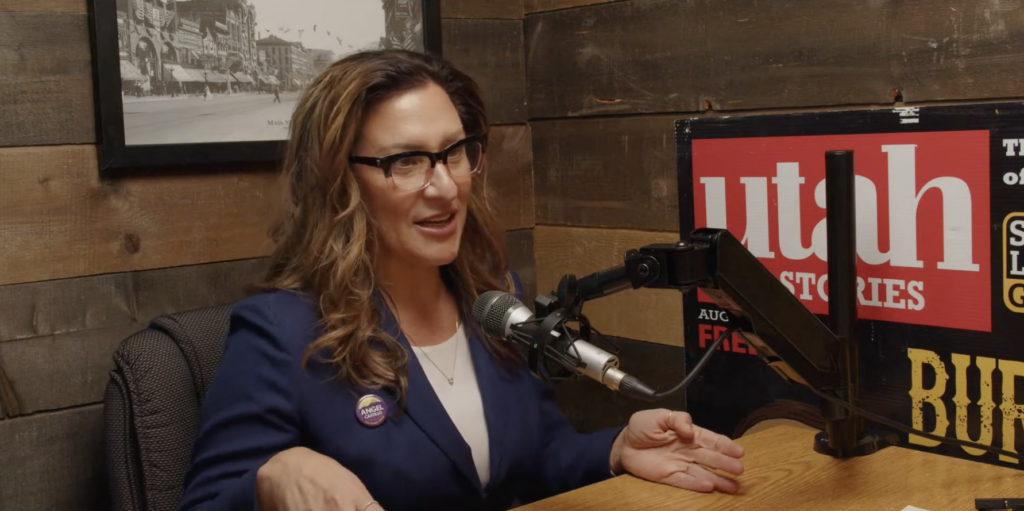
Candid Conversation with Mayoral Candidate, Angel Castillo

Angel Castillo, an Ogden mayoral candidate, is introduced as someone with a plan to address the lack of affordable housing for working-class residents.

|


In a recent episode of Utah Stories, host Richard Markosian engaged in a thought-provoking discussion with mayoral candidate Angel Castillo, shedding light on two critical issues plaguing Ogden and the state of Utah at large: the affordable housing crisis and flawed economic development practices that favor massive corporations over locally-owned businesses.

Castillo concedes that there is an alarming lack of affordable housing options for working-class residents in Ogden. She emphasized that this issue extends far beyond Ogden, as the entire state struggles with unaffordable housing. Castillo expressed deep concern for middle-class individuals who earn less than $60,000 annually and face challenges in purchasing homes, and even trailer parks are becoming out of reach for many.

Owning property, Castillo stated, is essential to breaking the cycle of generational poverty, fostering wealth independence, and securing a stable future for families. Moreover, she stressed that affordable housing is vital for attracting and retaining working-class professionals, ensuring the prosperity of the entire community.

The conversation shifted to discuss the state’s farming crisis, particularly in Summit County, where a farmer’s land is now worth much more than the income it generates. The increasing unaffordability of farmland has led many farmers to sell, raising concerns about food self-sufficiency in Utah. Angel Castillo proposed a solution by advocating for land banking, a system where non-profit entities preserve farmland with restrictive covenants to ensure its continued use for agriculture. This would provide young farmers with affordable leasing options and bolster Utah’s ability to produce its own food.

“I have nothing against big companies at all. However, the data shows that the investment in locals stays longer and upsets the ecosystem of how growth is happening in a less invasive way than bringing in big development and putting our infrastructure needs by giving tax increment financing (TIF) away that nobody’s paying into this infrastructure. So that is how a city goes bankrupt,” Castillo said. 

Delving further into economic development practices, the interview highlighted the dangers of relying on tax increment financing (TIF) to attract big-box retailers to the area. Castillo emphasized that TIFs can lead to a dependence on corporations for tax revenue, potentially harming local businesses and creating a vulnerable financial structure for the city. She stressed the importance of investing locally and fostering a vibrant community, as local businesses contribute significantly more tax revenue per acre than large corporations.

Discussing her candidacy for mayor, Angel Castillo shared her previous campaign experience in 2019 and her determination to tackle these challenges head-on. She expressed a passion for incremental development, bottom-up initiatives, and investing in the people and businesses within the community. Castillo also praised Governor Cox’s focus on rural areas and self-sufficiency.

The interview concluded with the promise of breaking a significant story concerning homelessness and drug-related issues in Salt Lake City on Monday. It highlighted the need for a comprehensive approach to governance, addressing both housing and social challenges for a brighter future for Utah.

“It takes some real investment to dig deep and understand what those unintended consequences and underlying costs are. Because you may look at what’s on the top of, oh look, new building, big box store. That’s exciting. But then you look underneath and that’s the iceberg part of what that costs you and who’s paying for that,” Castillo said. 

Angel Castillo’s platform for affordable housing and balanced economic development has garnered attention and support from various communities in Ogden. As the mayoral race unfolds, her innovative ideas continue to resonate with residents, and her commitment to transforming the city’s future could shape Ogden for years to come.

, , , , , ,

Join our newsletter.
Stay informed.


  • Highway 6 and the Midland Trail: Utah’s Transcontinental Highway History

    From Price Canyon to Delta’s desert stretch, Utah played a central role in building the Midland Trail, one of America’s earliest transcontinental highways and the foundation of today’s Highway 6.


  • Whiskey, Bullets & a Buried Town: Archaeologists Reveal Alta’s Wild Past

    Before Alta was known for powder days and lift lines, it was a silver mining town clinging to the side of a narrow canyon. In the late 1800s, men lived at 8,000 feet, went underground each day, and endured winters that regularly buried buildings in snow. This past summer, that mining town resurfaced — literally — during construction at the Alta Ski Area.

    To understand what Alta really looked like, you don’t begin with legend. You begin with its trash — and this time, that happened almost by accident.

    Alta Ski Area was installing underground water reservoirs to support snowmaking. Because the project sits on Uinta-Wasatch-Cache National Forest land, an archaeologist was required to monitor the excavation. No one expected the trench to produce much.

    But, It did.

    Artifacts began surfacing almost immediately. Enough that the Forest Service contacted the Utah State Historic Preservation Office for help. Lexi Little, who coordinates the Utah Cultural Site Stewardship Program, helped mobilize nearly 30 volunteers to assist with what quickly became a focused two-week excavation.

    Winter deadlines were approaching. The pipes for the reservoirs had to go in the ground. There wasn’t time for a slow, extended dig.

    “It was two weeks of digging in the dirt and helping figure out exactly what we were looking at,” Little said.

    Most of the people screening soil weren’t professional archaeologists. They were trained stewards from around Utah — part of a statewide volunteer network that now approaches 500 people. They poured dirt through shaker screens, scanning for fragments that could piece together a town long buried.

    “Archaeology is human trash,” Little explained. “Archaeologists are very into trash.”

    Alta had left plenty behind.

    https://youtu.be/hzIHzx3OGoo?si=dKcl2CEz-t6FZzYw

    Victorian-style ceramics appeared first — the kind typically used in hotels. Medicine bottles followed. Ink bottles. Hand-blown glass. A porcelain doll’s foot surfaced from the soil, a small detail that shifted the mental image of the town. Families were here. Children were here. This wasn’t only a camp of miners.

    The bottles helped establish time. Manufacturing details — whether glass was hand-blown or mold-made, whether a maker’s mark appeared on the base — allowed archaeologists to date many of the artifacts to the 1870s through the 1890s, when Alta was booming as a silver mining town.

    “That gives you that range of dates for when Alta was really booming,” Little said.

    One reusable soda bottle clearly stamped “Salt Lake City” connected the canyon to the valley economy below.

    Then something unusual rolled out of a dirt pile.

    A corked bottle. Intact. Liquid still inside.

    Continue reading and support independent Utah journalism with a purchase of Utah Stories (Digital + Print) or 3 month free trial (Digital).


  • The Only Full Bottle of Alcohol Ever Found in Utah Was Unearthed in Alta

    When a backhoe rolled a corked bottle out of the dirt at Alta this summer, no one immediately grasped what they were holding. It wasn’t empty. It wasn’t shattered. It was full. “The bottle that was discovered up at Alta is the only bottle of alcohol ever discovered in an archaeological excavation in the state…


  • How Horses Help Kids Heal: Inside Utah’s Equine Therapy World

    Kelty Johnson trains horses for a living, but her deeper work happens in the quiet space between animal and human. On the Utah Stories podcast, she explains how equine therapy helps children regulate emotions, build confidence, and reconnect through presence rather than pressure.