Hidden Utah

Helping Ghosts Move On in Moab, Utah

Fiona Raison in Moab, Utah helps ghosts that don’t know they’re dead and can’t move on to the next phase of existence.

|


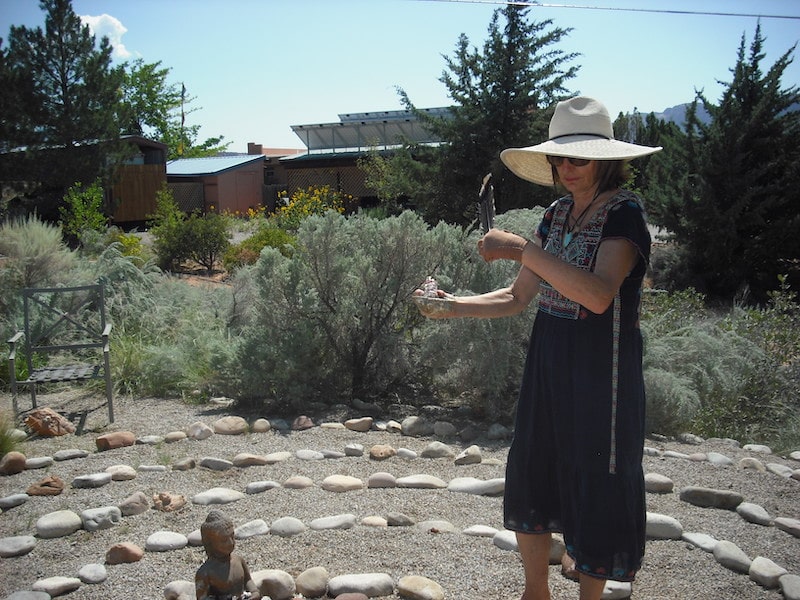
Fiona Raison burning sage in the labyrinth outside her home. She uses the labyrinth to help people work through dilemmas. Photo by Rachel Fixsen.

Moab-Based Fiona Raison Helps Ghosts to Move On.

Fiona Raison has been a healer for 30 years, helping both the living and the dead. She can help living people find the roots of physical and emotional pain, resolve internal dilemmas or get in touch with lost loved ones. She can help ghosts — “trapped souls” — get unstuck from the “in-between.”

Raison explained that ghosts don’t know they’re dead, and can’t move on to the next phase of existence. They’re invisible to those living in the third dimension. Ghosts can see and hear living people, but they can’t communicate, leaving them lonely, frustrated and confused. If this sounds like the plot of the movie The Sixth Sense, Raison said it is very much like that. 

Souls can get stuck, she said, when a person dies quickly and unexpectedly. 

“Murders, car crashes, accidents — that’s when souls just get trapped,” she said. “They don’t have time to transition gently.”

Raison, who is from England, began her service to the spiritual world decades ago when she was approached by a ghost in London. 

“Ghosts come to people who can help them,” she explained. 

She wasn’t sure what to do at the time, and sought advice from her masseuse, who she knew was a healer. Together they helped the ghost move on. 

Since then, she’s helped many ghosts. She remembered one instance when she was part of an event-planning team organizing a gathering in a 15th Century castle outside London. As she lit candles on a long, formal dining table, preparing for a party of 50 guests, the flames suddenly all went horizontal. She felt a heaviness — “a sense of wading through treacle,” she said — and realized there was a crowd of ghosts in the room. 

She told the event host that she needed some time to clear the building before the guests could enter. She had a “group conversation” with the spirits, asking if they knew they were dead. 

“None of them did,” she said. She gently helped them accept their state and connect to the divine energies that facilitate moving on. An army of angels, Raison said, was ready to receive them. 
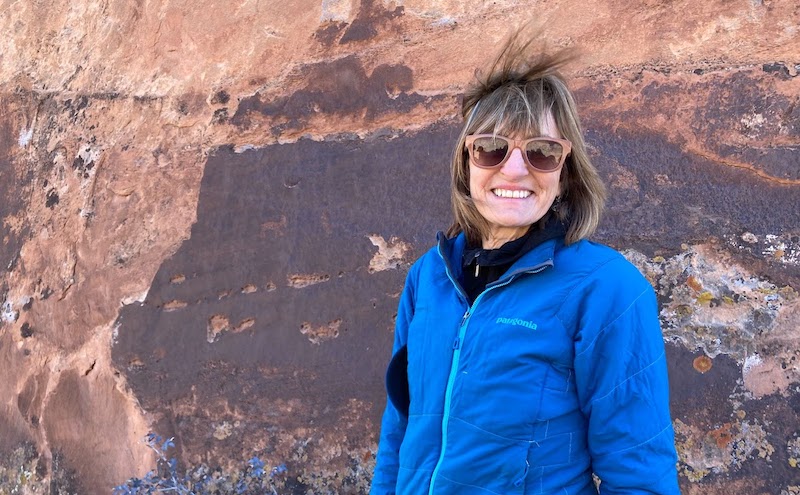
Photo courtesy of Fiona Raison.

Once she discovered that could hone her intuition to perceive ghosts and that she had the ability and willingness to help them, she felt a sense of duty to keep doing it. There’s a creative side to it, she said, like an artist who feels a painting come through them from a higher place. 

Raison has also been a tour guide for many years, and it was that profession that first brought her to Moab 17 years ago. Early on, she said it felt like the whole town of ghosts approached her, with many souls having been stuck since the years when Euro-Americans first arrived in Moab — a time when the town was “pretty rough around the edges,” she said. 

She recalled various buildings she’s cleared in the Moab Valley, including a vacant funeral home that was being converted into a thrift store, and the new owner asked Raison to cleanse the building first, a job she said was “really mucky.” A now-vacant lot used to have the old elementary school where a teacher asked her to clear a classroom before opening for the school year. 

Recently, new owners of the historic Apache Motel asked her to clear the old building. One of the ghosts trapped there, she said, was a dog that guests could hear lapping water throughout the night, until she helped it to transition.  

Raison said that once people understand what ghosts are and what they’re going through, their fear of them subsides. 

“People are in fear of the unknown,” she explained. Ghosts aren’t trying to hurt anyone. “They just need to go. They don’t have the capacity to hurt you.” 

For both living clients and trapped souls, Raison said she can only facilitate the healing process. The person has to do the work — self-reflection, acceptance — on their own. 

“We have to go through that individual process of making a connection with the divine,” she said.

Raison can be reached at Fionaraison77@gmail.com or 435-260-0263.

RELATED CONTENT

TOP FIVE HAUNTED PLACES IN UTAH

Pete Marshall Has No Issues with the 24 Ghosts Who Inhabit His Shop

Get Up Close with the Ghosts of Ogden

A Ghost Plays Piano in the Old Mormon Church in the Middle of Night

Haunted Museum in Fairview, Utah: Utah Ghost Hunter Registers Voices From the Other Side

SUPPORT LOCAL JOURNALISM AND SUBSCRIBE TO PRINT MAGAZINE


Subscribe to Utah Stories weekly newsletter and get our stories directly to your inbox

* indicates required


, ,


Join our newsletter.
Stay informed.


  • Inside Moab’s Political Divide: Land, Tourism, and the Future of Grand County, Utah

    In the late 1950s, Edward Abbey took a job as a park ranger at Arches National Monument, just outside Moab. What he found there, and what he watched happen to it, would shape the rest of his life. Roads were being cut into the canyon country. Cars were replacing foot traffic. The National Park Service, in the name of accessibility, was engineering a kind of industrialization of the wilderness he’d come to love. Abbey wrote about it in Desert Solitaire, published in 1968, and the anger in that book wasn’t abstract. It came from watching something specific be changed by people who either didn’t understand what they had or didn’t care.

    Grand County has long been the most reliably left-leaning county in the state, a fact that puts it in sharp contrast to nearly everything around it. To understand how that happened, and where things stand now, I spoke with longtime residents and politicians who’ve watched it from the inside, people who’ve served in local government and lived through the shifts firsthand.

    Robert Greenberg.

    Bob Greenberg came from New York in 1976, took a job at the community mental health center, and never left. He went on to chair the Grand County Democratic Party and serve on the county council. When he arrived, he said, “the Democratic Party was said to be able to meet in a phone booth” — and even then, its members were a contradictory bunch. Yellow Dog Democrats from the oil patch were fiscally conservative but surprisingly open socially, allowing different demographics to feel safe moving to the county. 

    “The town fathers were desperate to have new people come to town,” Greenberg recalls. “They just didn’t want the people who actually showed up. They wanted some other people.”

    What followed was a demographic shift nobody planned. The people who filled the gap left by the bust were river guides, federal agency workers, artists, and eventually waves of outdoor recreationists discovering that southeastern Utah was among the most spectacular landscapes on earth. Tourism ended up being the only economic development avenue that actually worked. Manufacturing never had the labor force or market access, sewing factories came and went. The people the tourist economy attracted tended to be younger, more outdoor-oriented, and more liberal.

    Kevin Walker.

    Kevin Walker, a former Grand County commissioner who moved here in 1990 for the landscape, puts the county’s diversity in context. “Moab [is] a pretty diverse place since, I think, at least the 1950s with the uranium mining boom,” he says. “So it’s not a typical Southern Utah town.” 

    Part of what makes Grand County distinct is self-reinforcing. Federal agencies like the Park Service, the Forest Service, the BLM, have large presences here and pull in a different demographic than surrounding counties. People looking to live in Southern Utah with certain values gravitate toward the place where those values already have a foothold. Over time, that critical mass has made Grand County what it is politically, while neighboring counties went in very different directions.

    The defining conflict in Grand County has always been over land.

    In the 1970s and 80s, it was extraction versus preservation in the starkest terms. County commissioners floated toxic waste incinerators. A plan emerged to site a high-level nuclear waste repository at the entrance to Canyonlands National Park. 

    “It really, really galvanized environmentalists everywhere, but particularly in Grand County,” Greenberg says. Activists put up signs at the park entrance, watched them get chainsawed down, and came back with steel reinforcement. That stubborn, physical, unglamorous persistence became part of the local political character.

    Continue reading and support independent Utah journalism with a purchase of Utah Stories (Digital + Print) or 3 month free trial (Digital).


  • Utah Archaeology Month 2026: Events, Sites, and 13,000 Years of History

    “Utah is filled with 13,000 years of human history,” explains archaeologist and State Historic Preservation Officer, Chris Merritt. “Every single artifact tells us something about the people that came before us, from the first Native Americans entering what we now call Utah to the remains of the uranium mining industry. Each layer of the past tells more of the story of who we are as Utahns.”


  • Moab Trail Closures: The Fight Over Public Land Access and Off-Roading

    Trail closures threaten livelihoods and slowly limit access to ordinary families, says Dave Hellman, owner of Xtreme 4×4 Tours in Moab. Wilderness advocates argue that stronger protections are necessary to preserve fragile landscapes. As lawsuits reshape trail access across southern Utah, Moab increasingly sits at the center of a growing conflict over who public lands are really for.