
Podcast

Why is the media not reporting on who is really at risk from COVID-19?

I’ve been following the local news on Coronavirus. A few stories in our local Salt Lake Tribune clearly demonstrate what is lacking in COVID-19 coverage.

|


I’ve been following the local news on Coronavirus and I just want to point out a couple of stories in our local Salt Lake Tribune, which demonstrate what is clearly lacking in the coverage.

LISTEN TO THE PODCAST:

WATCH THE VIDEO:

We have a story about how nationwide many of Latin Americans are getting the Wuhan Virus. And we also know that 100,000 people have now died. 

And no disrespect to those who have died, but I want to know who are these people who are dying? I am more interested in the following two things completely ignored by the media, than in the ethnicity of the victims:

  1. Their age
  2. Their weight and preexisting conditions

I’m bothered that there hasn’t been a single story in my local media providing these key statistics. Why should age and pre-existing conditions matter so much? 

Because if we had clear access to these two statistics then we could determine the risk factor for ourselves. Understanding the risk is what allows us to make good decisions.

So let’s say the newspaper was proving to me what I actually want to know. Then I would be able to put in my preexisting conditions, my weight and my age and then I could get a risk factor for COVID-19. Instead what I’m getting is that a lot of Latinos are contracting coronavirus and a lot of people who were in long-term care facilities are dying, primarily because these people aren’t being properly protected. For example, out of the 100,000 that have died from Coronavirus, over 30,000 have died from New York City alone. And 42% of all the Coronavirus victims have been from long-term care facilities. We are failing to protect our most vulnerable because, in places like New York, those who had contracted COVID were sent back to their facilities rather than being quarantined.

Our news media is not giving us rational logical facts. Instead, they are comparing this death toll to that of two of our most recent bloody wars. This is not equivalent. Americans have always been able to make rational risk assessments on their own. America transforming into a totalitarian state, removing our Civil Liberties, and locking down our economy and population is a huge mistake.
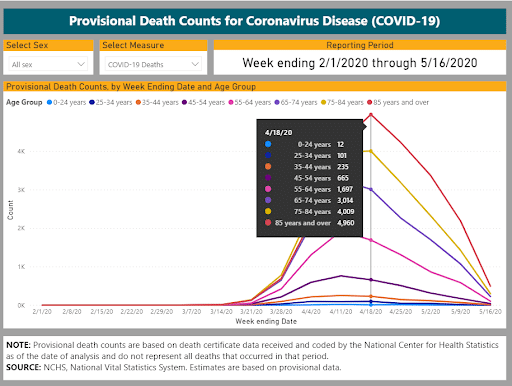
Who is dying from COVID-19

So what this chart shows from the Center for Disease control is that a huge number of the victims that died, passed away a couple of weeks ago and the spike that you see here happened right around April 23rd. We had a spike in deaths of people over the age of 85. I believe this mostly represents what happened in New York. As of May 8th, nearly 30,000 Americans died of Coronavirus who were in long-term care facilities. This is because Andrew Como was telling people in these facilities to go back to their facilities if they had the virus. Can you believe how ignorant this was?

Rather than protect our most vulnerable, we put them into harm’s way.

But let’s go back to this graph. Let’s examine how many people have died who are within ten years of my own age. How is my age bracket looking?

And is it the virus so deadly as most of the media wants to make you believe?

Take a few minutes to watch the video where Professor Hendrick Streeck, University of Bonn director of the Institute of Virology and Institute for HIV Research discusses the university’s antibody study and what it means for the coronavirus pandemic.

——

This is a paragraph from Stat’s news:

The death toll skews old even more strongly. Overall, China CDC found, 2.3% of confirmed cases died. But the fatality rate was 14.8% in people 80 or older, likely reflecting the presence of other diseases, a weaker immune system, or simply worse overall health. By contrast, the fatality rate was 1.3% in 50-somethings, 0.4% in 40-somethings, and 0.2% in people 10 to 39.

The age-related death risk probably reflects the strength, or weakness, of the respiratory system. About half of the 109 Covid-19 patients (ages 22 to 94) treated at Central Hospital of Wuhan, researchers there reported, developed acute respiratory distress syndrome (ARDS), in which fluid builds up in the small air sacs of the lungs. That restricts how much air the lungs can take in, reducing the oxygen supply to vital organs, sometimes fatally; half of the ARDS patients died, compared to 9% of patients who did not develop the syndrome.

This from ABC news 4:

https://www.abc4.com/news/top-stories/19-cases-of-coronavirus-confirmed-in-utah-some-of-them-young-students/

FOR MORE UTAH STORIES PODCASTS GO HERE.



Join our newsletter.
Stay informed.


  • When Main Street Burned: The Aftermath of the Salt Lake City Fire That Hit Downtown Bars

    Fire doesn’t respect zoning, property lines, or even the most popular block on Main Street. On the evening of Monday, August 11, 2025, a blaze that began around 8:40 p.m. on Main Street. It moved quickly through a row of aging, interconnected buildings that had become the heart and soul of Salt Lake City’s fledgling bar district. By the time firefighters brought it under control, multiple businesses were damaged, dozens of workers were displaced, and one of the city’s most active stretches went dark.

    The fire started at London Bell and spread into neighboring structures, severely damaging Whiskey Street. White Horse never caught fire, but smoke, water, and a partial roof collapse caused extensive interior damage, forcing a full rebuild. Other nearby businesses were affected as well, including some that had helped turn this part of Main Street into one of its most active and economically stable stretches.


  • Whiskey, Bullets & a Buried Town: Archaeologists Reveal Alta’s Wild Past

    Before Alta was known for powder days and lift lines, it was a silver mining town clinging to the side of a narrow canyon. In the late 1800s, men lived at 8,000 feet, went underground each day, and endured winters that regularly buried buildings in snow. This past summer, that mining town resurfaced — literally — during construction at the Alta Ski Area.

    To understand what Alta really looked like, you don’t begin with legend. You begin with its trash — and this time, that happened almost by accident.

    Alta Ski Area was installing underground water reservoirs to support snowmaking. Because the project sits on Uinta-Wasatch-Cache National Forest land, an archaeologist was required to monitor the excavation. No one expected the trench to produce much.

    But, It did.

    Artifacts began surfacing almost immediately. Enough that the Forest Service contacted the Utah State Historic Preservation Office for help. Lexi Little, who coordinates the Utah Cultural Site Stewardship Program, helped mobilize nearly 30 volunteers to assist with what quickly became a focused two-week excavation.

    Winter deadlines were approaching. The pipes for the reservoirs had to go in the ground. There wasn’t time for a slow, extended dig.

    “It was two weeks of digging in the dirt and helping figure out exactly what we were looking at,” Little said.

    Most of the people screening soil weren’t professional archaeologists. They were trained stewards from around Utah — part of a statewide volunteer network that now approaches 500 people. They poured dirt through shaker screens, scanning for fragments that could piece together a town long buried.

    “Archaeology is human trash,” Little explained. “Archaeologists are very into trash.”

    Alta had left plenty behind.

    https://youtu.be/hzIHzx3OGoo?si=dKcl2CEz-t6FZzYw

    Victorian-style ceramics appeared first — the kind typically used in hotels. Medicine bottles followed. Ink bottles. Hand-blown glass. A porcelain doll’s foot surfaced from the soil, a small detail that shifted the mental image of the town. Families were here. Children were here. This wasn’t only a camp of miners.

    The bottles helped establish time. Manufacturing details — whether glass was hand-blown or mold-made, whether a maker’s mark appeared on the base — allowed archaeologists to date many of the artifacts to the 1870s through the 1890s, when Alta was booming as a silver mining town.

    “That gives you that range of dates for when Alta was really booming,” Little said.

    One reusable soda bottle clearly stamped “Salt Lake City” connected the canyon to the valley economy below.

    Then something unusual rolled out of a dirt pile.

    A corked bottle. Intact. Liquid still inside.

    To access this post, you must purchase Utah Stories (Digital + Print) or 3 month free trial (Digital).


  • The Only Full Bottle of Alcohol Ever Found in Utah Was Unearthed in Alta

    When a backhoe rolled a corked bottle out of the dirt at Alta this summer, no one immediately grasped what they were holding. It wasn’t empty. It wasn’t shattered. It was full. “The bottle that was discovered up at Alta is the only bottle of alcohol ever discovered in an archaeological excavation in the state…


  • How Horses Help Kids Heal: Inside Utah’s Equine Therapy World

    Kelty Johnson trains horses for a living, but her deeper work happens in the quiet space between animal and human. On the Utah Stories podcast, she explains how equine therapy helps children regulate emotions, build confidence, and reconnect through presence rather than pressure.