Utah Stories

Murray’s Cameo College Celebrates 50 Years in Biz, with High-Glamour Show

Almost nothing spells glamour more than enchanted characters wearing beautiful clothing and adorned with inspired make-up, hair and nail stylings.

|


There are two definitions of the word “cameo.”

A cameo is a piece of jewelry, typically oval in shape, consisting of a portrait in profile carved in relief on a background of a different color
or
A short descriptive literary sketch which neatly encapsulates someone or something.

While the Murray-based Cameo College of Essential Beauty includes a cameo pendant as part of its logo, the organization imbued much more the spirit of the second definition in celebrating its 50th anniversary with its 14th-annual student hair, makeup, nails and fashion show.

The Colorful Background

Cameo is celebrating its 50th year in operation.

The beauty school, offering cosmetology (think hair, barbering, nails, and makeup) and esthetics (think skincare, eyelash extensions, and waxing/hair removal) is now a third-generation family business.

The company was started by Bud Reddick, who is now 80 years old and resides in Taylorsville. The original shop was in Sugar House at 2100 South and 1019 East—the current Home Again antique shop.

Jerome, Idaho-raised Reddick, while on home from service in the Navy in the 1960s, observed how successful one of his male friends, a hairdresser, had become. His friend had a nice car, looked like he made good money, and—like Warren Beatty’s character in the 1975 comedy “Shampoo”—was a hit with the ladies.

That sealed the deal.

Once Reddick got out of the Navy, he signed up for beauty school, and then opened his own beauty school. Cameo was born.

His daughter, Brenda Scharman, 58, who grew up in Rose Park and West Valley, and now—a credited horsewoman—resides in Oakley. “The Sandwich” in three generations of Cameo family leadership, Brenda upped the glamour game of the business, commissioning the build of the school’s location in Murray and serving on state and national boards for the cosmetology and esthetics education industry.

Reddick’s granddaughter, Rickie Mehl, 35, is the current Director of Cameo. Mehl laughingly pokes fun at her finally having been “reigned in” to the family business after pursuing some wild times. (Her mother deems it “many” wild times.) A “settled” Mehl has now assumed the mantle of leadership for the family business, but always, with her personal sense of style.

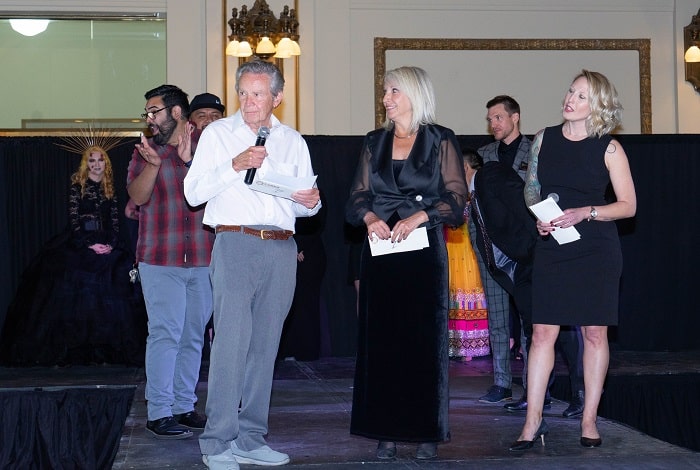
Mehl’s wild side showed in a good way with this year’s student show, held Wednesday, Oct. 16—with local drag queen Molly Mormon hosting the gig–and a much more glamorous, upgraded venue for the event: This year, the college graduated from its usual hang for the show—the Murray High School auditorium—to downtown’s swanky Grand Hall at the Gateway Mall.

The change in venue made the catwalk experience all the more glamorous—for the models themselves and for the estimated 450-plus guests in attendance at the evening show. Proceeds for the event went to the Salt Lake City YWCA.

Glamour and More, More, More

Almost nothing spells glamour more than enchanted characters wearing beautiful clothing and adorned with inspired make-up, hair and nail stylings.

A Xena-like warrior princess, Greek and Roman mythological gods and goddesses, 1940s ballgown-wearing divas and victory-rolled housewives alike, and even Buddhism’s founder Buddha himself graced the Grand Hall stage for the Cameo show, showcasing each student’s vision for a glamour story they wanted to share—through the application of fashion, hair, makeup, and nail design.

One model who didn’t grace the stage—a seeming diva who walked out on the student designer who had been counting on her to demonstrate her skills to the judges and the audience—ended up, unwittingly, being memorialized: the student she walked out on won an honorable mention shout outs by multiple judges, praising her grace under pressure and her not becoming discouraged.

It seemed to be a night of serendipity falling on those influenced by folks walking out: The college offered a full-ride scholarship, won by a random drawing. The first name drawn had exited the show, so the inherited win fell to Luis De Dios of West Jordan.

Interestingly, DeDios, who has long aspired to become a barber or cosmetologist, is the uncle of a current Cameo student and attended the show to support her. He now plans to attend Cameo this January on a full-ride, $18,000-value scholarship.

Cameo awarded a $1,000 prizes for first-place in the Cosmetology and Hair Design Division. Second- and third-place winners won $500 and $250, respectively.

Cameo also awarded a $600 product prize to the first-place winner in the Nails Competition. Second- and third-place winners won $200 and $100 in product gifts, respectively.

Cameo family sandwiched-between-two generations-entrepreneur Scharman says the night “brought tears” to her eyes.

“When I started the business, there were just four students.”

, ,

Join our newsletter.
Stay informed.


  • The $7 Million Recruit: How NIL Changed College Athletics Forever

    In 2012, Jabari Parker, a top high school prospect and member of the Church of Jesus Christ of Latter-day Saints, was facing his biggest decision to that point in his life: where to play college basketball. 

    Fans of BYU athletics hoped and perhaps prayed that Parker would pick the school owned by the church he was raised in. BYU was listed as one of his final choices. But he ultimately chose to spend his college years at Duke before attempting a career in the NBA. BYU fans were disappointed, but no one was truly surprised. Duke over BYU was the best choice for a young prospect in 2012. 

    A.J. Dybantsa.

    What changed between 2012 and 2024 when A.J. Dybantsa, the number one high school prospect, chose BYU over every other school? The answer is roughly $7 million dollars. That is what Dybantsa is reportedly making to play basketball at BYU. 

    The deal was supported by Utah Jazz owner Ryan Smith, who met multiple times with the Dybantsa family in multiple attempts to bring the young player to Provo. 

    According to Smith, he had no financial role in bringing Dybantsa to BYU, but the influence of Utah’s most famous billionaire acting as a “booster” or unofficial recruiter certainly swayed the decision.

    Prior to 2021, boosters acting as recruiters was taboo to the NCAA governing body. It was called improper recruiting. But in 2021, California began the modern era of NIL, or the ability of a college athlete to benefit from their name, image, or likeness, when they passed the “Fair Pay to Play Act.” 

    This new law gave college athletes in California the ability to benefit from their NIL, something that was banned in the rest of the country to that point. The NCAA saw that this law would create an unfair advantage for California schools that could now give young athletes the chance to make money off their talent and image while still in college. 

    The NCAA knew they needed to do something quickly, so they rushed through a policy that opened up NIL to all college athletes in the country, and it has been expanding and evolving over the last four years. 

    Grant Duff, who has coached at the University of Utah, Weber State University, and is now the defensive coordinator for Idaho State University, says, “The best part of NIL is that athletes have an opportunity to make good money. The downside comes with the free-for-all that money causes.”

    Dybantsa confers with BYU Head coach, Kevin Young.

    One of the biggest current examples of what a school can do when the boosters are willing to pay for success is Texas Tech University. From 2020-2024, Texas Tech had 34 wins, which works out to 6.8 wins per year with a low of 4 wins and high of 8. Then Texas Tech’s boosters got involved, led by Cody Campbell, an oil industry businessman and Chairman of the Texas Tech board. The football program was given 28 million dollars for NIL with a simple message attached to the large pile of money: Win. And win now. And win they did. 

    By signing NIL deals with athletes in the transfer portal, Texas Tech went from a middle-of-the-pack school in their conference to one of the top 12 teams in the country. They didn’t just win games in 2025, they made many of their opponents look like they didn’t belong on the same field, including the University of Utah and BYU twice. That is what money can buy.

    Continue reading and support independent Utah journalism with a purchase of Utah Stories (Digital + Print) or 3 month free trial (Digital).


  • Priced Out of Summer Fun? These Activities Cost Almost Nothing

    As summer approaches, many of us start looking for new ways to be active. Whether you’re emerging from a cozy winter of hibernation, or searching for a replacement for skiing and snowboarding, there are inexpensive and accessible ways to get outside, get active, and make the most of summer. 


  • The Reality of Meth Psychosis on Utah’s Streets

    On the streets of downtown Salt Lake City, psychosis has become part of the landscape.

    People scream at invisible enemies. Some believe they are prophets. Others wander through traffic carrying conversations with voices nobody else can hear. To passersby, it can look theatrical, bizarre, and absurd. But behind many of those episodes is a darker reality few people want to confront directly: methamphetamine-induced psychosis, prolonged sleep deprivation, trauma, addiction, and the slow destruction of a person’s ability to distinguish reality from delusion.


  • Did Utah Leaders Already Sell Out Tremonton to Big Tech?

    When Kevin O’Leary appeared on Fox Business and casually announced that Utah would soon become home to what could be the largest AI data center project in the world, many Utahns had the same reaction:

    Wait… this was already approved?