Moab

Rafting the Yampa: A Libertarian Publisher is Exposed to the Beliefs, History and Ideology of Environmental Protectionists

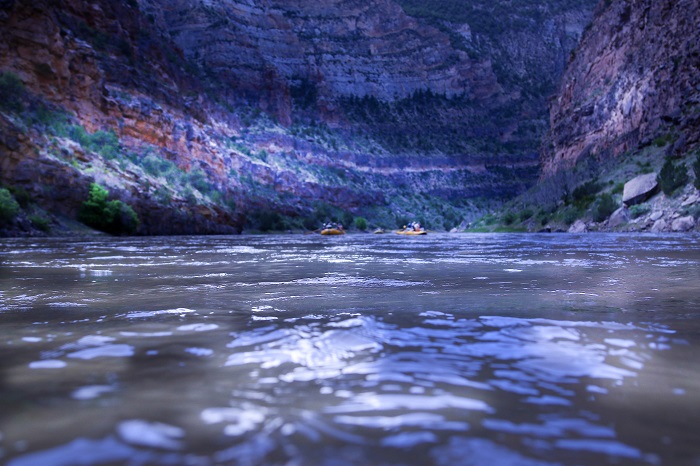
“Okay,” I thought, “I’m going to be going down a river with people whose primary ideology I disagree with.” But then I reasoned, “maybe my point of view could provide an interesting story.

|


“Okay,” I thought, “I’m going to be going down a river with people whose primary ideology I disagree with.” But then I reasoned, “maybe my point of view could provide an interesting story.

Why should every story be about everyone being agreeable? I’ll go, I decided, be nice yet disagreeable, and completely honest.”

So I went on a trip down the Yampa River with a group of people who I knew would very likely espouse many things with which I would disagree since they were hard-core environmentalist liberals. As for me, I’m a small-government libertarian.

Read the rest of the story on MoabStories.

 

, ,


Join our newsletter.
Stay informed.


  • Inside Moab’s Political Divide: Land, Tourism, and the Future of Grand County, Utah

    In the late 1950s, Edward Abbey took a job as a park ranger at Arches National Monument, just outside Moab. What he found there, and what he watched happen to it, would shape the rest of his life. Roads were being cut into the canyon country. Cars were replacing foot traffic. The National Park Service, in the name of accessibility, was engineering a kind of industrialization of the wilderness he’d come to love. Abbey wrote about it in Desert Solitaire, published in 1968, and the anger in that book wasn’t abstract. It came from watching something specific be changed by people who either didn’t understand what they had or didn’t care.

    Grand County has long been the most reliably left-leaning county in the state, a fact that puts it in sharp contrast to nearly everything around it. To understand how that happened, and where things stand now, I spoke with longtime residents and politicians who’ve watched it from the inside, people who’ve served in local government and lived through the shifts firsthand.

    Robert Greenberg.

    Bob Greenberg came from New York in 1976, took a job at the community mental health center, and never left. He went on to chair the Grand County Democratic Party and serve on the county council. When he arrived, he said, “the Democratic Party was said to be able to meet in a phone booth” — and even then, its members were a contradictory bunch. Yellow Dog Democrats from the oil patch were fiscally conservative but surprisingly open socially, allowing different demographics to feel safe moving to the county. 

    “The town fathers were desperate to have new people come to town,” Greenberg recalls. “They just didn’t want the people who actually showed up. They wanted some other people.”

    What followed was a demographic shift nobody planned. The people who filled the gap left by the bust were river guides, federal agency workers, artists, and eventually waves of outdoor recreationists discovering that southeastern Utah was among the most spectacular landscapes on earth. Tourism ended up being the only economic development avenue that actually worked. Manufacturing never had the labor force or market access, sewing factories came and went. The people the tourist economy attracted tended to be younger, more outdoor-oriented, and more liberal.

    Kevin Walker.

    Kevin Walker, a former Grand County commissioner who moved here in 1990 for the landscape, puts the county’s diversity in context. “Moab [is] a pretty diverse place since, I think, at least the 1950s with the uranium mining boom,” he says. “So it’s not a typical Southern Utah town.” 

    Part of what makes Grand County distinct is self-reinforcing. Federal agencies like the Park Service, the Forest Service, the BLM, have large presences here and pull in a different demographic than surrounding counties. People looking to live in Southern Utah with certain values gravitate toward the place where those values already have a foothold. Over time, that critical mass has made Grand County what it is politically, while neighboring counties went in very different directions.

    The defining conflict in Grand County has always been over land.

    In the 1970s and 80s, it was extraction versus preservation in the starkest terms. County commissioners floated toxic waste incinerators. A plan emerged to site a high-level nuclear waste repository at the entrance to Canyonlands National Park. 

    “It really, really galvanized environmentalists everywhere, but particularly in Grand County,” Greenberg says. Activists put up signs at the park entrance, watched them get chainsawed down, and came back with steel reinforcement. That stubborn, physical, unglamorous persistence became part of the local political character.

    Continue reading and support independent Utah journalism with a purchase of Utah Stories (Digital + Print) or 3 month free trial (Digital).


  • Utah Archaeology Month 2026: Events, Sites, and 13,000 Years of History

    “Utah is filled with 13,000 years of human history,” explains archaeologist and State Historic Preservation Officer, Chris Merritt. “Every single artifact tells us something about the people that came before us, from the first Native Americans entering what we now call Utah to the remains of the uranium mining industry. Each layer of the past tells more of the story of who we are as Utahns.”


  • The Utah Bombings That Exposed One of America’s Greatest Forgers

    On an ordinary October morning in 1985, downtown Salt Lake City was shattered by a blast that killed businessman and document collector Steve Christensen. Hours later, a second bomb tore through a quiet Holladay neighborhood, killing Kathy Sheets, the wife of Christensen’s former business partner. The next day saw a third explosion. This one was in a car near Temple Square that nearly killed rare-documents dealer Mark Hofmann. 

    Rumors swirled instantly, tying the attacks to money, religion, and shadowy early-Mormon documents Christensen had recently acquired. For days, Utah held its breath. What unfolded was stranger and darker than fiction. The bombs weren’t the work of religious extremists or enemies of the Church of Jesus Christ of Latter-day Saints, but instead, the doings of Mark Hofmann himself. Hofmann was a nerdy, soft-spoken dealer who had secretly become one of the most skilled document forgers in American history. 

    His creations were so convincing that they reshaped historical narratives, fooling scholars, collectors, and church leaders. When the lies began to close in, the bombs became his final, desperate attempt to keep his world from collapsing.

    Hofmann had been fabricating Mormon and American historical documents for years. He was a prodigy of deception, sourcing period paper, mixing inks that cracked just right, and mimicking handwriting with obsessive precision. Most of all, he knew how to read people. Utah in the 1970s and ’80s was a collector’s paradise. As bookseller Ken Sanders told Salt Lake Magazine, it was “a consciousness shift,” a recognition that rare Utah history was a treasure worth pursuing. It was also, he notes, fertile ground for affinity fraud.

    Nothing captured that vulnerability more than the Salamander Letter, a supposed 1830s correspondence which claimed Joseph Smith encountered a magical white salamander rather than an angel. The document shook Latter-day Saint circles. Church leaders, worried about its implications, quietly purchased it along with other materials Hofmann dangled before them. Many reasoned that if the church was willing to buy it, then it must be authentic and true, and Hofmann understood that psychology perfectly.

    Continue reading and support independent Utah journalism with a purchase of Utah Stories (Digital + Print) or 3 month free trial (Digital).


  • Moab Trail Closures: The Fight Over Public Land Access and Off-Roading

    Trail closures threaten livelihoods and slowly limit access to ordinary families, says Dave Hellman, owner of Xtreme 4×4 Tours in Moab. Wilderness advocates argue that stronger protections are necessary to preserve fragile landscapes. As lawsuits reshape trail access across southern Utah, Moab increasingly sits at the center of a growing conflict over who public lands are really for.