Utah Farmers

Bill White Farms: Products for People, not Corporate Profit

If a man is lucky, there comes a point when his life’s work and his legacy combine to benefit others. Bill White is a lucky fellow in this respect. His name has been synonymous with delicious food in Utah for the past 25 years. He’s best known for his eight Park City restaurants—Grappa, Chimayo, Wahso,…

|


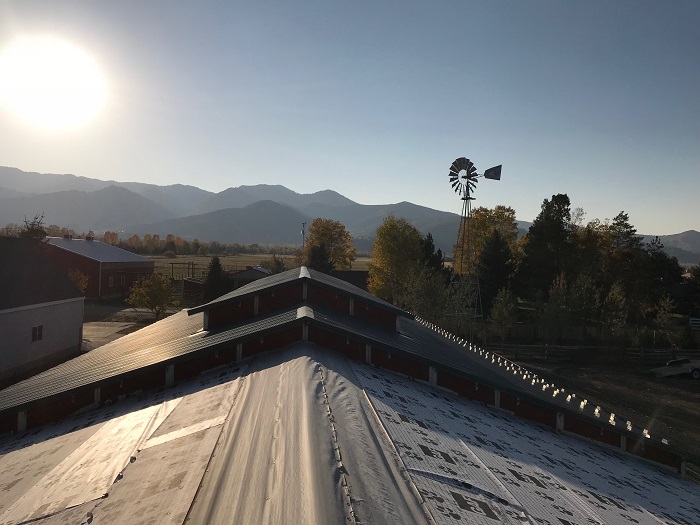
View from the top of Bill White Ranch. Photo by Bill White.

If a man is lucky, there comes a point when his life’s work and his legacy combine to benefit others. Bill White is a lucky fellow in this respect.

His name has been synonymous with delicious food in Utah for the past 25 years. He’s best known for his eight Park City restaurants—Grappa, Chimayo, Wahso, Windy Ridge Café and Bakery, Ghidotti’s, Sushi Blue, and Billy Blanco’s. His latest endeavor, Bill White Farms, is a return to his northern Michigan farming roots with an eye on making the Park City community a better, healthier place for all.

Bill White Farms is primarily funded with profits from White’s restaurants, and encompasses two properties—the farm on Highway 224, and a 5-acre ranch on Old Ranch Road—each operating under the Earthganic standards White developed and trademarked to describe his holistic approach to agricultural and ranching practices.

Harvesting Earthganic tomatoes. Photo here and below by Beth Rossi.

From soil restoration and cover cropping to rotational grazing and a focus on producing protein sources that improve human nutrition, White’s current efforts far surpass organic farming practices and USDA animal health standards.

The Highway 224 farm has become a model of clean farming principles and produces four dozen varieties of fruits and vegetables. The produce is served in the restored buildings on the property for charitable dinners benefiting other non-profit organizations and donated to the Christian Center of Park City to feed 4,000 Park City residents each month. “There is so much need that we’ve had to limit client visits to the pantry to twice a month,” White explains, of the dire situation many locals face.

Not surprisingly then, very little product from the farms is leftover for use at White’s restaurants. “The chefs can come by and use the herbs and produce for seasonal nightly specials, but we aren’t trying to be the main supplier for any of our properties.” Instead, the restaurants actually give back to the farms. All of the compost materials are used to feed the animals being raised.
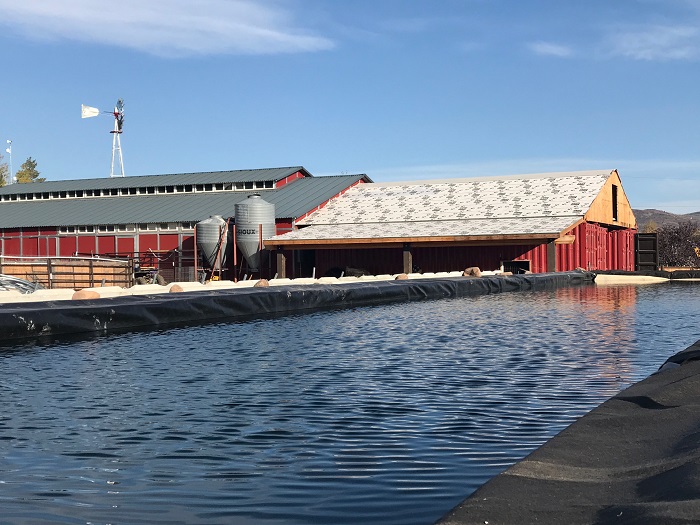
Test version of the trout farm.

Restaurant scraps are put into compost trays where worms turn it into fresh, nutrient-rich soil that is then used as fertilizer for future crops. Those worms will also eventually feed the 50,000 rainbow trout thriving in a new, 100,000 gallon trout farm, which will finally fill the bellies of Park City residents.
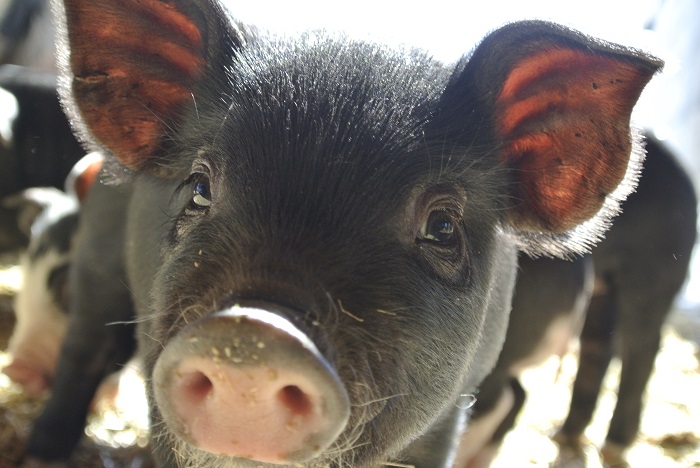
In addition to the trout, the Old Ranch Road property is home to humanely raised pigs, chickens, turkeys, cows, and lambs that forage in open pastures and enjoy fresh air in addition to those kitchen scraps, alongside fruits, nuts, and vegetables for supplemental feed and finishing.

White also has 100 head of cattle that he will use as seed-stock for genetically superior meat—eventually bred to yield premium quality and flavor in the finished beef when raised with Earthganic practices. White sees this as an important long-term project not only for his
own restaurants, which purchase approximately $1 million in beef each year, but also as a way to educate ranchers about the viability of raising healthy herds in humane and chemical-free ways.

As White continues to build this lasting legacy for the Park City community and beyond, his eventual goal is to funnel more of the food grown on the farm and ranch into his restaurants. It is a goal worth waiting for topbankinfo.

Bill White Farms
5373 UT-224, Park City



Join our newsletter.
Stay informed.


  • Riverbed Ranch Utah: Cult, Commune, or Utah’s First Modern Homesteading Town?

    Driving out past the town of Delta on a gravel road for a couple of hours, we almost turned around. Following a rain storm, the road is wet and muddy but still decent. Jesse Fisher is worried we’ll get stuck, but we plow through giant puddles of water, and as the clouds lift, we reach the homestead community of Riverbed Ranch, consisting of 1250 acres of reclaimed desert.

    Almost like an oasis, Riverbed Ranch is home to 40 families who decided to depart city life, municipal taxes, congestion, air, light and sound pollution, and live in a place among chickens, goats and cows on self-reliant homesteads. 

    Describing Riverbed Ranch as “bucolic” would be inaccurate at this point. Sometimes there are purple flowers in the valley, but currently it is a desert — still beautiful, but most of the properties in the sprawling valley are still works-in-progress. But the scale of the valley and witnessing in person the first brand new town to break ground in Utah in 75 years is quite remarkable. 

    A few of the 2.5 acre plots consist of a trailer and a fence. Some plots have nice little homes that appear very homemade; others have more complete homes with nice fencing, with nicely organized pens for different animals, orchards and organization. 

    Some homes under construction even appear upscale and modern, where the inhabitants are indeed living as modern homesteaders, not seeking “luxury retreats” like so many other empty homes in Utah being built in hot tourist destinations such as Moab and Park City.

    We start by speaking with Tom and Kathy Barnes, whose homestead is a model for order and function. Turkeys walk around in their pen, excited for feeding time. Beside the turkey pen is another pen for chickens; one for goats, and another for pigs. All of the pens are connected to a large barn. By the look of their operation, the Barnes appear to be seasoned professionals.

    Indeed they are. Tom and Kathy raised their eight children “on a teacher’s salary,” homesteading in Payson, Utah on ten acres, reaching the point where the only store-bought items were toilet paper, shampoo, toothpaste and cashews. Most everything else, including fresh fruits, vegetables, milk and meat were raised themselves.

    Tom had just finished feeding his three hungry pigs when he took a moment to talk to me.

    “What are the advantages to living on a homestead?” I ask. 

    “Listen,” he says. “You can hear a pig eating … Once in a while we will hear a fighter jet pass over but that’s it.” 

    The Barnes are calm and content in their semi-retirement. They set up their homestead at Riverbed Ranch five years ago. They already knew homesteading and they realized even in retirement they could help the other inhabitants here, those with less experience, learn how to take on the demanding but satisfying lifestyle.

    “It’s basically like an extended family,” says Tom. “We are all like-minded out here. We are all going to help one another when our neighbors need help.”

    Tom says he and most of his neighbors are members of the LDS Church, and that most of the city’s LDS members are a part of a ward which makes up their “ward family.” “Out here,” he says, “everybody is our extended family. So we all know we are going to help one another and learn to get along … Like early pioneers in a small town. It’s very much the same thing.

    A wild goose chase?

    “We could live out here like it was 1849, but we have all of the conveniences of modern society, so why not take advantage of the best of both worlds?”

    I wonder how adaptable these modern pioneers are. Raised on a homestead, would these folks ever want to join the modern world again? The Barnes kids are mostly choosing city life, but their kids and grandkids love visiting them, running around free-range. Tom adds, “One of our sons is starting his own homestead in Piute County.”

    We drive around on the hard gravel roads and get a sense of how all of the residents here justify the hard-scrabble, off-grid life, which requires living off pumped well water, solar power for electricity, and propane for heat. 

    We are aiming to get a sense of the  bigger reason why all of these people are out here, far away from freeways and Walmarts. Are they all latter-day preppers?

    Continue reading and support independent Utah journalism with a purchase of Utah Stories (Digital + Print) or 3 month free trial (Digital).