

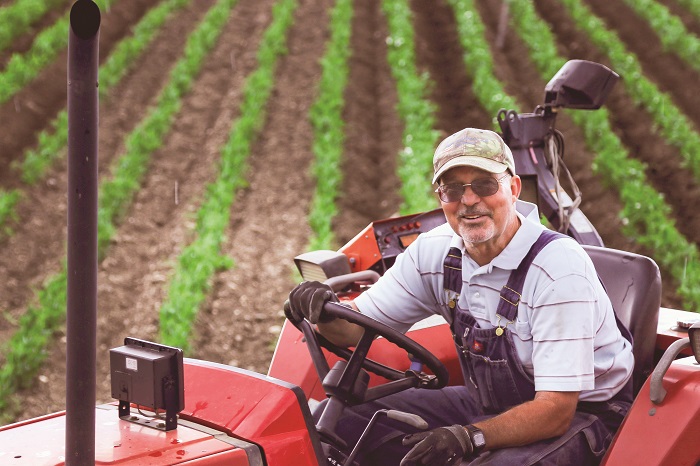
Alan Bangerter is no stranger to moving his farming operations in the name of “progress,” which usually comes in the form of freeways built on top of and replacing fertile farm ground.
The Legacy of Legacy
In 1999 UDOT moved the main Bangerter family farm (30 acres that they bought in the 1970s). The farm was located in the intended path of the Legacy Parkway , so the Bangerters had to find another property near their home and their other farm properties located in Bountiful and Farmington. Bangerter bought 23 acres located at 500 South and 600 West in late 2001, with the money that he received from UDOT from the Legacy Parkway arrangement. It’s taken him years to get the property so that it produces consistently good crops annually . Then the City attempted to move them again.
Some might question: Why put up with encroaching suburban development? Why not just move far away from the city? Bangerter says this is impossible because their Bountiful center of operations is home to over 100 years worth of farm infrastructure in the form of equipment (tractors, tillers, trucks, frigotrucks) and a warehouse with cold storage. Their farm properties need to be close to their storage and processing facilities. The Bangerters’ 20 acre “main base” was purchased in 1902, and the Bangerters (Alan and his three sons who work alongside him) have four homes adjacent to and around this property. Bangerter adds, “Encroachment is also happening in Layton, Syracuse and Clinton. Many farmers have been moving out for years, but it’s moving to less desirable soil further away from population centers.” These factors all make the business of farming much more difficult.
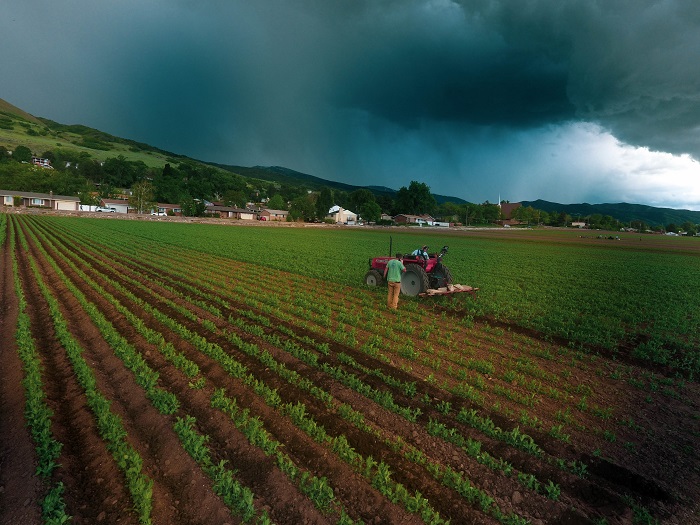
According to the State Commissioner of Agriculture, today only 2% of Utah’s fruits and vegetables are produced in-state. Considering Utahns penchant for self-reliance, even stocking away months and even years supplies of food for a disaster, there is some irony that on a city and state level Utah’s political leaders place so little value on family farms and community-level self-reliance.
Farm Family Values
The lack of value that cities place on farms — even one of Utah’s oldest family farms — was demonstrated when Bangerter’s property garnered media attention when the City of Bountiful attempted to take Bangerters’ property through eminent domain. They wanted to put a park and soccer fields where one of Bangerter’s farm properties was located. But thankfully, due to media scrutiny and a viral Facebook campaign, The city’s actions were thwarted.
“There was only room for 100 but 300 showed up,” said Bangerter, adding, “City Council got a good tongue lashing … The only thing that missing was pitchforks and torches.Doctor Chapel talked about the value of local produce and nutrition. The commissioner of agriculture talked about the value of family farms; people who had worked for us over the years got up and talked about learning the value of hard work …The food bank talked about how we donated 45,000 pounds of food last year.That’s common practice: where we used to dump it, now they come and pick it.” So why don’t city and state leaders understand the intrinsic value of farms?
“When politicians and developers evaluate a property they always examine it in its, ‘highest and best use,’” says Bangerter. “ In the past if you put a subdivision there, they will consider that the highest and best use. I believe we will see the day that farmland is the ‘highest and best use.’ “We have taken our vegetable production for granted that we will always have fresh food, because it comes from California, Florida and Texas. But that production is shifting now to Mexico.”
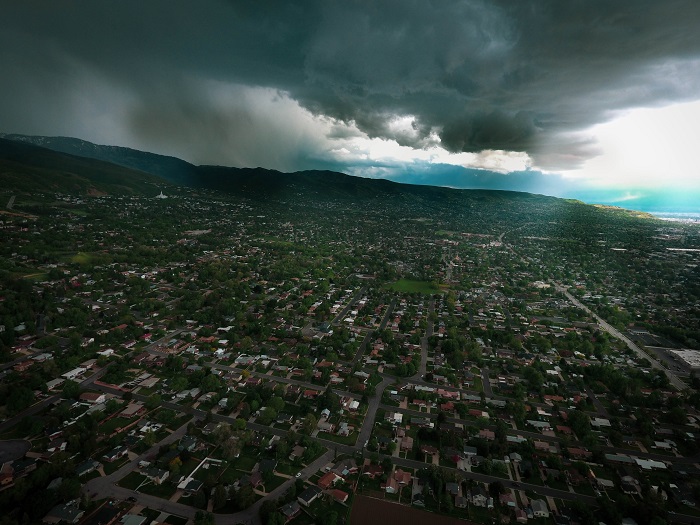
“You can build homes just about anywhere, you can build roads just about anywhere, but as you probably know you can’t grow vegetables everywhere. The soil and the conditions need to be just right or it just won’t work. If they just start seeing that the farms that are left are using the land in the best possible way.”
It’s predicted that for every dollar increase in gas prices, household grocery bills will increase by $50 per week for a family of four. But this problem can be solved with an increase in locally-produced food. And at a time when the nutritional value of food is so low, and as a result so many people suffer from malnutrition and obesity, shouldn’t our political leaders place a value on land that produces highly nutritional food? Alan Bangerter certainly sees things this way.
A Sixth Generation Family Farm
While most family farms need to be broken up and subdivided, and sold after two generations, the Bangerter farm is indeed rare. His farm is now into its sixth generation, with his grandchildren now participating in harvesting and weeding.
Bangerter was able to buy out his siblings in the seventies. The Bangerter farm employs dozens of area teenagers during the summer and generations of teens have grown up considering their experience on the Bangerter farm to be one of the best work-ethic learning experiences of their childhood. “Most of our help till recently has been teenager help,” says Bangerter. “It’s not for every kid. The first year they pay piece rate, once they catch on they can do well. They have to learn the faster they work, the more they earn. Then school starts and they all stop.”
There aren’t a lot of great opportunities for teens to learn how to work hard using motor skills; as well as gaining a greater appreciation for how food is produced while also learning the value of hard work and our shared cultural heritage. If the Bangerter farms were replaced with homes or strip malls, the options available to the teens would be to work at fast food chain restaurants where the value of working using motor skills to harvest, wash, then is replaced by learning how to operate cash registers and pack fries into containers.
According to Bangerter, “This year, due to the media coverage we had over 100 kids wanting to work on the farm …We need to participate in the H2A Visa program, from mid-July on because once school starts we are unable to get enough workforce to harvest all the vegetables. We try to get kids to help us pick pumpkins. It’s the worst thing in the world to have produce rotting on the vine because you don’t have enough help to harvest.”
The Bangerters can now rest easy because their farm will not likely disappear anytime soon. At the beginning of May things were a lot less certain. Bangerter explained that UDOT had drawn up a new highway plan that would end up requiring another eight acres of his property. “When the Federal Government comes in and says they are going to build a road, there isn’t much you can do about it.” Bangerter was prepared to comply . But then Farmington City needed to relocate a park that would have to move due to the highway construction. They chose to locate the new park on Bangerter’s new property.
Bangerter didn’t want to lose his farm that he had put so much effort into preparing so he hired attorney Randall Edwards to help him with the fight.Edwards informed Bangerter that the City of Bountiful was attempting to get Bangerter to sign a document which would have put his farm into a preservation conservation easement. “They did it as a ploy to try and get our ground,” said Bangerter. It would have essentially relinquished control of his farm over to the City, but the City didn’t put it this way. Using the guise of “protection” they were telling Bangerter this was his best possible option. His attorney informed Bangerter ofa much better option: the Agricultural Protection Area (APA) designation, which is far more advantageous for farmers, allowing farmers to sell their farm in the future and not be beholden to the city like a conservation easement would have done.
Bangerter is now an advocate for this protection, saying, “I think every farmer should have their farm protected who is in encroachment; it makes it very difficult for a farm to be declared a nuisance.” We learned that a far better designation for his ground was an Agricultural Protection area, which would protect his ground from developers, and basic complaints from neighbors.
Still Bangerter doesn’t hold any grudges or ill-will toward the City, “We are very grateful that Farmington City and UDOT are willing to try an alternative. We don’t have anything against these guys.”
FOR MORE STORIES ABOUT UTAH FARMERS GO HERE.
