Sugar House

Sego Lily Update in Sugar House

Construction of the Sego Lily will be finished in December, and the Draw will re-open at that time.

|


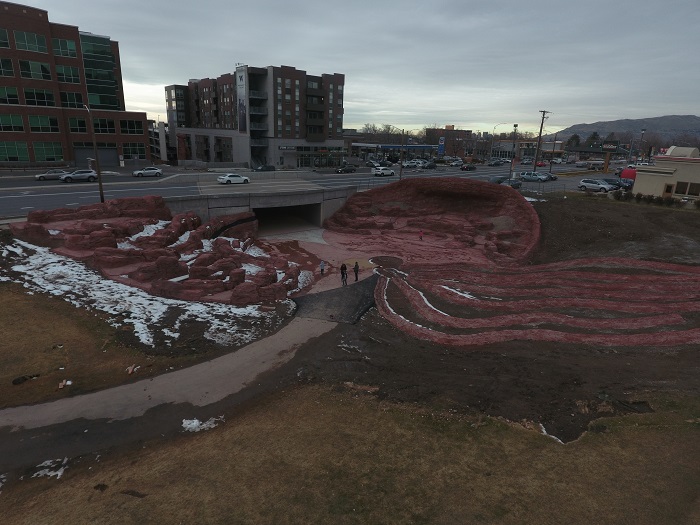
Drone Photo of Sego Lily Sculpture by Richard Markosian

Since early October, 2017, the Sego Lily has been growing and spreading across the western slope of Sugar House Park, with its petals rising slightly above the crest of 1300 E. The story of the Lily has many layers—functional, artistic, historical, and educational.

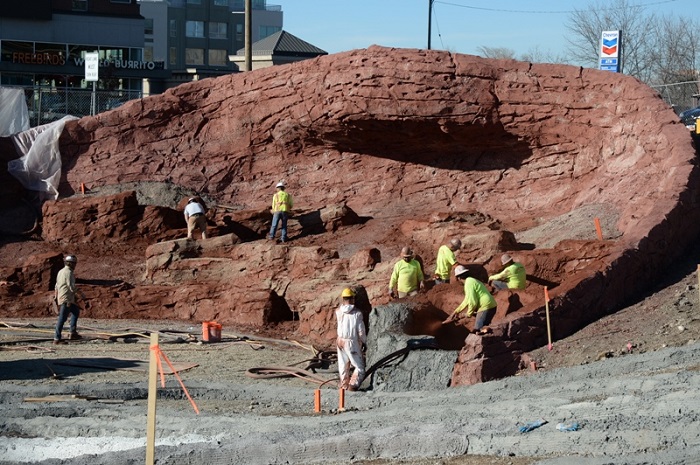
The first stages of construction clearly identified the Lily as a flood-control structure with a heavily-engineered concrete foundation and drainage features. But as weeks went by, the finish work on the spillway took on another aspect. The north wall, built to deflect flood water from the park’s Parley’s Creek detention pond, was transformed. It emerged as a curving flower petal, arching gracefully down to a plaza with rocky outcrops that formed benches and raised beds for shrubs and flowers.

The south wall became another petal of the Sego Lily, with sculptural seating and narrow interconnected paths that descended from the sidewalk on 1300 E. The rock mounds were made to look like the geological forms in Echo Canyon, artfully carved and finished with sand and pebbles. That conglomerate is similar to the puddingstone found in the canyon and other parts of the Wasatch Mountains.

The third petal of the Lily is distinctively different, formed from the reinforced grassy berm that rings Sugar House Park. Next spring, seven shotcrete “veins” will separate rows of vegetation, recalling food crops that were planted in the Salt Lake valley by 19th-century pioneers.

The tunnel under 1300 E. is a popular bicycle and pedestrian crossing along Parley’s Trail. The south wall of the tunnel has been textured to appear like a slip fault in an exposed coal seam, with the rock strata squeezed and distorted. The geological coal seam added another chapter to the pioneer narrative of the Draw at Sugar House.

Construction of the Sego Lily will be finished in December, and the Draw will re-open at that time. The Lily’s green stem and leaf (aka water conduit/ bike-ped trail to the tunnel) will be finished in the spring, when the native shrubs and trees are installed.
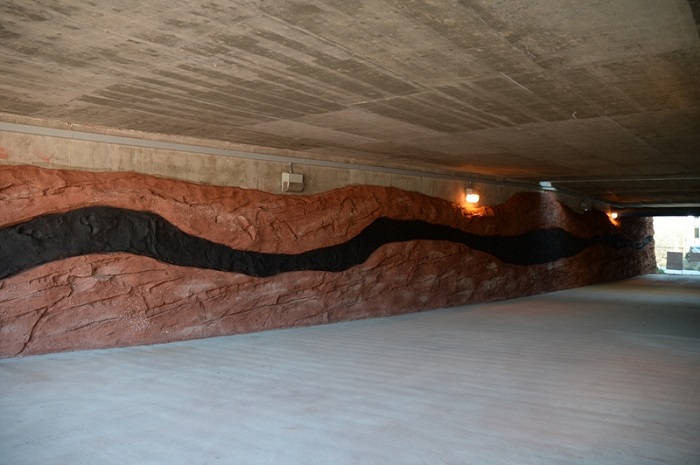
Sego Lily Construction Photos by Neal Olson.

Join our newsletter.
Stay informed.


  • Sugar House Restaurants on the Rise: New Spots Reshaping the Neighborhood

    Sugar House is in the middle of a full-scale dining shift. Over the past two years, new openings, relocations, and rebrands have reshaped the neighborhood, bringing everything from shabu-shabu and Thai curries to steakhouse cocktails, food-hall energy, and century-old LA flavors. These additions are changing how locals eat, gather, and think about Sugar House as a dining destination.

    To access this post, you must purchase Utah Stories (Digital + Print) or 3 month free trial (Digital).


  • Eight-Story Hotel at Sugar House’s Former Sizzler Site

    The long-vacant Sizzler lot in Sugar House is now at the center of a debate over an eight-story hotel proposal. After receiving a recommendation for approval from the Planning Commission, the project now heads to the Salt Lake City Council for a final decision.


  • Sugar House Businesses Recover After Prolonged Road Construction

    For nearly two years, construction along 2100 South reshaped daily life in Sugar House, testing the patience and resilience of local businesses. With roads and sidewalks finally reopened, owners are beginning to take stock of what was lost, what changed, and what recovery might actually look like.


  • An Argentine Food Tradition Finds a Home in Sugar House

    In Sugar House, Maria Florencia Farr makes empanadas that carry more than filling. They carry memory. Each one recalls suburban Buenos Aires, where families gathered late at night and meals were unhurried, familiar, and shared.

    “In Argentina, dinner doesn’t happen at five,” she says. Empanadas were a constant in her childhood, as ordinary and dependable as cookies in an American home. Learning to seal them, shaping the distinctive repulgue by hand, marked a small but meaningful rite of passage.

    When Florencia moved to the United States 18 years ago, food became one of the clearest reminders of what she had left behind. She missed the everyday tastes of home and kept searching for them. Over time, that longing evolved into something larger, shaping the decision to build a place rooted in tradition, meant to be shared.

    The remainder of this story is available to subscribers.

    To access this post, you must purchase Utah Stories (Digital + Print) or 3 month free trial (Digital).