Faster and more abruptly than anyone expected, the familiar old buildings and businesses of downtown Sugar House have disappeared. Ten years ago, city planners commissioned a survey of buildings in the area to determine whether it could be designated as a historic district. But within months, the buildings south and west of the main intersection were gone, along with any chance for preservation efforts in the surveyed area.
Now we must rely on public art to recall the history of Sugar House. The giant sugar beets at Sprague Library and Hidden Hollow recall the town’s namesake sugar mill. The Sego Lily dam rising at the west-side end of Sugar House Park is a monument to Utah’s state flower. Concrete benches that look like couches remind us of the days when Sugar House was the “Furniture Capital of the West.” And the schools of fish lined up on 2100 South are a nod to Parley’s Creek and the Jordan & Salt Lake Canal, still flowing under the street through the business district.
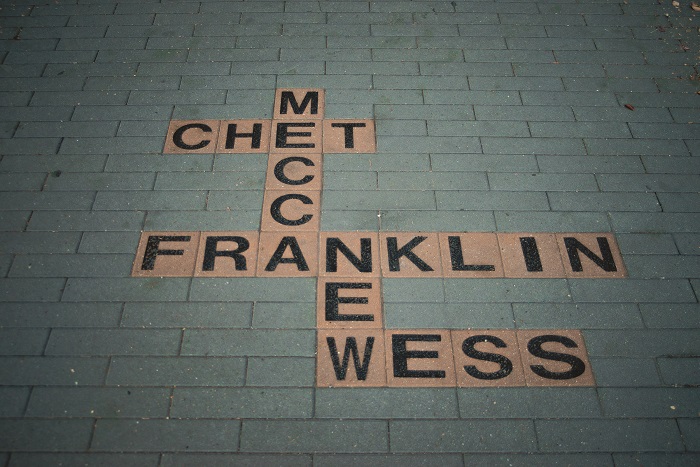
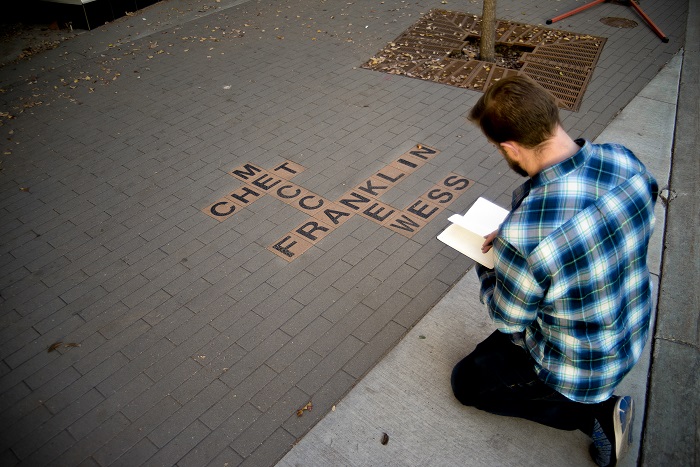
Also underfoot, and mostly unnoticed by passers-by, are more than a dozen mysterious etchings stamped into the concrete on the street corners. Laid out like crossword puzzles, the names of people and places provide clues about some of the businesses that once occupied the town center. The 2004 Sugar House Business District Paving Project is the work of artists Bernardo Flores-Sahagun and William Littig, a public art project for the Salt Lake City Arts Council and Redevelopment Agency of SLC.
As with the quiz show “Jeopardy,” the puzzles provide answers to questions that refer to the history of Sugar House. At 900 East and 2100 South, the puzzle reads “Petty Ford,” and the secret question is: What automobile dealership was located on this corner?” At 1000 East: “JC Penney’s” identifies what used to occupy the building that is now Natural Grocers. Along with others such as the Southeast Bowling Courts (#7 ACROSS at 1150 East 2100t South, now Mattress Firm,) these buildings are still standing.
Others are long gone. Hygeia “Iceland,” at 1208 East 2100 South was demolished for the Extended Stay America hotel. Southeast Theatre (#1 DOWN at 1100 E. Wilmington) is now The Men’s Wearhouse.
Other clues and questions refer to historic figures. Philo Farnsworth invented the television and worked for Nathaniel Baldwin at Utah Radio (#1 and 5 DOWN and 6 ACROSS at 2300 South Highland Drive.) Joe Hill and the Utah Penitentiary are answers to the puzzle at the southwest corner of 1300 East 2100 South.
Fortunately, the clues to each of the artists’ puzzles were kept on the upstairs shelves of Sprague Branch Library and survived the summer flood that destroyed some of the library’s collection of nonfiction books. To find out what the word games mean and learn more about the complex history of Sugar House, ask at the main desk for the file to the “Sugar House Anagrams.”