In response to the protests on Saturday August 11 in Charlottesville, Virginia, the League of Native American Voters organized a rally against racism at the Salt Lake City and County Building. Around 2000 protesters attended. Whole many groups participated—such as Antifa, Black Lives Matter, Democratic Socialists, Indigenous resistance, Students for a Democratic Society, Pandos, Utah Against Police Brutality, and others. There were also many individuals who came to show solidarity, with some being armed. Observing the growing crowd of demonstrators, one protestor, Josh Straugther said, “Being here is amazing, because… this is not the most black city out here.”
The rally hosted different speakers from many different organizations. One speaker, Kaneischa Johnson, summed up the mood of the audience by stating, “I’ve got a lot to be mad about.” Other speakers called for the crowd to challenge what they see as a civic and political system entrenched in racism—a notion that was largely well received. When another speaker suggested that the United States foundation was built upon racism, some applauded in support of the declaration, but a majority of the audience remained silent, but interested.
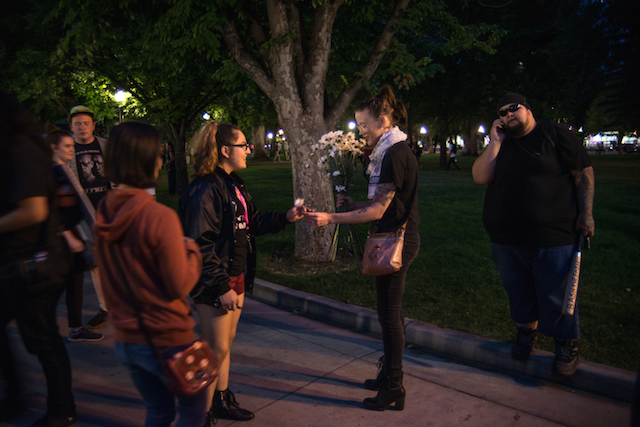 The rally largely remained peaceful, although passions ran high. At one point a motorcyclist revved his engine as if to silence the speakers. Almost immediately, contingents of several of the more militant groups in attendance rushed to assess whether the biker was a threat to their rally. Tempers briefly flared as the biker reacted defensively to protesters descending upon him. Apparently he was there in support, but the way he showed support sparked the tempers of some protesters. In the end, the protesters and the biker parted ways on seemingly friendly terms.
There didn’t seem to be many counter demonstrators. A group of five people standing on the edge of Library Square were met with suspicion. One who held an American flag became the focus as he found himself surrounded by masked protesters. While being confronted, the counter-demonstrators stood their ground, but came across as uncomfortable. According to a Facebook post made later on the groups’ behalf, this altercation was a misunderstanding.
The rally ended with a moment of silence for Heather Heyer—the victim of the hit and run attack by Neo-Nazis during the Charlottesville protests. The main emphasis throughout the rally was to take action against racism—with one way being the power of the vote.
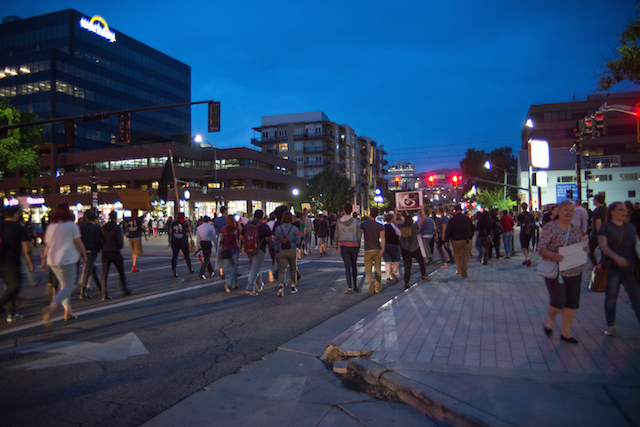
It did not seem like the march was officially planned by the organizers, but several members of the indigenous resistance took the street, inspiring 100 to 200 protesters to follow. The SLCPD mobilized several officers on motorcycles to shadow the marchers as they have done during other demonstrations. One officer said to a protester, “As long as you’re safe, do your thing.”
The protesters marched north on State Street and east on 100 S toward 400 E. During the march they chanted slogans such as “No Justice, No Peace” and “No Trump, No KKK, No Fascist USA!” Onlookers watched, with some showing support for the protesters. Most of the protesters remained passive, marching down the middle of the street. Some, however, sought to move garbage cans and road blocks into the streets, and others spray-painted graffiti on the sidewalks. These potential obstacles were put back in their respective places by other protesters. While this occurred, a couple of the offending protesters became aggressive while maintaining a sense of anonymity toward journalists and the police.
At the end of the protest, the indigenous resistance led the formation of a blockade of 400 S and State Street, where the protesters blocked the intersection. One of indigenous resistance members blasted the main rally for pandering to mainstream political beliefs. The blockade lasted a few minutes before dispersing. During this last aspect of the rally, a young man in a Nirvana t-shirt made some disrespectful remarks toward the protesters. Like others before him, he was quickly challenged and was forced to make a retreat from a flying water bottle aimed at his back. While the rally and protest were without serious incident, any perceived challenge to the protester’s safety was swiftly dealt with by an overwhelming reaction from the crowd and police.