
Utah Farmers

Water(melons): The Essence of Life

Green River, Utah is watermelon heaven and the reigning authority is Nancy Dunham.

|


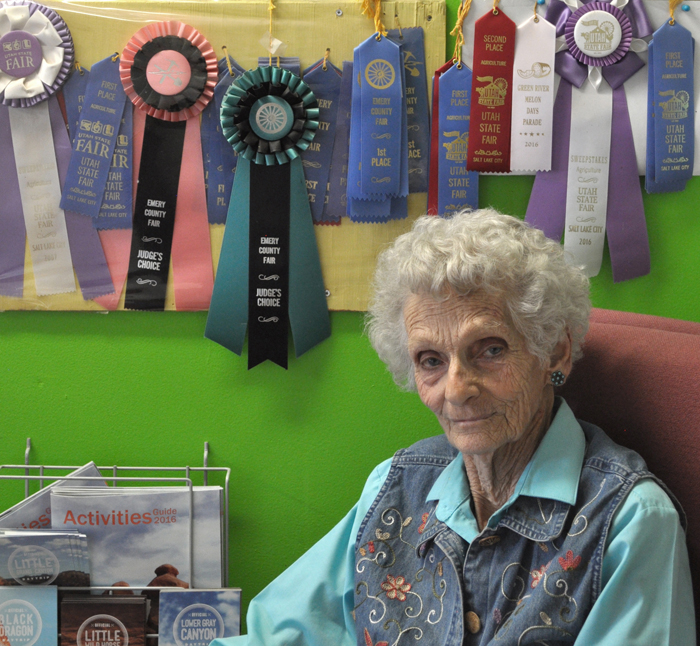
Nancy Dunham with some of the ribbons from her prize-winning watermelons. Photos by Paige Wiren.

Before Interstate 70 opened in 1970, Nancy Dunham’s children would haul their Red Flyer wagon filled with homegrown pumpkins to sell along the highway that ran through Green River. “That’s how it started,” the 86-year old Dunham Farms matriarch recalls. The kids soon started growing watermelons, and now Dunham Farms is one of three major melon farms in town, known for its award-winning fruit.

Nancy and her husband, Gene, moved to Green River during the uranium boom of the 1950s, and there, with their six children, the family started to put down roots in the community. Nancy’s son, Chris, now manages Dunham Farms’ 200-plus riverside acres, but Nancy’s decades of connection to the land and its seasonal cycles makes her not only a melon-growing authority, but also an intimate observer of the plant species and its relationship to the community.

Seated in her farmhouse decorated with a colorful mixture of multicultural and family keepsakes, Nancy’s turquoise shirt highlights her bright blue eyes. Kindness defines her appearance as she talks about life and melons.

“You can feel the soil and tell when it’s warm enough to plant,” says the slender storyteller, who also enjoys connecting to the earth by walking barefoot on the land. Nancy has a college degree in agriculture and talks just as comfortably about diploid seeds as well as the energetic frequency of melon plants.

Planting happens in May, and watermelon is the majority of seed sown. “The soil here is a remarkable blessing,” Nancy says of Green River’s favorable growing conditions. The Dunhams also grow other popular varieties including cantaloupe, Crenshaws, and others. “One day I counted 17 different kinds of melons being sold at our stand,” she recounts.

To stand in a field alive with flowering melon plants, Nancy shares, is a magical experience. The interval from flower to fruit is just six weeks, and then harvest begins. “That E flat thing about knowing when a melon is ripe? That’s just talk. You find the tendril and little leaf closest to the melon, and when that’s dry, it’s ripe,” she explains.
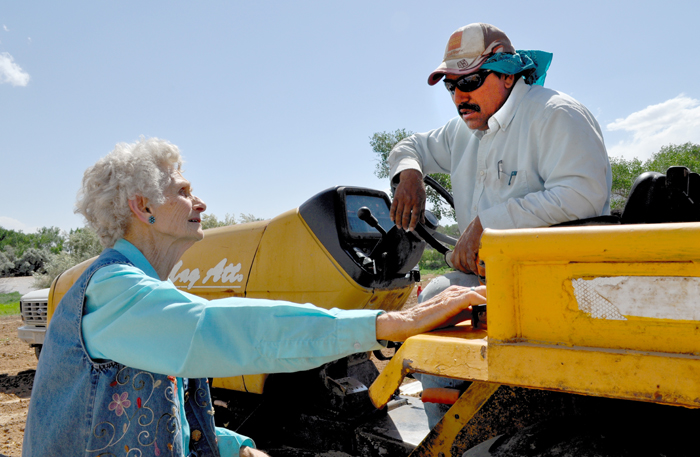
Nancy talking with field manager, Abel.

And Dunham melons are divine. “People from Grand Junction will drive here just to have melons for breakfast,” she mentions. In one of Nancy’s many scrapbooks brimming with newspaper clippings and photos is a letter in which the writer recounts the Dunham melon he’d eaten 63 years before, and then asks if it were possible to have some shipped to him in South Carolina.

Nancy also possesses a wealth of information about the plant’s other uses. Watermelons, she points out, are high in lycopene, a cancer preventative, and watermelon seed tea is purported to support kidney health. People carve the skin into fanciful artwork, make jellies and jams, “and with all that beautiful rind,” Nancy explains, “you can make salsas and relishes.” The seeds as well can be roasted and eaten. “We tried yellow watermelon wine once,” she remembers, “but the melons didn’t have a high enough sugar content.” In lieu of a birthday cake one year, Nancy presented a table of children with a watermelon ablaze with sparklers she’d poked into the rind. “I kind of ruined the tablecloth,” she laughs.

The annual September Melon Days mark the height of Green River’s harvest, and the town celebrates with a parade and festivities. In the Dunham’s melon stand building, there is a poster-sized frame filled with individual photos of worldwide customers posing in their Watermelon Days t-shirts at various locations around the globe. In fact, Nancy says the best part about growing and selling melons is the people. “Melons,” Nancy beams, “just make people happy.”



Join our newsletter.
Stay informed.


  • Riverbed Ranch Utah: Cult, Commune, or Utah’s First Modern Homesteading Town?

    Driving out past the town of Delta on a gravel road for a couple of hours, we almost turned around. Following a rain storm, the road is wet and muddy but still decent. Jesse Fisher is worried we’ll get stuck, but we plow through giant puddles of water, and as the clouds lift, we reach the homestead community of Riverbed Ranch, consisting of 1250 acres of reclaimed desert.

    Almost like an oasis, Riverbed Ranch is home to 40 families who decided to depart city life, municipal taxes, congestion, air, light and sound pollution, and live in a place among chickens, goats and cows on self-reliant homesteads. 

    Describing Riverbed Ranch as “bucolic” would be inaccurate at this point. Sometimes there are purple flowers in the valley, but currently it is a desert — still beautiful, but most of the properties in the sprawling valley are still works-in-progress. But the scale of the valley and witnessing in person the first brand new town to break ground in Utah in 75 years is quite remarkable. 

    A few of the 2.5 acre plots consist of a trailer and a fence. Some plots have nice little homes that appear very homemade; others have more complete homes with nice fencing, with nicely organized pens for different animals, orchards and organization. 

    Some homes under construction even appear upscale and modern, where the inhabitants are indeed living as modern homesteaders, not seeking “luxury retreats” like so many other empty homes in Utah being built in hot tourist destinations such as Moab and Park City.

    We start by speaking with Tom and Kathy Barnes, whose homestead is a model for order and function. Turkeys walk around in their pen, excited for feeding time. Beside the turkey pen is another pen for chickens; one for goats, and another for pigs. All of the pens are connected to a large barn. By the look of their operation, the Barnes appear to be seasoned professionals.

    Indeed they are. Tom and Kathy raised their eight children “on a teacher’s salary,” homesteading in Payson, Utah on ten acres, reaching the point where the only store-bought items were toilet paper, shampoo, toothpaste and cashews. Most everything else, including fresh fruits, vegetables, milk and meat were raised themselves.

    Tom had just finished feeding his three hungry pigs when he took a moment to talk to me.

    “What are the advantages to living on a homestead?” I ask. 

    “Listen,” he says. “You can hear a pig eating … Once in a while we will hear a fighter jet pass over but that’s it.” 

    The Barnes are calm and content in their semi-retirement. They set up their homestead at Riverbed Ranch five years ago. They already knew homesteading and they realized even in retirement they could help the other inhabitants here, those with less experience, learn how to take on the demanding but satisfying lifestyle.

    “It’s basically like an extended family,” says Tom. “We are all like-minded out here. We are all going to help one another when our neighbors need help.”

    Tom says he and most of his neighbors are members of the LDS Church, and that most of the city’s LDS members are a part of a ward which makes up their “ward family.” “Out here,” he says, “everybody is our extended family. So we all know we are going to help one another and learn to get along … Like early pioneers in a small town. It’s very much the same thing.

    A wild goose chase?

    “We could live out here like it was 1849, but we have all of the conveniences of modern society, so why not take advantage of the best of both worlds?”

    I wonder how adaptable these modern pioneers are. Raised on a homestead, would these folks ever want to join the modern world again? The Barnes kids are mostly choosing city life, but their kids and grandkids love visiting them, running around free-range. Tom adds, “One of our sons is starting his own homestead in Piute County.”

    We drive around on the hard gravel roads and get a sense of how all of the residents here justify the hard-scrabble, off-grid life, which requires living off pumped well water, solar power for electricity, and propane for heat. 

    We are aiming to get a sense of the  bigger reason why all of these people are out here, far away from freeways and Walmarts. Are they all latter-day preppers?

    To access this post, you must purchase Utah Stories (Digital + Print) or 3 month free trial (Digital).