Utah Stories

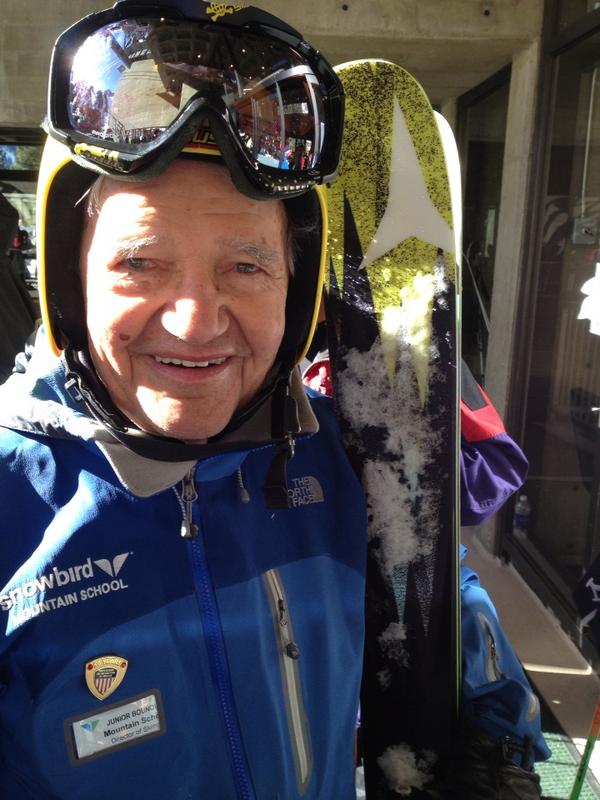
Junior Bounous – A Lifetime on the Slopes

Skiing with the Bounous family.

|


A8fTK-6CUAEQVAt
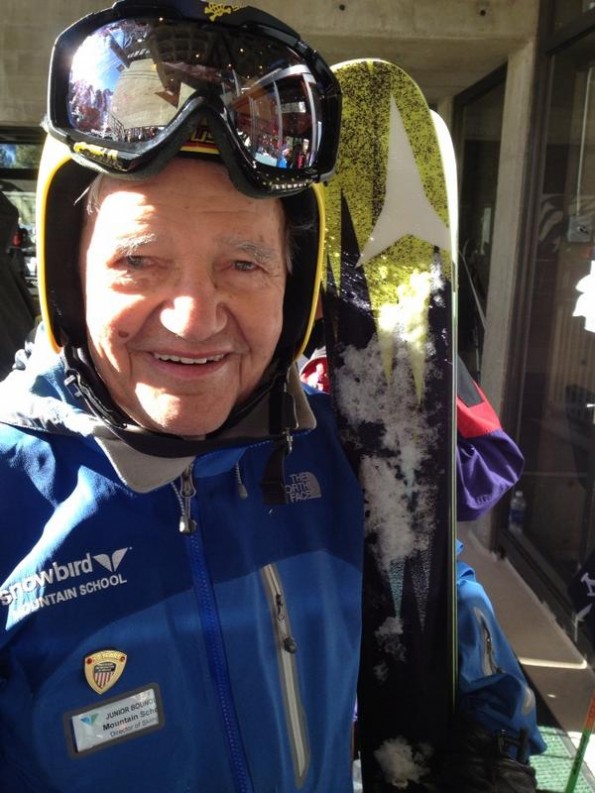
Junior Bounous

The Bounous family is a skiing legacy. Junior Bounous, now 90, started skiing with homemade skis made from barrel staves.  When he was around 8, his mother gave him his first pair of “real skis” which he used on the hills of Provo Canyon. There were no ski resorts at the time and so skiing involved a lot of hiking.

Junior competed for the first time in High School in cross country. At that time he and friends skied under the Timp Mountain Ski Club. He loved competing, but turned his attention to teaching, starting by giving classes through Provo Recreation and the Provo Herald Ski school.
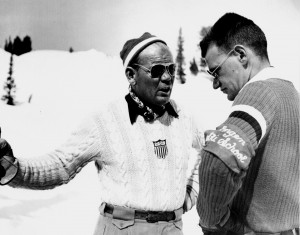
alf_engen_junior_bounous_at_alta_circa_1955
Al Engen and Junior Bounous at Alta circa 1955. Photo courtesy of the University of Utah J. Willard Marriott Library Special Collection

He became a certified instructor in 1948 and was hired by Alf Engen to teach full time at Alta. He helped set up a ski school at Sugar Bowl in California during the winter and spent summers in Provo working on the family’s fruit farm.

He was part owner of Timp Haven in Provo Canyon. It was later  sold to Robert Redford and renamed Sundance. In 1971 he was hired by Ted Johnson at Snowbird to help develop the new ski resort  and then became ski school director there. He “semi- retired a few times and officially turned in my uniform last April and I’m now fully retired.” His title was,  Director of Skiing, which he says it part honorary and part working with the public – skiing with different people, taking them on tours .
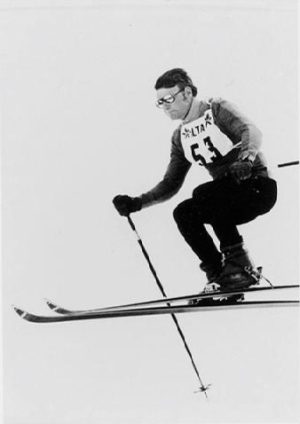
5_1
Photo Courtesy of the University of Utah J. Willard Marriott Library Special Collection.

Skiing from the top of Timpanogas seven times was a highlight of his  skiing career. “Three times I hiked to the top and four times I was dropped off by a helicopter. Timp has always been a wonderful challenge and a pleasure.”

“Now I just ski for fun. I  try to get up once a week and more often during holidays. I’m able to  ski with my wife, Maxine. And it’s hard to imagine but skiing is easier than walking or hiking when you’ve skied as much as I have. It is still easy to do and doesn’t require much energy. I haven’t been forced into missing a season or even part of a season due to injury. I’ve been very fortune in that I’ve never broken a bone or had a serious injury. I’ve had falls where I haven’t felt too good when I stopped rolling. Now the biggest problem is getting up.”

Junior’s oldest son, Barry Bounous teaches voices at BYU with his wife and carries on the family ski legacy by teaching skiing at Sundance on Saturdays.

Junior’s second son, Steven Bounous, learned skiing from his dad when he was two, at Sugar Bowl. He had an extensive racing career starting at Sundance when he six, and raced for over 20 years including time with the U.S. Ski Team. He became director of the Snowbird Sports Education Foundation in the late ‘80s and helps coach the Snowbird ski teams including Alpine and Big Mountain Free-Skiing. The programs currently has about 250 athletes and 50 coaches.

One of Steven’s most memorable experiences was racing in the World Cups.  “That was an incredible opportunity to ski all over the world competing.” He also recalls running ski adventures in New Zealand in the mid ’80s. “I was still competing professionally during winter and during summer I did tours in New Zealand when it was their winter.  We skied the Fox Glacier on Mount Cook, New Zealands’ high peak which we reached by helicopter. We skied in terrain that have never been skied before. Even now skiing un-tracked power and having the hill to yourself, there is nothing better. We skied ice fall and we could look right down into the ocean. It was spectacular scenery.”

It was an experience he was able to share with my dad when Junior joined him for 2 of the 8 years they ran the tours. 

He still skis with his dad, they’ve already been out a couple of times this year.

Junior says, “Skiing is a family business, but it’s also been a pleasure. I was fortunate that  I was able to pursue recreation as a profession. I was very lucky, and I’m not sure too many people can say that.”
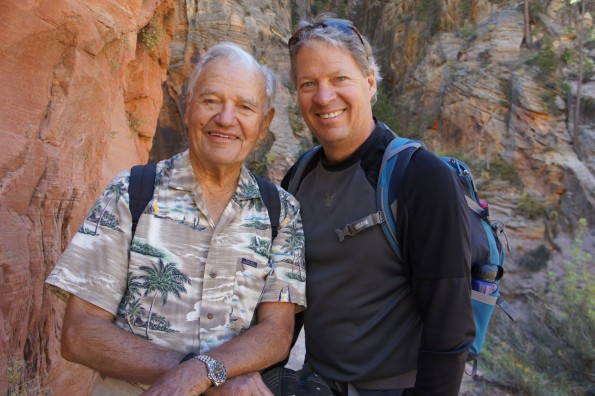
SONY DSC
Junior and Steve Bounous. Photo courtesy of Steve Bounous


Story by Connie Lewis


Join our newsletter.
Stay informed.


  • Highway 6 and the Midland Trail: Utah’s Transcontinental Highway History

    From Price Canyon to Delta’s desert stretch, Utah played a central role in building the Midland Trail, one of America’s earliest transcontinental highways and the foundation of today’s Highway 6.


  • Utah Acquires US Magnesium Assets in $30M Deal to Protect the Great Salt Lake

    Utah leaders announced the state has successfully won the bid to acquire key assets of the defunct US Magnesium facility on the Great Salt Lake, including its associated water rights and property.


  • Whiskey, Bullets & a Buried Town: Archaeologists Reveal Alta’s Wild Past

    Before Alta was known for powder days and lift lines, it was a silver mining town clinging to the side of a narrow canyon. In the late 1800s, men lived at 8,000 feet, went underground each day, and endured winters that regularly buried buildings in snow. This past summer, that mining town resurfaced — literally — during construction at the Alta Ski Area.

    To understand what Alta really looked like, you don’t begin with legend. You begin with its trash — and this time, that happened almost by accident.

    Alta Ski Area was installing underground water reservoirs to support snowmaking. Because the project sits on Uinta-Wasatch-Cache National Forest land, an archaeologist was required to monitor the excavation. No one expected the trench to produce much.

    But, It did.

    Artifacts began surfacing almost immediately. Enough that the Forest Service contacted the Utah State Historic Preservation Office for help. Lexi Little, who coordinates the Utah Cultural Site Stewardship Program, helped mobilize nearly 30 volunteers to assist with what quickly became a focused two-week excavation.

    Winter deadlines were approaching. The pipes for the reservoirs had to go in the ground. There wasn’t time for a slow, extended dig.

    “It was two weeks of digging in the dirt and helping figure out exactly what we were looking at,” Little said.

    Most of the people screening soil weren’t professional archaeologists. They were trained stewards from around Utah — part of a statewide volunteer network that now approaches 500 people. They poured dirt through shaker screens, scanning for fragments that could piece together a town long buried.

    “Archaeology is human trash,” Little explained. “Archaeologists are very into trash.”

    Alta had left plenty behind.

    https://youtu.be/hzIHzx3OGoo?si=dKcl2CEz-t6FZzYw

    Victorian-style ceramics appeared first — the kind typically used in hotels. Medicine bottles followed. Ink bottles. Hand-blown glass. A porcelain doll’s foot surfaced from the soil, a small detail that shifted the mental image of the town. Families were here. Children were here. This wasn’t only a camp of miners.

    The bottles helped establish time. Manufacturing details — whether glass was hand-blown or mold-made, whether a maker’s mark appeared on the base — allowed archaeologists to date many of the artifacts to the 1870s through the 1890s, when Alta was booming as a silver mining town.

    “That gives you that range of dates for when Alta was really booming,” Little said.

    One reusable soda bottle clearly stamped “Salt Lake City” connected the canyon to the valley economy below.

    Then something unusual rolled out of a dirt pile.

    A corked bottle. Intact. Liquid still inside.

    To access this post, you must purchase Utah Stories (Digital + Print) or 3 month free trial (Digital).


  • The Only Full Bottle of Alcohol Ever Found in Utah Was Unearthed in Alta

    When a backhoe rolled a corked bottle out of the dirt at Alta this summer, no one immediately grasped what they were holding. It wasn’t empty. It wasn’t shattered. It was full. “The bottle that was discovered up at Alta is the only bottle of alcohol ever discovered in an archaeological excavation in the state…