Utah Stories

Momentum Recycling: Why Glass Recycling is Important and Easy

Utah ranks well below the national average for glass recycling. What can you do to change that?

|


IMG_4952
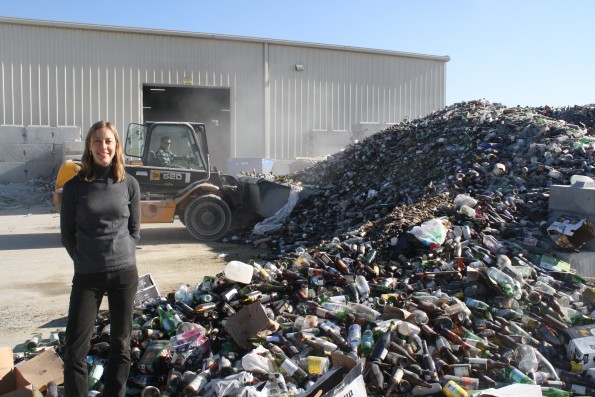
Kate Whitbeck co-owner of Momentum Recycling Photos by Justin Higginbottom

Most Utahns recycle their glass in the nearest trash container.  The state averages six to ten percent for its glass recovery where the national number is around 34 percent.

Momentum Recycling is working on changing all that. Located in the city’s industrial west side, it is the leading glass recycling facility in the state. “Pretty much any glass being recycled in the state is coming to us,” says Kate Whitbeck, co-owner of Momentum along with her husband Jeff and brother-in-law John Lair.

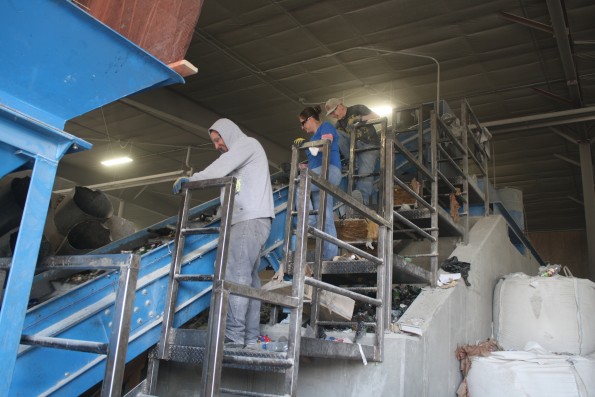
The idea of busting up bottles might sound like a great way for a person to release aggression, but on an industrial scale, it is a much more efficient process. Whitbeck explains that glass is first dumped into a giant hopper and moved along a conveyer belt where workers hand select green and clear pieces. The rest moves into a cylinder and is smashed by 24 automated hammers. A machine screens out contaminants, and separates the glass into two sizes. It is then heated to 190 degrees, melting any remaining glue, while a ferrite magnet pulls out metals.  The glass now resembles sand and is placed into large white bags. Most of it is sent to the Owens Corning fiberglass pant in Nephi. The rest is used for sandblasting, water filtration and coating for asphalt.

Originally from Utah, Kate went to work for the Peace Corps in Kyrgyzstan (where she also met her husband). They later returned to Central Asia to work for American-based NGOs implementing USAID and European-funded projects. She doubted she would ever return here, let alone own a glass recycling company. But return they did, and in 2008, Momentum acquired trucks and first started business as a recycling collection company — visiting bars, restaurants, and government buildings.“The focus was on zero waste…We wanted to help our clients divert as much waste as possible from the landfill,” says Kate.

In 2012 they built the plant and got a contract with Salt Lake City that included twenty drop-off locations and curbside pick-up. Curbside pick-up customers now number around 3,500.

Momentum provides diversion reports to businesses they serve showing the equivalent effect of their recycling on the environment — for example cars taken off the road.

But for those businesses or individuals not environmentally motivated, she provides an economic perspective by noting extending landfill life will save people money or that recycling plants provide manufacturing jobs. Much of the labor used at Momentum comes from the addiction treatment facility Odyssey House.IMG_4954
Join our newsletter.
Stay informed.


  • Highway 6 and the Midland Trail: Utah’s Transcontinental Highway History

    From Price Canyon to Delta’s desert stretch, Utah played a central role in building the Midland Trail, one of America’s earliest transcontinental highways and the foundation of today’s Highway 6.


  • Utah Acquires US Magnesium Assets in $30M Deal to Protect the Great Salt Lake

    Utah leaders announced the state has successfully won the bid to acquire key assets of the defunct US Magnesium facility on the Great Salt Lake, including its associated water rights and property.


  • Whiskey, Bullets & a Buried Town: Archaeologists Reveal Alta’s Wild Past

    Before Alta was known for powder days and lift lines, it was a silver mining town clinging to the side of a narrow canyon. In the late 1800s, men lived at 8,000 feet, went underground each day, and endured winters that regularly buried buildings in snow. This past summer, that mining town resurfaced — literally — during construction at the Alta Ski Area.

    To understand what Alta really looked like, you don’t begin with legend. You begin with its trash — and this time, that happened almost by accident.

    Alta Ski Area was installing underground water reservoirs to support snowmaking. Because the project sits on Uinta-Wasatch-Cache National Forest land, an archaeologist was required to monitor the excavation. No one expected the trench to produce much.

    But, It did.

    Artifacts began surfacing almost immediately. Enough that the Forest Service contacted the Utah State Historic Preservation Office for help. Lexi Little, who coordinates the Utah Cultural Site Stewardship Program, helped mobilize nearly 30 volunteers to assist with what quickly became a focused two-week excavation.

    Winter deadlines were approaching. The pipes for the reservoirs had to go in the ground. There wasn’t time for a slow, extended dig.

    “It was two weeks of digging in the dirt and helping figure out exactly what we were looking at,” Little said.

    Most of the people screening soil weren’t professional archaeologists. They were trained stewards from around Utah — part of a statewide volunteer network that now approaches 500 people. They poured dirt through shaker screens, scanning for fragments that could piece together a town long buried.

    “Archaeology is human trash,” Little explained. “Archaeologists are very into trash.”

    Alta had left plenty behind.

    https://youtu.be/hzIHzx3OGoo?si=dKcl2CEz-t6FZzYw

    Victorian-style ceramics appeared first — the kind typically used in hotels. Medicine bottles followed. Ink bottles. Hand-blown glass. A porcelain doll’s foot surfaced from the soil, a small detail that shifted the mental image of the town. Families were here. Children were here. This wasn’t only a camp of miners.

    The bottles helped establish time. Manufacturing details — whether glass was hand-blown or mold-made, whether a maker’s mark appeared on the base — allowed archaeologists to date many of the artifacts to the 1870s through the 1890s, when Alta was booming as a silver mining town.

    “That gives you that range of dates for when Alta was really booming,” Little said.

    One reusable soda bottle clearly stamped “Salt Lake City” connected the canyon to the valley economy below.

    Then something unusual rolled out of a dirt pile.

    A corked bottle. Intact. Liquid still inside.

    To access this post, you must purchase Utah Stories (Digital + Print) or 3 month free trial (Digital).


  • The Only Full Bottle of Alcohol Ever Found in Utah Was Unearthed in Alta

    When a backhoe rolled a corked bottle out of the dirt at Alta this summer, no one immediately grasped what they were holding. It wasn’t empty. It wasn’t shattered. It was full. “The bottle that was discovered up at Alta is the only bottle of alcohol ever discovered in an archaeological excavation in the state…