Charley Hafen met the celebrated artist Ed “Big Daddy” Roth in 1996 when Roth was hawking his signed silkscreened drawings at a car show. “I thought, ‘Whoa! That’s Ed Roth!’ when I saw him,” recalls the Salt Lake City jeweler. Hafen owns Charley Hafen Custom Jewelers and has known of the Big Daddy and his artwork since he was a boy. Like Roth, Hafen’s specialty is custom design.
Growing up, Hafen perused car magazines. For sale on the back pages were t-shirts with Roth’s idiosyncratic cartoon designs. He remembers the shirt he wanted but wasn’t allowed to purchase, a Beatnik beret-wearing ratrod with a goatee holding a bottle of wine. The image and name of the design, Wasted on Wine, didn’t fly with Hafen’s mom.
When they met, Hafen gave Roth his card and told him, “I build lots of custom design stuff. He gave me his card and called me about a month later.”
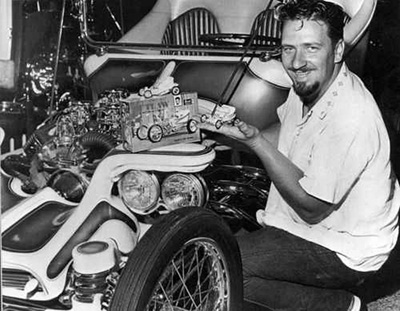
Roth grew up in California and had an affinity for both fast cars and drawing grotesque cartoon caricatures. He studied engineering in college, but building cars is what interested him most. With the advent of fiberglass construction, Roth began designing and fabricating fantastic one-of-a-kind hotrods. The Revell toy company produced model car kits from Roth’s designs. He received 1-cent from each kit sold and in 1963 earned $32,000 in royalties. Roth’s most widely recognized cartoon character, Rat Fink, was the monster-like antithesis of Mickey Mouse. Rat Fink t-shirts were extremely popular then, and still sell well through hotrod websites.
Midlife, Roth began re-examining his situation and subsequently joined the Church of Jesus Christ of Latter Day Saints. He married his third wife and moved to Manti, Utah. When that marriage ended in divorce, Roth began frequenting singles dances and met a woman he wanted to marry.
He contacted Hafen to make a ring. Roth sent him sketches, but the engagement didn’t work out. “He was still Big Daddy Roth,” Hafen explained. “He could be no one else and that proved too much for her.”
Then Roth met Ilene, and sent Hafen more sketches. Hafen couldn’t quite understand the concept, so Roth sculpted his idea out of clay and drove it to Hafen’s shop. Hafen traded a sapphire, gold and diamond ring for some of Roth’s artwork. Ed and Ilene married in 1998.
When Hafen traveled to Manti to choose some of Roth’s art, he went with a shopping list. “I had very specific things I was looking for,” he said. Most of the artwork he remembered from his childhood had been redone after Roth converted to Mormonism, but he did walk away with the refrigerator door the original Rat Fink was painted on, as well as Mud Truckin’, which Roth signed.
“I can still picture Ed eating a bag of burgers while I’m going through his personal archive of artwork,” Hafen remembers. “He knew how much his art was worth to me.”
Roth died in 2001. Church members as well as his hot rod-era friends attended the funeral.
Roth’s Mormon friends were on one side of the church and his L.A.crowd was on the other, Hafen explained with a laugh. Rows of classic cars were parked outside the church and Roth’s coffin was festooned with pinstripes.“The car guys did their best to be on their best behavior,” Hafen laughed. “But I’ve never seen such a division of mankind.”