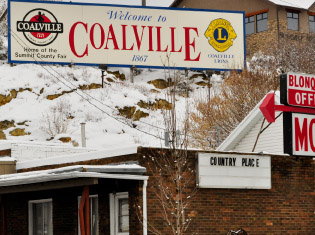
Total area, 3.3 square miles. Got its name when early settlers cashed in on Brigham Young’s $1,000 reward for finding coal within 40 miles of Salt Lake City.
“The town’s real pretty and the people are nice,” they all say. Yes, yes of course. Isn’t that what anyone says who has chosen to stay or move to a small town? Everybody knows everybody and they all help each other out. Life is simple. In Coalville there is not even a traffic light. Wait. What? Not a single traffic light? Now that’s a little bit interesting.
 Residents have lived in this Summit County town for generations. Chevron station and towing company owner Tom Moore says he’s traveled the world but keeps coming back to Coalville where he has deep roots. “My great-grandmother was the first white woman here,” he notes, back when the area around Chalk Creek was a rest stop on the Indian migratory highway.
First white woman? That’s interesting.
A bandit named Ike Potter was caught and hanged in Coalville. Hmmm…
The high school teams are the North Summit Braves. At the end of his shift at his family-owned Sinclair station, AJ Bell says that in the ’70s, when they tore down the old school, they discovered it was built on an Indian burial ground, and local legend says the new high school is haunted. Interesting. “And,” AJ adds, “Ted Bundy supposedly put one of his bodies up Chalk Creek. At least, I think that’s true.” Maybe not, but it’s interesting nonetheless.
“Do you know Luke Spencer on General Hospital?” asks Napa Auto Parts owner Phil Geary. “Anthony Geary, the actor who plays Luke, is a hometown boy.” A hometown boy, and Phil’s first cousin. Phil also talks up Coalville’s master seamstresses who belong to the community’s award-winning quilting guild.
Then there’s the mink. For years, the pelts from Adkins and Vernon farms commanded top market prices, but you know what’s even more interesting than that? Offbeat jewelers paid the ranchers a nickel apiece for mink penis bones that they then used to handcraft jewelry. Now that’s interesting! (And true!)
And horse thief Ike Potter? His bones washed up on the Echo Reservoir shore. Nobody paid a nickel for his bones.
The Logan-to-Park-City Ragnar race goes through Coalville. The hospital was made into the town library. Denise’s Home Plate cafe’s location used to be part of the old jail. The 4-H sale at the Summit County Fair is the largest in Utah. Notorious bandits hid out in nearby Cache Cave. Eagles migrate through Coalville, and old Frank Catellan used to gandy dance in the summertime for the railroad for .63 cents an hour.
There’s a story going around that the BLM won’t let you take a metal detector out on the now-exposed Echo Reservoir shoreline because there’s a safe buried out there that contains deeds to properties. And nobody knows what happened to the two-headed rattlesnake at Bunny’s Club.
Back to Ike Potter. He was a cattle thief, not a horse thief. And he was shot, some say murdered, not hanged. They do say before his death he put a curse on Coalville, that it would never prosper. Maybe it hasn’t prospered economically, but the town is rich with neighborly love.