Off Beat Characters

Single Action Shooting Society

The modern outlaw’s catharsis.

|


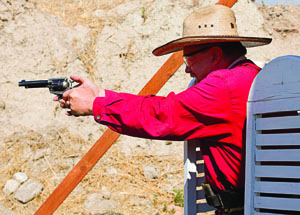
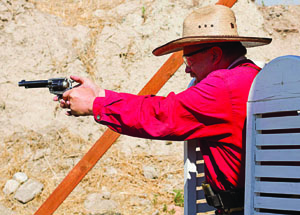
Lefty Pete has steel in his eyes and lead at his fingertips as he calmly says, “I aim to shoot you or see you hang at Judge Parker’s convenience.” Blam…Blam! Blam! Blam! Lefty blasts a fusillade at targets that represent nefarious desperados. When the dust settles, he is the only man standing.
Welcome to Utah’s Wild West – where rootin’ tootin’ and six-shootin’ members of the Single Action Shooting Society (SASS) go to great lengths to preserve the Western traditions of dead-eye marksmanship and the camaraderie of the open range.
Lefty (aka Paul Peterson) heads up the Utah Territory Gunslingers. It is a group of SASS aficionados who hone their skills at a gun range constructed to resemble a western town. Located behind the Lee Kay Center in Magna, the town has 10 venues including the Treys and Aces Saloon, the Cattleman’s Bank, a mine shaft and boot hill.
SASS is a worldwide organization that includes 20 chapters in Utah. When members compete, they enter a venue, announce a starting phrase such as “Pour me a sarsaparilla,” and then shoot a rifle, two pistols and a shotgun at targets for time and accuracy. Using a lever-action Winchester, Lefty can fire 10 shots in six seconds.
When not dealing out lead poisoning, Lefty resides in Sugar House and is a plumber by trade. “I come for the shooting and stay for the people,” he says. SASS members hail from all walks of life, and some go to great lengths to create a Western persona. “I chose the look of a working cowboy. When I first heard about SASS I thought it was the silliest thing ever. I wasn’t going to play dress-up! Then I got my hands on some competition guns and I was hooked.” Since it is a family oriented activity, Lefty says you will see members dressed as saloon girls and young cowpokes as well. “It is the fastest growing and the safest of the shooting sports,” he says.
The town, affectionately known as Big Salty, has been a work in progress for four years, and was built by volunteers donating their time and a fistful of dollars. Next year it will host the state championships. No doubt the streets will then be filled with high plains drifters, all waiting for the approach of High Noon. §

, , ,


Join our newsletter.
Stay informed.


  • Whiskey, Bullets & a Buried Town: Archaeologists Reveal Alta’s Wild Past

    Before Alta was known for powder days and lift lines, it was a silver mining town clinging to the side of a narrow canyon. In the late 1800s, men lived at 8,000 feet, went underground each day, and endured winters that regularly buried buildings in snow. This past summer, that mining town resurfaced — literally — during construction at the Alta Ski Area.

    To understand what Alta really looked like, you don’t begin with legend. You begin with its trash — and this time, that happened almost by accident.

    Alta Ski Area was installing underground water reservoirs to support snowmaking. Because the project sits on Uinta-Wasatch-Cache National Forest land, an archaeologist was required to monitor the excavation. No one expected the trench to produce much.

    But, It did.

    Artifacts began surfacing almost immediately. Enough that the Forest Service contacted the Utah State Historic Preservation Office for help. Lexi Little, who coordinates the Utah Cultural Site Stewardship Program, helped mobilize nearly 30 volunteers to assist with what quickly became a focused two-week excavation.

    Winter deadlines were approaching. The pipes for the reservoirs had to go in the ground. There wasn’t time for a slow, extended dig.

    “It was two weeks of digging in the dirt and helping figure out exactly what we were looking at,” Little said.

    Most of the people screening soil weren’t professional archaeologists. They were trained stewards from around Utah — part of a statewide volunteer network that now approaches 500 people. They poured dirt through shaker screens, scanning for fragments that could piece together a town long buried.

    “Archaeology is human trash,” Little explained. “Archaeologists are very into trash.”

    Alta had left plenty behind.

    https://youtu.be/hzIHzx3OGoo?si=dKcl2CEz-t6FZzYw

    Victorian-style ceramics appeared first — the kind typically used in hotels. Medicine bottles followed. Ink bottles. Hand-blown glass. A porcelain doll’s foot surfaced from the soil, a small detail that shifted the mental image of the town. Families were here. Children were here. This wasn’t only a camp of miners.

    The bottles helped establish time. Manufacturing details — whether glass was hand-blown or mold-made, whether a maker’s mark appeared on the base — allowed archaeologists to date many of the artifacts to the 1870s through the 1890s, when Alta was booming as a silver mining town.

    “That gives you that range of dates for when Alta was really booming,” Little said.

    One reusable soda bottle clearly stamped “Salt Lake City” connected the canyon to the valley economy below.

    Then something unusual rolled out of a dirt pile.

    A corked bottle. Intact. Liquid still inside.

    Continue reading and support independent Utah journalism with a purchase of Utah Stories (Digital + Print) or 3 month free trial (Digital).


  • How Horses Help Kids Heal: Inside Utah’s Equine Therapy World

    Kelty Johnson trains horses for a living, but her deeper work happens in the quiet space between animal and human. On the Utah Stories podcast, she explains how equine therapy helps children regulate emotions, build confidence, and reconnect through presence rather than pressure.


  • Angela Brown: The Woman Behind SLUG Magazine and Craft Lake City

    Angela Brown is the publisher and owner of SLUG Magazine, one of the city’s longest-running independent publications and a central voice in Utah’s alternative arts and music scene. She is also the founder of Craft Lake City, a nonprofit that has grown into one of the state’s largest platforms for local makers and creative entrepreneurs.


  • Can Utahns Still Afford to Have Kids?

    When families cannot afford homes near their jobs, the daily math becomes brutal. Commutes stretch longer. Childcare costs pile up. Mortgages consume more of a household’s income. The result is what economists call “house-poor” families—people who technically own a home but have almost nothing left over to live on.

    The obvious question is: why isn’t this being fixed?