Utahns can hear carols and cowbells played on the city’s organs
 The majestic sound of a pipe organ is the perfect musical soundtrack for the Christmas season. It inspires and comforts, allowing listeners to feel they are part of life’s grandeur.
Utah is renowned for its organ culture. The BYU music program trains organists and the ML Bigelow Company in American Fork builds them. But the true joy comes from
hearing sacred and secular organs being played and meeting the artists who create the music.
Few sounds equal the 11,000 pipe Mormon Tabernacle organ. It can softly accompany the choir or trumpet resoundingly during daily recitals that have been held at the Tabernacle since 1903. The pipes are operated by five keyboards and foot pedals. “I feel so lucky that I sometimes have to pinch myself,” said organist Andrew Unsworth. “Organists come here from all over the world and I get to do this daily.”
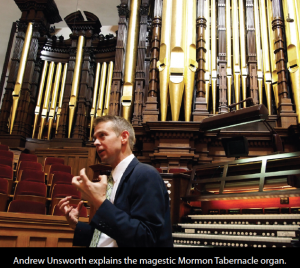 Andrew started playing piano at four and by his teen years knew he had to learn the organ. The versatility is attractive. “There are so many possibilities you feel as if you are conducting an orchestra,” he said. And then there is the volume. Organists control massive blowers that feed air through the pipes. To feel this floor-shaking force is a rush. “If I wasn’t an organist I would have been a heavy metal guitarist,” he laughed.
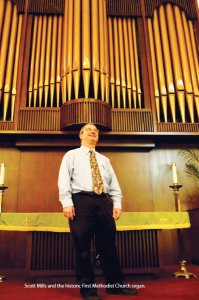
Organist Scott Mills at the First United Methodist Church traces his organ teacher lineage back to J.S. Bach. The Methodist Church organ has been in place since 1905 and during its restoration craftsmen are incorporating pipes from the Salt Lake Masonic Temple organ. “Pipe organs last forever,” Mills said. “I fell in love with this one because it has such romantic sounds.” The church is seeking to raise $300,000 so that all the organ’s 2,500 pipes will function. The 1,100 that are currently used still allow Mills to create and compose pieces such as “Bring Forth the Breath of God,” which best summarizes the central role that Mills believes organs have in church services.
 At the Cathedral of the Madeleine, organist Douglas O’Neill will be busier than Santa on Christmas Eve. O’Neill will play the church’s Irishmade organ at the midnight mass and the early morning worship services, trying to catch some sleep in the rectory between masses. He operates a keyboard that connects via levers to the pipes. For this reason he faces the organ and must watch all proceedings that are behind him on a small television screen. As a teenager, O’Neill knew he wanted to be an organist.
“I’m still hooked,” he said. These are but a few of the locations in Salt Lake where a person can hear classical organ music.
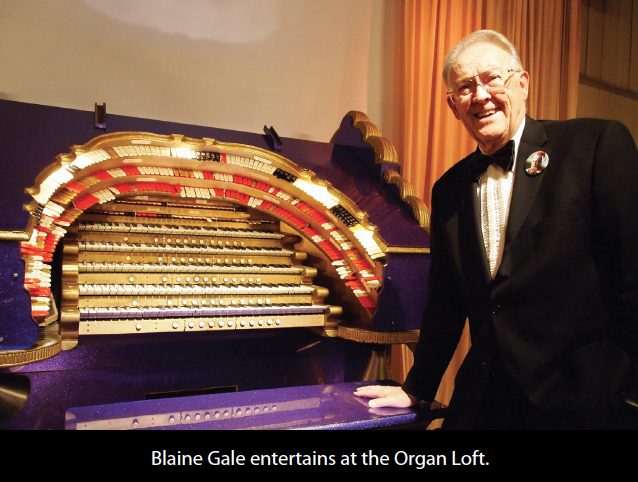
You can also hear organists ringing cowbells and whistling police sirens. Theater organs, which were a mainstay of silent movie houses, still entertain audiences at Peery’s Egyptian Theater in Ogden and the Organ Loft, 3331 S. Edison Street in Salt Lake, where organist Blaine Gale holds court.
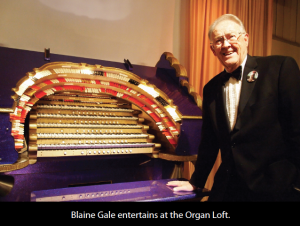 He sits at a mighty Wurlitzer Organ with five keyboards, 14 foot pedals and 2,400 pipes that produce sound effects such as train whistles and aauugah horns. The organ is directly below the movie screen, and Gale is actually part of the movie. He does not play from a score, but constantly improvises based on the movie action and crowd reaction. “Since the audience is different, each performance is different. The organ is the master and I am its servant,” he said.
Gale is a retired military officer and a self-taught organist. At age 78 he still finds it a joy to perform. After playing music for a lifetime, he surely must have a special song? “A lot of people ask me that question. I simply answer, ‘I’ll tell you my favorite piece of music if you tell me what was your favorite breath.’”