
BYU’s Museum of Art is Closing the Door on the Gates of Paradise Exhibit but the Replicas Remain
What do a Renaissance sculptor, Laie Hawaii, and a museum in Provo have in common?
The Gates of Paradise.
In 1452, sculptor Lorenzo Ghiberti finished his masterpiece: two bronze doors depicting 10 scenes from The Old Testament which were installed on the eastern side of the Baptistry of San Giovanni in Florence, Italy.
Now, five hundred years later, you don’t need a plane ticket (or even a museum ticket) to see Ghiberti’s masterpiece up close. An 18 foot replica created from casts of the original doors’ molds—which had been stored at BYU-Hawaii since 1984—can be seen at the Museum of Art at Brigham Young University through October 24th .
Dr. Sharon Gray, retired Professor of Art Education at BYU and current church service missionary serving as curator of the art collection at BYU–Hawaii, is largely to thank, along with Bill and Barbara Benac who helped fund the exhibit, for recognizing what was being stored in Hawaii and for getting it to Provo.
“I feel like [God] is smiling… at the circumstances that have brought this together, and the amount of people that are flooding to see it, and the enthusiasm with which it’s received,” says Dr. Gray.
The exhibit, called Gilded Paradise, includes a comparative timeline of Ghiberti’s life and work alongside other important Renaissance masters, one of which later gave the doors their nickname. Michelangelo is said to have been so impressed with his predecessors’ work that he remarked, “They are truly worthy to be the Gates of Paradise.”
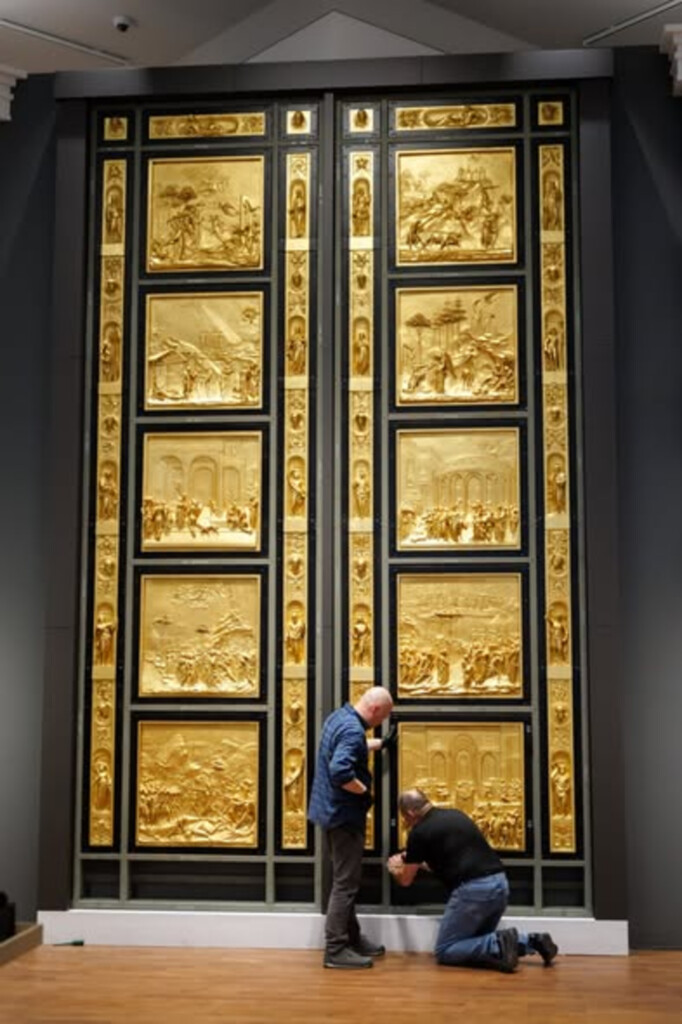
Everything from materials like plaster to the several layers of shellac and gold leafing that give the doors their luster is demonstrated in an interactive display. These detailed processes, devised by the museum’s Exhibit Production & Installation Manager, John Adams, were used to recreate all 42 panels including a number of ornate, narrow panels that line the sides of the 10 biblical scenes.
“We needed to try and maintain as much of the original essence of his doors as possible,” says Adams. “There was a lot of missing detail. There was a lot that we had to recreate and put back into it.”
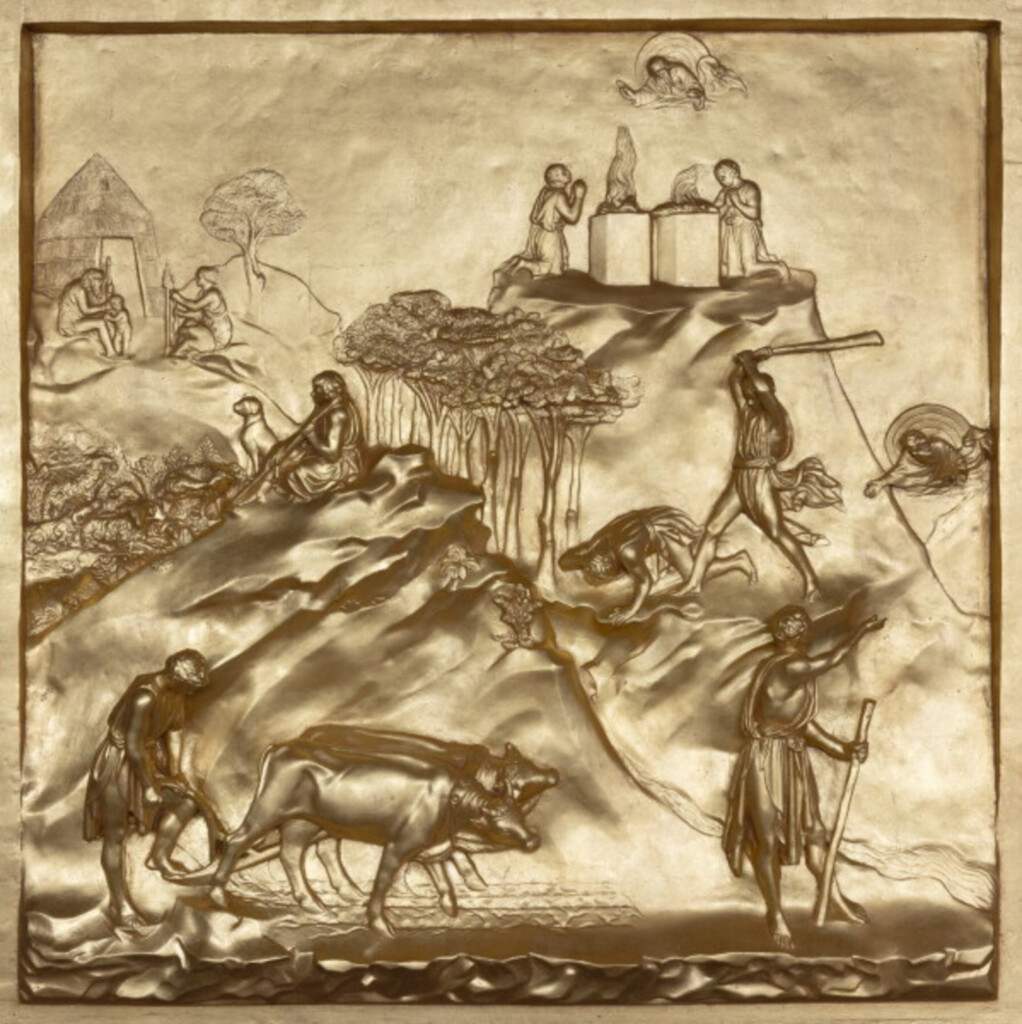
Although it took Adams and his team 10 years to research and restore this masterpiece, it took Ghiberti almost three times that to produce the originals. With painstaking skill, he carved the detailed images representing some of the best-known scenes from the Bible: Adam and Eve, Cain and Abel, Noah, Abraham, Jacob and Esau, Joseph, Moses, Joshua, David, and Solomon and Sheba.
But in Florence, you have to look at the artwork from a distance which is why Dr. Gray says the local exhibit is not to be missed.
“For one thing, you can see these up close and personal with the educational materials that they can’t see in Florence. You need binoculars to see the Adam and Eve panel and the Cain and Abel panel [there]. You can’t see the two salamanders that are crawling on the ground by Adam’s leg… and the head of the serpent. You can’t see those details from a distance satisfactorily, especially with gilding… you would need some kind of telescope or binoculars to see the amazing detail.”
In Provo, images of each of those 10 panels can be seen at eye level with a synopsis of the story depicted, a description of the elements found within the scene, the historical significance and artistic techniques used, as well as its placement within the larger doors so you can identify where each panel is located in the full-size replica.
“I’m going to miss the interpretive materials that are an educator’s dream,” says Dr. Gray. “You can see the blowups at actual size of the originals… and here’s the story, and the interpretive information, and then the models that were made, the 3D models—those are all just incredible resources.”
The Gilded Paradise exhibit ends its eight month run on October 24th, 2026, but according to Adams, the doors themselves will become a permanent fixture at the Museum.
“The exhibit will come down, but the Gates of Paradise will be up,” he says. “It’ll take about two weeks to move it to a more semi-permanent location.”
Since it opened in February, art lovers, historians, theologians, families, and visitors from various backgrounds have come to appreciate the Gates of Paradise replicas. With the start of the new school year and the ending of the exhibit, what better time for teachers from multiple disciplines to bring their classes to experience the doors?
“There’s only like eleven [replicas of Ghiberti’s] bronze doors in the world at this time,” says Adams. “It’s a big thing to have something like this [here].”
Admission to the Museum of Art is free and the exhibit can be viewed Monday through Saturday starting at 10 a.m. and closing at various times. Visit the website for more information.
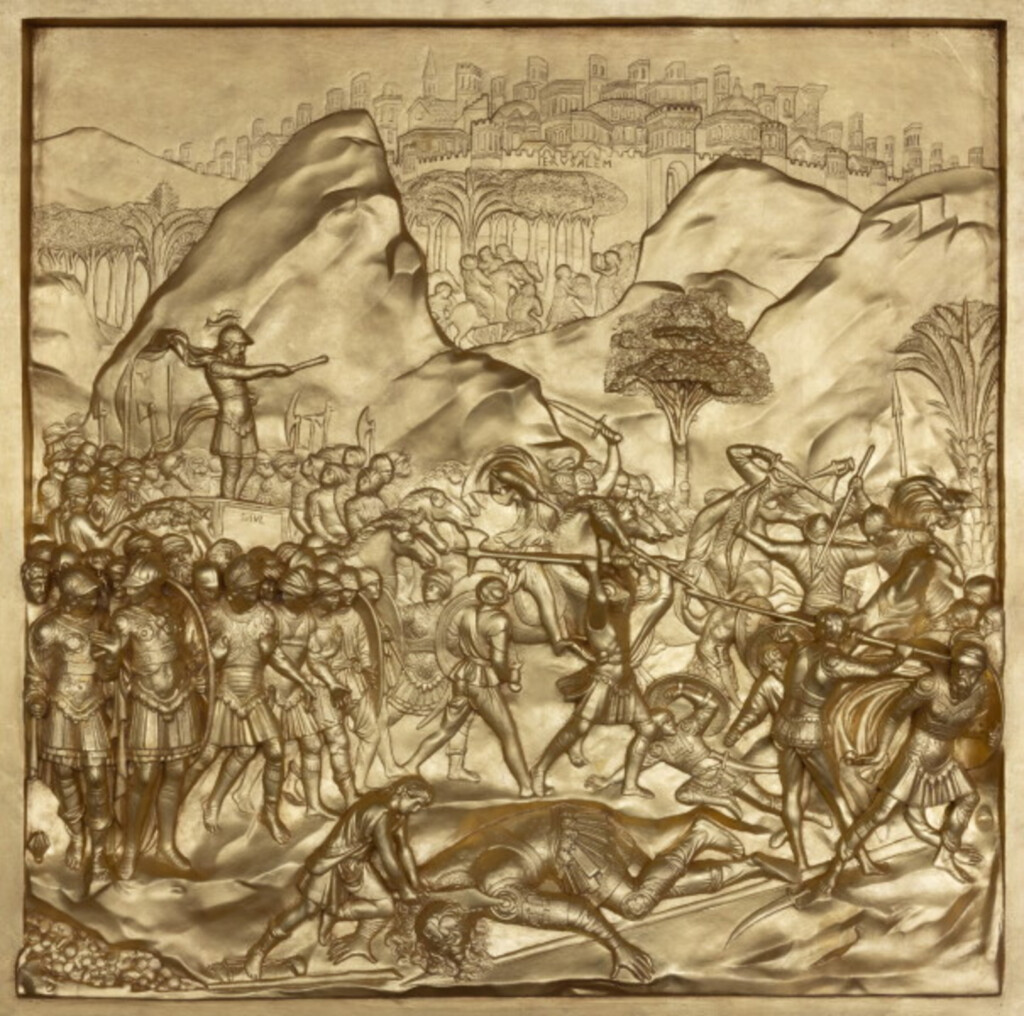
Feature Image: Replica of Lorenzo Ghiberti’s door panel depicting David and Goliath. Image courtesy of BYU.