Community Relations

Remembering the Salt Lake City Flood of  ’83

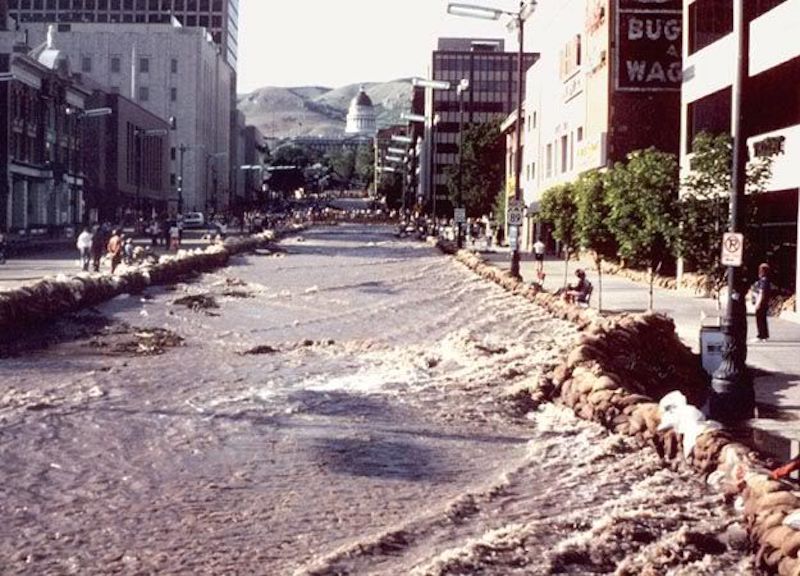
Many remember Salt Lake flood of 1983 that sent a river coursing down State Street, the sandbag parties, the rushing water, the fears of essential equipment getting overwhelmed. 

|


I recently posed a question on a Facebook site called, “If you grew up in Salt Lake, you will remember this.” I asked the followers what they remembered about the 1983 Salt Lake flood that sent a river coursing down State Street. It struck a chord and I heard back from many people about the sandbag parties, the rushing water, the fears of essential equipment getting overwhelmed. 

Salt Laker Janet Duran commented, “I remember a sign on a bank: ‘The only thing worse than a flooded basement is a flooded attic.’” 

I spoke with Steven Faurschou who worked downtown that Spring. 

“My office was at 155 S State Street. I was working on a computer conversion at Utah/Idaho Supply in the Beneficial Life Building that Sunday. The office was on the second story, and I looked out the window, south down State Street, trying to figure out what all the commotion was about. Cars were being towed away and trucks were dumping sand in the middle of the street.”

Faurschou went down to see what was going on, and city workers told him that the street was going to become a river that night. People were coming to stack sandbags and they advised him to “grab some sandbags, sandbag your building, and be prepared for lots of water.”

“Literally thousands of people showed up to fill sandbags,” Faurschou said. “It was amazing to  see all those people out there working. Churches let their congregations out early to sandbag. It really brought the community together … ”

Faurschou decided to stay downtown to watch the water come, and come it did. “At first it was a small trickle. Nothing more than a heavy rainstorm. I thought it was kind of anticlimactic. But as I kept watching, more and more started coming down the street and soon it was up to the level of the sandbags. They were stacked three high. The engineers could see that the middle of the street was higher than the edges, like a crown, so people started wading to the middle of the street to move the bags to the edges and curbs.” 

By then the water was flowing so fast and strong it knocked people off their feet. Faurschou said he watched in amazement as one guy was swept all the way to 2nd South with a sandbag on his lap.

“One thing really concerning,” Faurschou said, “was that when the river started down State Street, there was a real fear about all the utility infrastructure running along the street. City workers were hoping to keep water out of it, but if they weren’t able to do that, and if the tunnels flooded, all power would be lost. They couldn’t predict how long it would take to repair if that happened.” Fortunately for the city, that didn’t happen. 

Faurschou had a front row window to the Salt Lake River for the next couple of weeks. He watched bridges go up to cross the street and people navigating the new reality. 

The flood didn’t just impact downtown. Faurschou said that 13 South was closed from Liberty Park to the Jordan River. He said they actually hauled in dirt to build a canal to siphon off some of the water. They also enlarged the pond in the park to handle the runoff. 

There were water dikes along I-80 railroad tracks, and Saltair was inundated. All the attractions were flooded and ruined after only being open for a few years. 
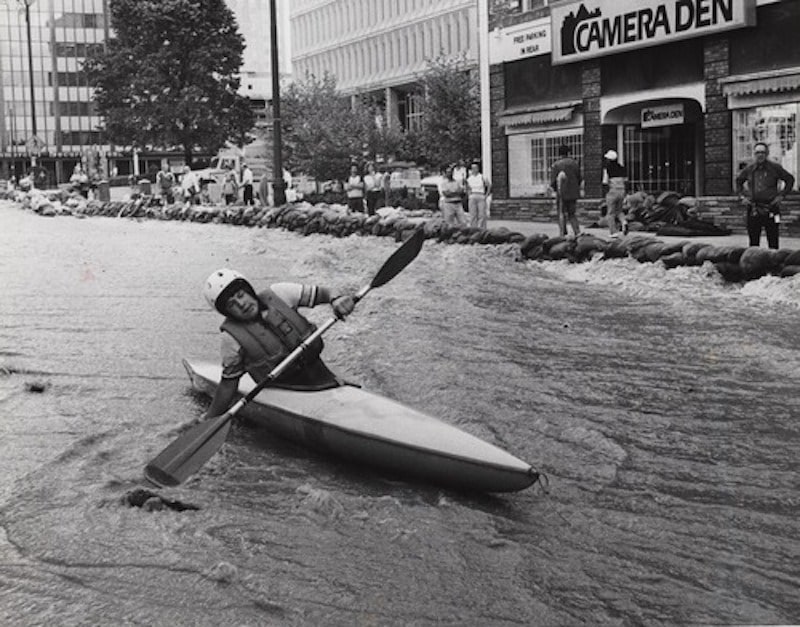
It wasn’t all serious though.

Resident Joe Mortensen made the most of the situation. “I had my fly rod and waders with me and stopped downtown to have some fun while all the lookie loo tourists were down there snapping pictures,” he wrote. And Scuba Hamby recalls that, “In ‘83, we rode our bikes in the [State Street] river. We were kids, but man it was fun.”

Subscribe to Utah Stories weekly newsletter and get our stories directly to your inbox

* indicates required


, ,


Join our newsletter.
Stay informed.


  • Salt Lake City Newcomers Club: Finding Friendship and Belonging Since 1948

    Moving away from your hometown can come with many blessings. But for some, it also comes with just as many bouts of loneliness. That ache of not knowing where to meet people, or grieving the friends you left behind, comes in waves. Workplaces and churches can sometimes provide ready-made communities, but what happens when they don’t? Where do you go to find true belonging?


  • Highway 6 and the Midland Trail: Utah’s Transcontinental Highway History

    From Price Canyon to Delta’s desert stretch, Utah played a central role in building the Midland Trail, one of America’s earliest transcontinental highways and the foundation of today’s Highway 6.


  • Whiskey, Bullets & a Buried Town: Archaeologists Reveal Alta’s Wild Past

    Before Alta was known for powder days and lift lines, it was a silver mining town clinging to the side of a narrow canyon. In the late 1800s, men lived at 8,000 feet, went underground each day, and endured winters that regularly buried buildings in snow. This past summer, that mining town resurfaced — literally — during construction at the Alta Ski Area.

    To understand what Alta really looked like, you don’t begin with legend. You begin with its trash — and this time, that happened almost by accident.

    Alta Ski Area was installing underground water reservoirs to support snowmaking. Because the project sits on Uinta-Wasatch-Cache National Forest land, an archaeologist was required to monitor the excavation. No one expected the trench to produce much.

    But, It did.

    Artifacts began surfacing almost immediately. Enough that the Forest Service contacted the Utah State Historic Preservation Office for help. Lexi Little, who coordinates the Utah Cultural Site Stewardship Program, helped mobilize nearly 30 volunteers to assist with what quickly became a focused two-week excavation.

    Winter deadlines were approaching. The pipes for the reservoirs had to go in the ground. There wasn’t time for a slow, extended dig.

    “It was two weeks of digging in the dirt and helping figure out exactly what we were looking at,” Little said.

    Most of the people screening soil weren’t professional archaeologists. They were trained stewards from around Utah — part of a statewide volunteer network that now approaches 500 people. They poured dirt through shaker screens, scanning for fragments that could piece together a town long buried.

    “Archaeology is human trash,” Little explained. “Archaeologists are very into trash.”

    Alta had left plenty behind.

    https://youtu.be/hzIHzx3OGoo?si=dKcl2CEz-t6FZzYw

    Victorian-style ceramics appeared first — the kind typically used in hotels. Medicine bottles followed. Ink bottles. Hand-blown glass. A porcelain doll’s foot surfaced from the soil, a small detail that shifted the mental image of the town. Families were here. Children were here. This wasn’t only a camp of miners.

    The bottles helped establish time. Manufacturing details — whether glass was hand-blown or mold-made, whether a maker’s mark appeared on the base — allowed archaeologists to date many of the artifacts to the 1870s through the 1890s, when Alta was booming as a silver mining town.

    “That gives you that range of dates for when Alta was really booming,” Little said.

    One reusable soda bottle clearly stamped “Salt Lake City” connected the canyon to the valley economy below.

    Then something unusual rolled out of a dirt pile.

    A corked bottle. Intact. Liquid still inside.

    To access this post, you must purchase Utah Stories (Digital + Print) or 3 month free trial (Digital).


  • The Only Full Bottle of Alcohol Ever Found in Utah Was Unearthed in Alta

    When a backhoe rolled a corked bottle out of the dirt at Alta this summer, no one immediately grasped what they were holding. It wasn’t empty. It wasn’t shattered. It was full. “The bottle that was discovered up at Alta is the only bottle of alcohol ever discovered in an archaeological excavation in the state…