
Noisy Neighbors Cause Community Chaos
OGDEN VALLEY, Utah—To Eva Dennis, there’s a good side to short-term vacation rentals and a bad side.
During a recent trip to Europe, Dennis used AirBnb to find places to stay — an old French farmhouse, a Tuscan villa, a small castle surrounded by a moat.
“You get these opportunities to stay in some pretty cool spots,” she said. “We’re a family of seven, so hotel rooms are not ideal.”
Dennis is also an AirBnb host. She uses the platform to advertise a condo she owns on 25th Street in Ogden, where short-term rentals — stays less than 30 days — are allowed by law.
Her AirBnb guests pay more per night than would long-term renters. They typically stay less than a week, which means Dennis can schedule more frequent cleanings and keep a better eye on wear and tear.
For the past two years, however, Dennis has experienced the flipside of short-term rentals. She lives 15 miles from her condo, in an area of Eden where rentals of less than 30 days aren’t allowed. Still, she says, a house nearby operates like a hotel, sleeping 25 people, according to the AirBnb listing.
“It’s a constant family reunion the whole summer,” Dennis said. People play games and make noise late into the night. Bright lights are left on and stream into her bedroom. Cars come and go in what’s usually a quiet neighborhood. When guests leave, garbage sometimes overflows from trash bins.
The property owner, who resides in Kaysville and spoke on the condition of anonymity, said he rarely receives complaints. When he bought the home just over two years ago, he introduced himself to the neighbors and gave them his phone number.
“We really do want to keep our neighbors happy,” he said. “That’s our No. 1.”
After one noise complaint, he kicked the guests out and installed a noise meter. In the winter, he said, he pays to plow the area by the community mailboxes even though he doesn’t have to.
Dennis remains unsatisfied. “We would never choose to live by a short-term rental,” she said.
“The frustrating part is when we do complain about it [to the county], nothing happens. There’s no enforcement.”
That’s about to change.
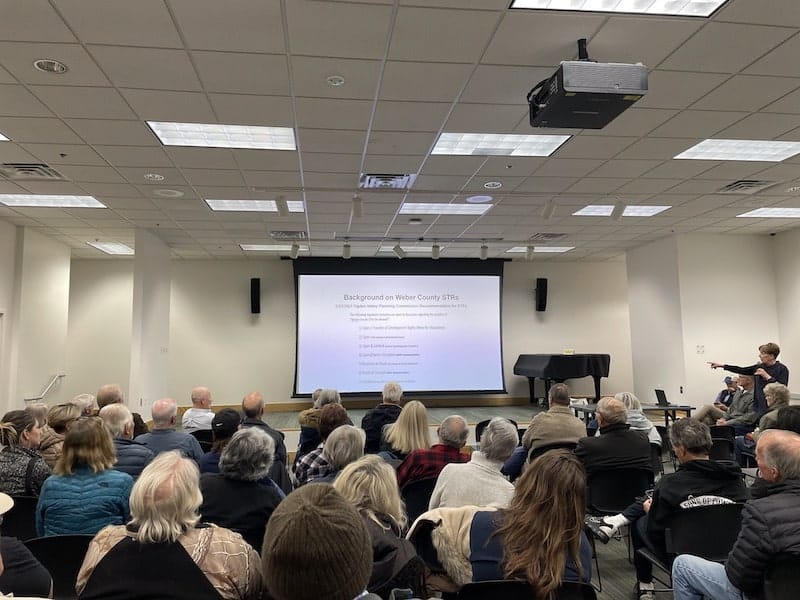
In January, the Weber County commission unanimously approved new regulations for short-term rentals. The ordinance, which applies to the county’s unincorporated areas, details stricter rules for owners and renters and levies larger fines against violators. It also aims to halt short-term rentals occurring in zones where they aren’t allowed.
“I want to create a hammer to make sure people stay compliant,” Commissioner Jim Harvey said during the Jan. 10 meeting. “We don’t want bad actors.”
Lee Schussman, an Eden resident, has followed the issue closely for the past two years and advocated for better, more effective oversight.
“The new ordinance is, I think, a reasonable plan to address a really difficult problem,” he said.
But Mike Ulrich isn’t happy. The Salt Lake County man bought a home in Eden last year for getaways for his large family. He rented it to short-term guests on occasion, even though zoning didn’t allow it.
Since it’s his second home, he pays a property tax rate 45 percentage points more than primary home owners. The majority of that goes to Weber County schools, which his kids don’t attend.
“And now I can’t even generate an income to pay my mortgage,” he said. “How is that fair?” Ulrich has since found a long-term renter, but he says the rent doesn’t cover his mortgage.
With a full-time job and four kids, Ulrich said, he doesn’t have time to go to the county or community meetings. He said his older neighbors often do.
“The people that don’t have time to go to all these meetings, we’re getting ruled by this retired class of people.”
Short-term rentals have caused so much debate that state lawmakers are also drafting a short-term rental bill, led by Rep. Calvin Musselman, a Weber County republican. If passed, he said, it will require owners to obtain a sales tax license and clarify what evidence cannot be used to fine violators, among other items.
Whatever state legislators decide, counties will have to comply. This makes Eden resident Jan Fulmer worried. In two months, she collected over 450 signatures on a petition urging county commissioners to regulate short-term rentals.
By her count, Ogden Valley now has just over 1,000 legally zoned short-term rentals, amounting to nearly 25 percent of all dwellings. Area developers continue to request zoning changes that would allow for more which means the potential for 900 more legal short-term rentals.
Not all of Ogden Valley’s short-term rentals are actively rented, but Fulmer said they still threaten the community.
She points to famous ski towns throughout the West where locals can no longer afford to live. She also notes that Utah’s No. 1 city for short-term rentals is Park City. Last November, officials there announced a potential pilot program that pays homeowners not to rent their properties short-term.

Is there data on short-term rentals?
Short-term rentals in Utah increased nearly 27% from 2019 to 2021, according to the Kem C. Gardner Policy Institute at the University of Utah.
Weber County, home to Weber State University and Ogden, ranks sixth among Utah’s 29 counties in short-term rental properties with just over 800. The majority are in Ogden Valley, where there are three ski resorts and Pineview reservoir, a popular spot for summertime boating.
As of last July, Ogden Valley had about 40 active business licenses for short-term rentals, according to Weber County records. That’s well under 10 percent of the six to eight hundred such businesses that are believed to be operating.
What happens now that Weber County’s ordinance passed?
While Weber County’s ordinance officially took effect on January 24, some timelines are unclear. For example, the county still needs to decide when notices will be sent out to owners and whether owners can fulfill existing bookings.
Once the county sets a deadline, owners wanting to rent their properties short-term must obtain a business license. The application requires a parking and trash-disposal plan and contact information for a “responsible agent” who can be on-site within 60 minutes of a complaint, among other things. First-time applicants will undergo a property inspection. If approved, the license number must be displayed on all advertisements.
In the meanwhile, the county has hired Granicus, which specializes in monitoring and enforcing short-term rental compliance. The St. Paul, Minnesota-based firm will scrub over a dozen short-term-rental websites for local properties being advertised, create a database, compare them to the list of properties that have been granted licenses, and report those that haven’t to the county.
An owner who is found to be renting a property short-term without a business license will receive a warning. If caught again, the owner will be assessed a fine equal to double the advertised nightly rental rate for each day of violation.
Will exceptions be made?
The new ordinance doesn’t allow for any exceptions. “It’s pretty cut and dry,” said Bill Cobabe, a planner in the Weber County Planning Division.
What can owners of short-term rentals in zones that don’t allow them do? Cobabe said there are two options. One is to request a property rezone, which Cobabe acknowledged can be “tough.”
The second option is to wait.
“Then in a few months, or maybe a year, come back and say, hey, now that everything’s all ironed out and everything’s running smoothly, maybe it’s time to start considering these exceptions to the rules.”
Cobabe urged people to “stay tuned and continue to give their input.”
“Nothing is ever perfect, especially not on the first go. So, we’ll be looking to make tweaks and changes and revisions as the enforcement comes online.”
Additional changes to the ordinance could be triggered by state legislation. If a state bill is passed, as State Rep. Musselman expects, that means counties will need to comply.
How will complaints be handled?
Previously, a single code enforcement officer fielded neighbor complaints. Going forward, Granicus will staff a 24-hour hotline. Upon receipt of a complaint, Granicus will contact the “responsible agent” who has one hour to resolve the issue and report back, or else the property owner will be fined the entire amount of that rental.
“We know that with a 24/7 operation, we need to have 24/7 enforcement,” said Gage Froerer, Weber County commissioner.
How will Granicus be paid?
Bill Cobabe expects the contract with Granicus to start in early 2023. The county will front the cost, which totals just over $28,000 for the first year, but expects to recoup it through license fees and fines.