Utah History

How Did Utahns Celebrate Valentine’s Day 100 Years Ago?

Valentine’s Day, widely celebrated around the globe with flowers, sweetheart messages and chocolate, has a bit of a checkered past.

|


Valentine’s Day, widely celebrated around the globe with flowers, sweetheart messages and chocolate, has a bit of a checkered past.

In ancient Rome, agricultural communities gathered for Lupercalia in mid-February, a festival that later fell out of favor with early Christians and Popes.

Dr. Eliza Rosenberg, who lectures on biblical history at Utah State University, described it this way: “Lupercalia was about fertility, both in terms of human fertility and fertility of crops,” Rosenberg said. “And it was kind of a naughty festival that could get a little sexy.”

The day got its current name from a liturgical feast in memory of the beheading of a third-century Christian martyr not much romance to be found there.

In the 1300s, the day became associated with the first bird activity signaling winter had begun to fade away. The English poet Geoffrey Chaucer memorialized this event in his lengthy Parliament of the Birds.

“Among the common folk there was this idea, especially in Britain, that February 14 or 15 was a day the birds chose their mates for the year,” Rosenberg said, acknowledging that it likely wasn’t true, but made for a nice legend.
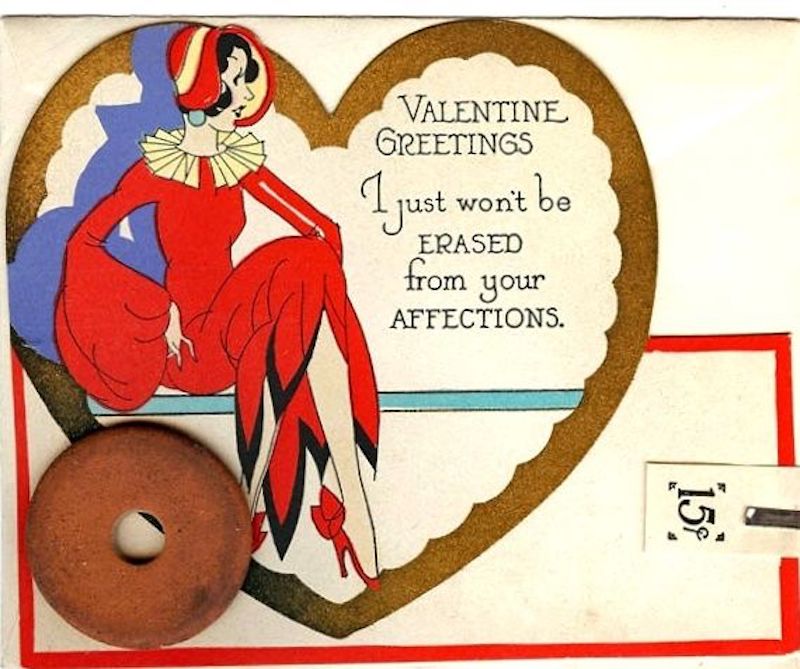
However, Rosenberg said that today’s concept of a romantic Valentine’s Day gained currency among average folk due largely to one thing: “The invention of wood pulp paper.”

While Johannes Gutenberg is credited with inventing the printing press in 1436, the 1840 discovery of the manufacture of wood pulp made printed products much more affordable.   

“That meant you could mass print these fun little cards,” Rosenberg said, “and your average person could often afford them.” 

Almost two centuries later, cards and chocolates continue to play a big part in marking the day, traditions that have held steady for well over a century. And for those with more expendable income, jewelry, flowers, dinner and dancing also rounded out the celebration.

The Salt Lake Tribune’s February 15, 1923 society page featured news of a Valentine’s Day dance for more than 200 guests hosted by Mr. and Mrs. D.C. Turner at the Newhouse Hotel. 

That same year, florists vied for customers with newspaper ads. The Miller Floral Co. touted its artistic arrangements and prompt deliveries, while Huddart Floral Co. suggested that bright and fragrant spring flowers were the best way to express the “charming spirit” of the day. 

Huddart also offered out-of-town telegraph service, a feature that became obsolete as faster forms of communication evolved.

But the Great Depression of 1929 hit the U.S. hard, spanning the next decade. So store-bought flowers became frills that few could afford. 

But inexpensive homemade messages still provided a way to convey love. In February 1930, The Salt Lake Tribune published instructions on how to make a nifty Valentine’s Day calendar. 

And there is also anecdotal evidence that schoolchildren exchanged notes and sweets in the 1930s. Born in 1923, my mother-in-law Renate’ McKitrick fondly remembered the thrill of cards filling her homemade Valentine’s box at Nora Elementary School near Indianapolis, IN. She also reminisced about the boy who gave her a substantial box of chocolates. 

“The Depression’s effect, in general, followed the broad pattern that on the one hand people were broke, but on the other hand things like cards and a little bit of chocolate were pretty cheap,” Rosenberg said. “People could write a pretty verse on a scrap of paper, or find some flowers.”

By 1939, World War II began, finally concluding in May 1945. 
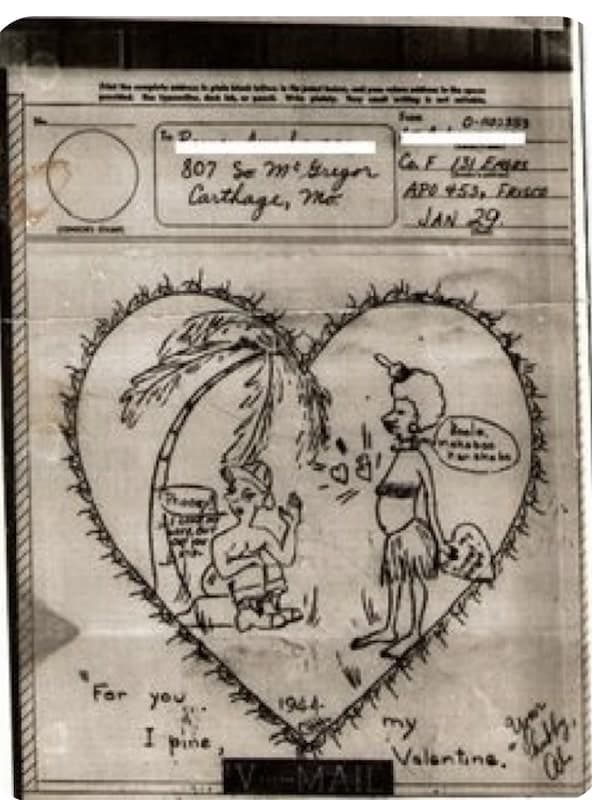
West Jordan resident Sherri Park shared a Victory Mail Valentine that her father Al stationed in the Philippines sent to her mother Rachel in 1944, saying he pined for his Valentine. 

Park acknowledged that her parents later divorced after 40 years, and “it wasn’t a great romance.” But in early 1944, the very thought of getting home to his wife helped bolster the lonely soldier’s morale.

As a special education teacher in Sandy during the late 1980s and 1990s, Park remembers the school Valentine exchange being a big deal.

“Each child had a box and they all got valentines,” Park said, adding that candy might be included as well.

For whatever reason, Valentine’s Day continues to gain popularity,  providing almost everybody with a much needed boost. 

“In the last few generations, Valentine’s Day has gone global,” USU’s Rosenberg said. “It’s about romance and having fun ― and an excuse to eat chocolate. Everybody loves it.”

Subscribe to Utah Stories weekly newsletter and get our stories directly to your inbox

* indicates required


,


Join our newsletter.
Stay informed.


  • From Immigrant Miner to U.S. Senator: The Rise of Thomas Kearns in Park City

    In June of 1883, 21-year-old Thomas Kearns arrived in Park City with little to his name and no guarantee of success. Like many young men drawn to the mining camps of the West, he was poor, ambitious, and willing to take whatever work he could find. After months of grueling labor underground as a mucker in the Ontario Mine, Kearns distinguished himself through persistence and curiosity, spending his evenings studying manuscripts on mining and land rights long after his shifts ended.

    That quiet discipline soon changed his fortunes. A chance observation while tunneling led Kearns and a small group of partners to lease nearby claims, uncovering one of the most productive silver deposits in Utah history. In less than a decade, the immigrant laborer had become a millionaire and a central figure in Park City’s economy, setting in motion a rise that would carry him far beyond the mines.

    To access this post, you must purchase Utah Stories (Digital + Print) or 3 month free trial (Digital).


  • Why Price, Utah, Needed a Rock and Fossil Shop

    After years in Salt Lake City and an interlude in Oregon, Kathie Chadbourne settled on Price as the location for her new rock shop. The town appealed to her because of its strong ties to geology and archeology, and its place within the Dinosaur Diamond. At first, she wondered whether a shop like hers might already exist there.


  • Highway 6 and the Midland Trail: Utah’s Transcontinental Highway History

    From Price Canyon to Delta’s desert stretch, Utah played a central role in building the Midland Trail, one of America’s earliest transcontinental highways and the foundation of today’s Highway 6.


  • Whiskey, Bullets & a Buried Town: Archaeologists Reveal Alta’s Wild Past

    Before Alta was known for powder days and lift lines, it was a silver mining town clinging to the side of a narrow canyon. In the late 1800s, men lived at 8,000 feet, went underground each day, and endured winters that regularly buried buildings in snow. This past summer, that mining town resurfaced — literally — during construction at the Alta Ski Area.

    To understand what Alta really looked like, you don’t begin with legend. You begin with its trash — and this time, that happened almost by accident.

    Alta Ski Area was installing underground water reservoirs to support snowmaking. Because the project sits on Uinta-Wasatch-Cache National Forest land, an archaeologist was required to monitor the excavation. No one expected the trench to produce much.

    But, It did.

    Artifacts began surfacing almost immediately. Enough that the Forest Service contacted the Utah State Historic Preservation Office for help. Lexi Little, who coordinates the Utah Cultural Site Stewardship Program, helped mobilize nearly 30 volunteers to assist with what quickly became a focused two-week excavation.

    Winter deadlines were approaching. The pipes for the reservoirs had to go in the ground. There wasn’t time for a slow, extended dig.

    “It was two weeks of digging in the dirt and helping figure out exactly what we were looking at,” Little said.

    Most of the people screening soil weren’t professional archaeologists. They were trained stewards from around Utah — part of a statewide volunteer network that now approaches 500 people. They poured dirt through shaker screens, scanning for fragments that could piece together a town long buried.

    “Archaeology is human trash,” Little explained. “Archaeologists are very into trash.”

    Alta had left plenty behind.

    https://youtu.be/hzIHzx3OGoo?si=dKcl2CEz-t6FZzYw

    Victorian-style ceramics appeared first — the kind typically used in hotels. Medicine bottles followed. Ink bottles. Hand-blown glass. A porcelain doll’s foot surfaced from the soil, a small detail that shifted the mental image of the town. Families were here. Children were here. This wasn’t only a camp of miners.

    The bottles helped establish time. Manufacturing details — whether glass was hand-blown or mold-made, whether a maker’s mark appeared on the base — allowed archaeologists to date many of the artifacts to the 1870s through the 1890s, when Alta was booming as a silver mining town.

    “That gives you that range of dates for when Alta was really booming,” Little said.

    One reusable soda bottle clearly stamped “Salt Lake City” connected the canyon to the valley economy below.

    Then something unusual rolled out of a dirt pile.

    A corked bottle. Intact. Liquid still inside.

    To access this post, you must purchase Utah Stories (Digital + Print) or 3 month free trial (Digital).