Utah Homeless

The Utah Homeless Conundrum: Salt Lake’s Unsheltered Not Able to Find Shelter while Winter Is Approaching

Driving around Salt Lake on a cold day I witnessed a series of desperate situations of unsheltered communities in peril.

|


There is a false dichotomy: downtown Salt Lake City residents cannot be both compassionate for the homeless and compassionate to business owners and residents.

Downtown Salt Lake City October 26th —Witnessing first-hand the temperature drop below freezing along with Salt Lake City Police’s futile tug-of-war against the Salt Lake City homeless community was something akin to watching the SS operate in their “jack-boot” squads. As the reality was setting in for the unsheltered that they would be braving a snowstorm outside in the cold, it was clear many were feeling desperate. Police/homeless encounters were happening all over downtown. 

Driving around I witnessed a series of desperate situations of a community in peril. One woman named Rachel, who appeared to be suffering likely from mental illness and/or drug addiction, was handcuffed and then released by SLCPD. Her wrists were swollen and red. “They don’t give a f***!” she repeated.  I brought her a simple lunch from Maverick, she waited for me sitting and crying muttering incoherent words.
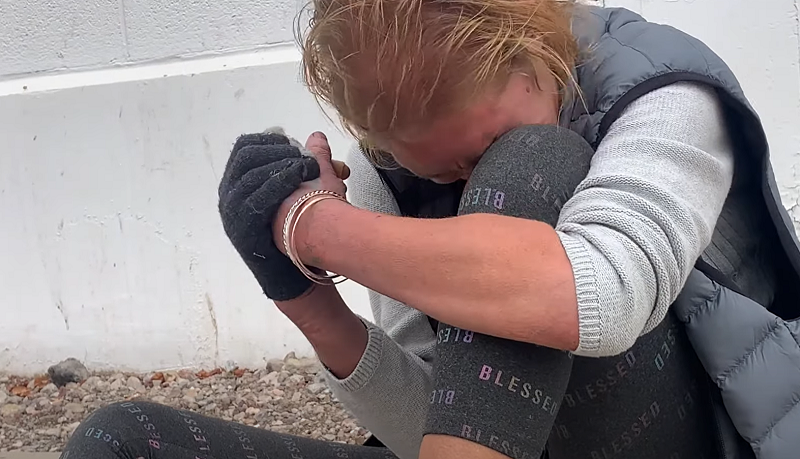
Rachel, a Salt Lake unsheltered woman distressed after her encounter with the police.

I drove on to the backside of the Rio Grande train station. A group of unsheltered men in a small homeless camp was starting to move carts and belongings around. When I approached they were negotiating a deal for a shopping cart full of dismembered bicycle parts. “$30 is a great deal for all of this!” They stopped when I asked them where they planned on going.

“I have no idea. There is no plan. We would like to stay here. This is where the services are.” said John with clear eyes and currently sober. His hands were incredibly large and dirty. He later told me he was working with copper wire the night before.

They were told by SLCPD that they needed to move or have their belongings thrown away. “You are lucky to get away with the backpack on your back.”
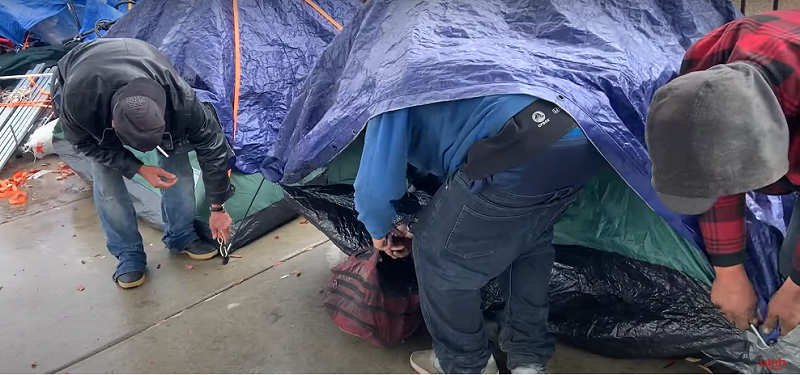
A group of unsheltered men in Salt Lake forced to move their camp in inclement weather.

The men were located in the most logical area, near where they can get meals and showers, out of the way of the general population— near the Weigand Center and Saint Vincent’s Dining Hall. The entire scene appeared just cruel as the police approached to tell them for the last time that they needed to go while nowflakes and temperature were falling. “Just when we think we can start settling in they just come in and push us back down.” 

John told me he became homeless after he lost his job at Big-D Construction. This happened after his truck and all of his tools were stolen about eighteen months ago. “After my entire livelihood was gone, and I lost my apartment, I just became depressed, and I couldn’t get out of bed.” 

The understaffed SLCPD force has been given a terrible mandate: make those who are suffering, suffer even more. 

Driving along 300 West out in front of the Salt Lake City Mission, two unsheltered homeless couples were fighting for space to camp where they could remain dry. The situation is dire for one simple reason: there is no secure place for hundreds, possibly up to 1,000 unsheltered people in Salt Lake City to stay warm. 

If these people were a wave of Ukrainian refugees, we would put up FEMA tents and call in the National Guard and step in with food and a call for volunteers. However, because these are unsheltered homeless, many with drug addictions; many with psychological disorders; some who are recently homeless, priced out of the housing; some who are drug and sex traffickers– this is all somehow a new normal. We are more accepting of this because many larger cities have it even far worse than Salt Lake City. Still, we could be doing far better.

Why isn’t there a sanctioned campground? Why isn’t a new shelter, or even just a big camping area with security allowed? Because there is currently a stand-off between Wasatch Front Cities (Utah) and Salt Lake City leaders. Salt Lake City placed a moratorium on building any new shelters in the city. Utah leaders don’t want to step up because the shelters and the homeless resource providers keep asking for more money while offering little to no accountability for the money already provided. Those who have shown greater compassion to help the homeless have essentially been punished for their generosity. 

“[Homelessness] isn’t just Salt Lake City’s problem, this is Utah’s problem. Cities and residents all over Utah need to step up,” said James Behunin, Executive Director of the Pioneer Park Coalition. 

Part two coming soon.

RELATED CONTENT

Why More Homeless Spending Is Resulting in More Homeless People

Releasing Murderers in Utah Needs to Stop, Says Danielle Ahn

The $300 Million Utah Homeless Question

Utah’s Scary Housing Market

Rampant Crime is Forcing Residents to Leave Ballpark Neighborhood in Salt Lake City

SUPPORT LOCAL JOURNALISM AND SUBSCRIBE TO PRINT MAGAZINE


Subscribe to Utah Stories weekly newsletter and get our stories directly to your inbox

* indicates required


,


Join our newsletter.
Stay informed.


  • Whiskey, Bullets & a Buried Town: Archaeologists Reveal Alta’s Wild Past

    Before Alta was known for powder days and lift lines, it was a silver mining town clinging to the side of a narrow canyon. In the late 1800s, men lived at 8,000 feet, went underground each day, and endured winters that regularly buried buildings in snow. This past summer, that mining town resurfaced — literally — during construction at the Alta Ski Area.

    To understand what Alta really looked like, you don’t begin with legend. You begin with its trash — and this time, that happened almost by accident.

    Alta Ski Area was installing underground water reservoirs to support snowmaking. Because the project sits on Uinta-Wasatch-Cache National Forest land, an archaeologist was required to monitor the excavation. No one expected the trench to produce much.

    But, It did.

    Artifacts began surfacing almost immediately. Enough that the Forest Service contacted the Utah State Historic Preservation Office for help. Lexi Little, who coordinates the Utah Cultural Site Stewardship Program, helped mobilize nearly 30 volunteers to assist with what quickly became a focused two-week excavation.

    Winter deadlines were approaching. The pipes for the reservoirs had to go in the ground. There wasn’t time for a slow, extended dig.

    “It was two weeks of digging in the dirt and helping figure out exactly what we were looking at,” Little said.

    Most of the people screening soil weren’t professional archaeologists. They were trained stewards from around Utah — part of a statewide volunteer network that now approaches 500 people. They poured dirt through shaker screens, scanning for fragments that could piece together a town long buried.

    “Archaeology is human trash,” Little explained. “Archaeologists are very into trash.”

    Alta had left plenty behind.

    https://youtu.be/hzIHzx3OGoo?si=dKcl2CEz-t6FZzYw

    Victorian-style ceramics appeared first — the kind typically used in hotels. Medicine bottles followed. Ink bottles. Hand-blown glass. A porcelain doll’s foot surfaced from the soil, a small detail that shifted the mental image of the town. Families were here. Children were here. This wasn’t only a camp of miners.

    The bottles helped establish time. Manufacturing details — whether glass was hand-blown or mold-made, whether a maker’s mark appeared on the base — allowed archaeologists to date many of the artifacts to the 1870s through the 1890s, when Alta was booming as a silver mining town.

    “That gives you that range of dates for when Alta was really booming,” Little said.

    One reusable soda bottle clearly stamped “Salt Lake City” connected the canyon to the valley economy below.

    Then something unusual rolled out of a dirt pile.

    A corked bottle. Intact. Liquid still inside.

    Continue reading and support independent Utah journalism with a purchase of Utah Stories (Digital + Print) or 3 month free trial (Digital).


  • The Only Full Bottle of Alcohol Ever Found in Utah Was Unearthed in Alta

    When a backhoe rolled a corked bottle out of the dirt at Alta this summer, no one immediately grasped what they were holding. It wasn’t empty. It wasn’t shattered. It was full. “The bottle that was discovered up at Alta is the only bottle of alcohol ever discovered in an archaeological excavation in the state…


  • How Horses Help Kids Heal: Inside Utah’s Equine Therapy World

    Kelty Johnson trains horses for a living, but her deeper work happens in the quiet space between animal and human. On the Utah Stories podcast, she explains how equine therapy helps children regulate emotions, build confidence, and reconnect through presence rather than pressure.


  • Angela Brown: The Woman Behind SLUG Magazine and Craft Lake City

    Angela Brown is the publisher and owner of SLUG Magazine, one of the city’s longest-running independent publications and a central voice in Utah’s alternative arts and music scene. She is also the founder of Craft Lake City, a nonprofit that has grown into one of the state’s largest platforms for local makers and creative entrepreneurs.