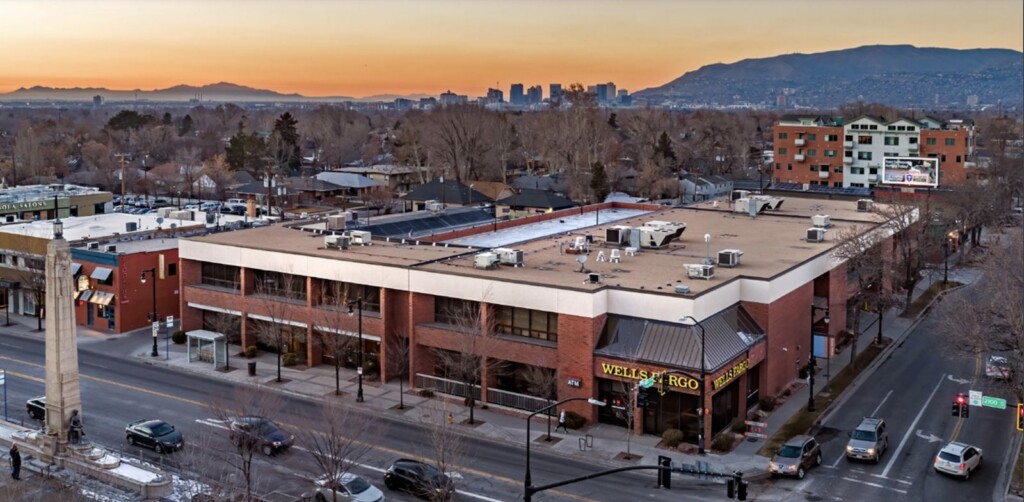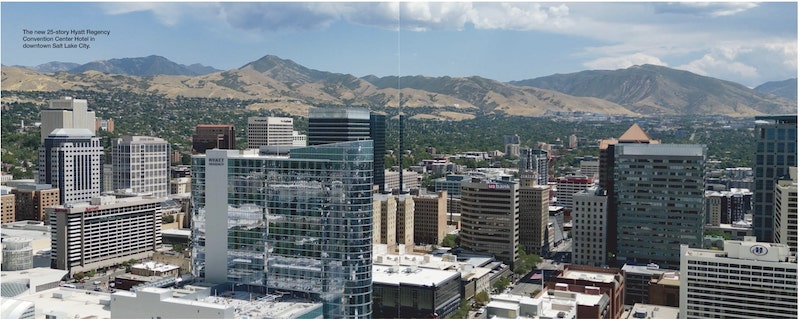
Downtown Salt Lake City — The new Hyatt Regency has become a new crown jewel of Salt Lake City, resting beside the Salt Palace Convention Center. A block to the east, on Main Street, the former Pantages Theater has been sadly demolished. Soon to be rising in its place will be a 45-story luxury apartment tower funded by the Hines Corporation ― which has just over $90 billion in their real estate portfolio. The tower will be across the street from Salt Lake’s Eccles Theater, where Goldman Sachs and JP Morgan Chase, KeyBank, and Wells Fargo occupy substantial real estate, all surrounding the glorious City Creek Center Mall featuring Tiffany and Michael Kors.
For now, I won’t point out the obvious: Going into our next recession cycle with so much of Salt Lake City’s tax revenue and economy shackled to Wall Street Corporations is like a very pleasant voyage on the Titanic: we know it’s going down; it’s filling with water fast, but aren’t the finger sandwiches delicious? And isn’t the violin concerto so nice?
Amy Leininger is the entrepreneurial owner of Ruin Bar. The Leiniger’s made a substantial bet to relocate their bar from Sugar House to Main Street. Leininger loves walking to Main Street everyday to operate her business. From BBQ joints to ad agencies to boutiques and markets, Amy and her husband Rheda have been downtown business owners for the past 15 years.
Regarding Main Street changes, Leininger says: “I’m sad to see the Pantages Theater go. I wish the history could have been saved,” but she adds,” I’m excited about the new dynamic the Hines tower will bring to this side of Main Street. We can’t be curmudgeons; we need to evolve and to accept the changes.”
Across from Ruin is Boomerang’s Downunder Bar, where drinks are a bit cheaper and appeal to young partiers. Jacqueline Joseph, along with her boyfriend, run a bar downstairs and a nightclub upstairs. With summer gone, I ask Joseph how they liked the concept of keeping Main Street closed to cars over the weekend, which is in its second year.
“We loved open streets. It was great for business. It’s an awesome idea. They should just go for it and close Main Street to cars all the time,” said Joseph. Downunder says they likely have until March to find a new building, as their building will likely be also sold as part of the Heinz tower development. The small buildings are getting demolished and 40-story residential towers are moving in. Downtown is quickly becoming a place for urban residents.
But as this evolution occurs, the question remains: is downtown transforming to the needs and desires of residents or to the desires of city planners?
Salt Lake City Planning Director Nick Norris says that all of downtown will experience huge changes as Salt Lake begins to adopt a much more bike-friendly, pedestrian-friendly high-density urban model. The biggest change reflecting this transformation is around lower 9th, where the entire three blocks have been gutted all summer for residential buildings, mixed use, and a major bike corridor. Along 300 West, a wide bike lane lined with trees travels south to Home Depot.
“We are changing the form of the area to match the new residential usage,” Norris says.
He says that the initiative is to make Salt Lake City more bike-friendly so that residents choose to make more trips using clean 30-pound bicycles rather than dirty 2,000-pound cars. It makes sense, especially considering that Salt Lake City’s air quality is horrible in the winter. But whether or not residents will buy in, or believe that cycling is “great for everyone else ― just not me,” remains to be seen.
Still, downtown and Main Street have some major issues. Mainly, winter is coming soon with a huge number of unsheltered homeless. The current plan is to “flex” all of the homeless resource centers, thereby increasing capacity. In doing so, the city is breaking a promise to every neighborhood that accepts homeless resource centers.
Residents and business owners are feeling the stress of the city’s absence of a better plan ― the city needs more shelter space, more beds, more services, and their only plans are to again use the Ramada Inn and likely to purchase yet another airport hotel and expand the homeless voucher and overflow programs.
Amy J. Hawkins is the Chairwoman of the Ballpark Neighborhood Community Council. She believes the Homeless Resource Centers have failed both the homeless population and the residents. The crime rate, the murders and the drug and sex trafficking are all indicative that the current homeless policy is failing. She adds that demolishing the Road Home after mismanagement, then using the same group who failed to manage the former Road Home to manage the new resource centers made no sense.
The good news on the affordable-housing front is the approval of the Other Side Village, where the Salt Lake City Council has approved the plans to build 58 deeply affordable housing units on eight out of potentially forty acres. This will be just a small drop in the bucket to start, but the Other Side Academy peer-support model (rather than heavy reliance on case workers) has proven to be a success in truly transforming the lives of former felons, drug addicts and alcoholics. But it’s clear more transformational help is desperately needed.
Main Street, Salt Lake City’s housing, SLC’s economy, and future should include all residents, including the lower class. Why? Even from a highly pragmatic, economic sense, there is a very good reason why.
We are currently facing a massive labor shortage. If all unsheltered homeless were placed into ideal conditions, many of them would be smart, skilled and educated enough to fill the current job openings. An unsheltered homeless man who we will call John told me, “While just a small few might make us look bad, there are skilled mechanics out here, and people with degrees. But they have got to stop just pushing us down. Give us a real chance and we can get off the streets.”
The scene is tragic like this can’t be the same Salt Lake City with its ritzy new apartments and hotels, and the fancy headquarters of the LDS Church, but it is like so many other boom cities where we find both the best of times and the worst of times.
RELATED CONTENT
Homeless Victimized By Criminals at Gail Miller Shelter
Utah’s Main Street Program to Boost Local Economies
Getting Better Handle on Salt Lake’s Unsheltered Population
Are Salt Lake Homeless Resource Centers a Failure for the Neighborhoods that Welcomed Them?
Body Found in South Jordan Along Jordan River Parkway Trail

SUPPORT LOCAL JOURNALISM AND SUBSCRIBE TO PRINT MAGAZINE
Subscribe to Utah Stories weekly newsletter and get our stories directly to your inbox