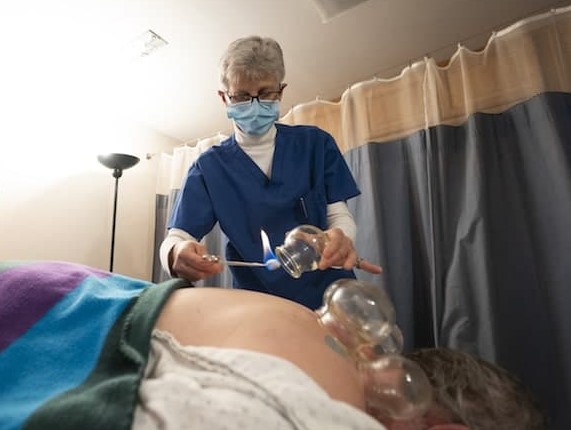
Pins and needles may be the most common perception many people have about acupuncture. But this ancient Chinese practice of healing has a fascinating history and philosophy.
Acupuncture is the practice of penetrating the skin with thin, metallic needles which are then activated through specific gentle movements of the practitioner’s hands.
According to John Hopkins Medicine, “Traditional Chinese medicine practitioners believe the human body has more than 2,000 acupuncture points connected by pathways or meridians. These pathways create an energy flow (Qi, pronounced “chee”) through the body that is responsible for overall health. Disruption of the energy flow can cause disease. By applying acupuncture to certain points, it is thought to improve the flow of Qi, thereby improving health.”
Dr. Kris Justesen, director of Alpine Wellness Center, is an Oriental Medical Doctor (O.M.D.) and a Board Certified Licensed Acupuncturist (L.Ac.) who has practiced for more than 33 years. “We approach a patient the same as any other health care provider,” says Justesen. “We’ll get a medical history on you and then find out when the pain started, how long it has been, how it manifests, is it sharp, dull, achy, or electric?”
Acupuncture therapy is comprehensive. “We deal with the organs and the body, the spirit, and life, plus the muscles and the meridians, tendons, and sinews. We deal with the whole system, the whole being.”
Justesen moved to California to go to chiropractic college. She wanted to become a chiropractor after she had a back injury that was helped by a chiropractor and was able to avoid surgery. While coaching a softball team, a player asked her if she had considered acupuncture school. “I just laughed and said I didn’t even know what that was. She then gave me a brief synopsis of what acupuncture is.”
Justesen eventually decided to give it a try. “They had a very extensive program. I got into two classes and thought it was the hokiest damn thing I had ever done. They were talking about putting a point here and it does this to your body and another point here that does something else.”
Not being a quitter, she decided to finish the classes before dropping out. In the meantime she injured her back and/or neck moving concrete blocks. “To this day I don’t know what I injured,” says Justesen. She was prescribed pain medication and muscle relaxers. “I’m not going to take pain medication for this,” she said.
When she went to class, she tucked her hand in her belt for a makeshift sling since it hurt to dangle her arm. A fellow student told her she could get acupuncture treatments for free.
“I got a very strong treatment,” says Justesen, “They put a needle in my leg and had me raise my arm. I had not been able to move my arm or shoulder at all. I said, ‘I can’t, I can’t.’ The therapist said, ‘just try.’ In the meantime he was torturing this point in my leg. I started to raise my arm. Oh my God, it was moving!”
After the second strong treatment she had full range of motion. “I still had pain in my shoulder and my neck,” says Justesen, “but I got my movement back which meant I could go back to work.”
Realizing there is something to this ancient medical art, she decided to pay a little closer attention. “That was a turning point for me to stay in it,” she says. “It’s what got me into it purely by accident, because it was an accident.”
In her decades as a practitioner, Justesen has seen acupuncture acceptance become more widespread. Chronic pain, lower back pain, migraines, fibromyalgia, and carpal tunnel syndrome are just a few conditions that have been helped with acupuncture.
If you’re considering acupuncture, look for a board-certified licensed acupuncturist. Pins and needles might be just what you need.
Alpine Wellness Center is located at 1664 Dawn Drive, Cottonwood Heights. (801) 263-9380
RELATED CONTENT
Utah Guru of Home Organization: Declutter Your Home for a Healthier Mind
The Power of Meditation and Overcoming the Impossible