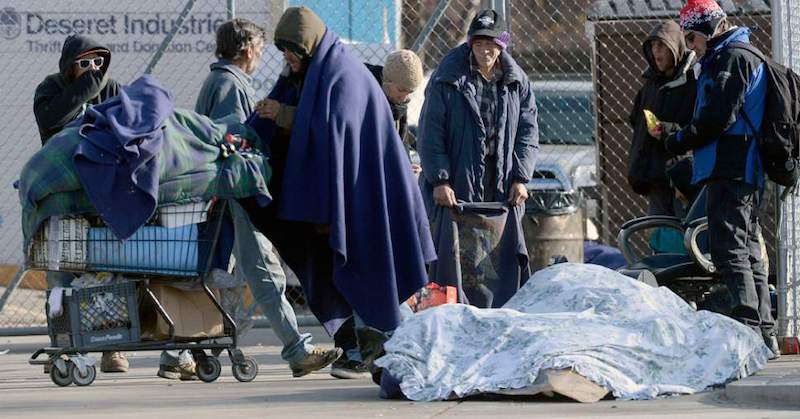
That special season has arrived with its twinkling lights, decked-out trees and holiday carols wafting through the air. But for Utah’s unsheltered population, this time of year means extra pain and suffering ― or worse
Wayne Niederhauser stepped into the new role of Utah Homeless Services Coordinator in mid-April. His concern as winter weather closes in is fairly simple, that “someone wouldn’t be able to get to a warm place when it was absolutely necessary. Then you have somebody having a severe health situation or even passing away.”
A special “Point In Time” count ― a snapshot conducted September 10, 2021 in Salt Lake, Weber, Carbon-Emery and Iron Counties ― found 2,410 sheltered individuals and 1,155 unsheltered, according to Utah’s 2021 Homelessness Report.
Niederhauser views homelessness as a statewide issue, but said central cities bear the brunt of the problem, especially Salt Lake City, Ogden and St. George. “We have providers in all parts of the state. There is so much good that’s being done,” Niederhauser said. “But the challenge is that a lot of it hasn’t been coordinated, especially on a state level.”
Neiderhauser noted that lack of affordable housing and increased evictions have contributed to a bottleneck in the shelter system, where individuals end up staying longer before permanent housing opens up. As of mid-November, Salt Lake City shelters had hit capacity and the Salt Lake Valley Coalition to End Homelessness had yet to nail down overflow facilities that could provide havens from upcoming wintery blasts. “Unfortunately it seems to always come down to the last minute, making it all happen,” Niederhauser said.
But by Nov. 16 ― as temperatures dropped below freezing ― the Salt Lake Valley Coalition to End Homelessness announced selection of the Ramada Inn at 1659 W North Temple for use as an overflow shelter, which the Salt Lake City Council approved in a 5-2 vote.
It has been widely reported that Salt Lake City’s elected officials had tired of carrying the bulk of this widespread burden and had hoped neighboring cities would step up.
Several nonprofits help fill gaps in the system, among them Unsheltered Utah, which organized last December to help address immediate needs of the unsheltered population along the Wasatch Front. Loni Newby and Nathan Kizerian serve on the board of directors for the nonprofit. “It’s playing chicken with people’s lives,” Newby said of the yet-to-be-determined overflow facilities in Salt Lake City. “At this point there has to be an option, a place people can use as a warming center.” Unsheltered Utah accepts donations of nonperishable food items, such as easy-open canned food that can serve as a meal. Coats, gloves, hats, scarves, shoes, boots and socks also rank high on their list, as well as hand-warmers, small tents, and sleeping bags rated for under 30 degrees. Cash donations also help. “We’ve seen people come up and ask if we have any garbage bags,” Kizerian said of another valued donation. “One lady said, “This is where we live, it’s our home, why should we trash it?’”
The first and third Sundays of each month, Unsheltered Utah delivers donations and a hot meal to homeless individuals in the Salt Lake area, and the third Sunday is spent in Ogden, Newby said. Homemade chicken noodle soup is KIzerian’s favorite contribution: “We just ladle it out of a big stockpot. I’m excited for soup season.” Newby applauded Utah families who step up and provide special fare during the season. “There are a lot of small acts of service that will happen from Thanksgiving through Christmas,” Newby said. “There will be families who drop off pizzas, families that do their own personal coat drive or hat drive or scarf drive or sock drive.” But she encouraged them to consider working with Unsheltered Utah on a regular basis, “because the needs continue after the holidays end.”
At Ogden’s Lantern House shelter, Community Outreach Director Stacey Gallegos said they will find a place to sleep anyone who comes their way this winter. They average over 200 per night, she added. Lantern House also accepts Covid positive clients, housing them in their family wing. In the meantime, its sheltered families have been moved to hotels. The only individuals not welcomed are those who received a one-year ban because they made significant threats against either a staff member or client, Gallegos said, adding that, “We have rules and expect everybody to follow them.” The Lantern House gets festive each Christmas, with their board of directors serving dinner and residents receiving small gifts.
And after suspending its long-standing holiday celebration for homeless individuals and low-income clients during last year’s Covid threat, the Weber County Main Library has reinstated the event for the afternoon of December 24. Library Director Lynnda Wangsgard said they’re planning a socially distanced gathering with food, drink, music and special games for the kids. “We typically have 300 to 400 people drop by,” Wangsgard said. “We’re still a haven for the homeless population in the winter,” even though 2020 stood out as an anomaly.
MORE ON HOMELESS PROBLEM IN UTAH
An Alternative Salt Lake Homeless Solution: Switchpoint May Be the Answer
Homeless Policies in Salt Lake City: Paying off? Or an Endless Money Pit?
Six Years of Failed Homeless Policy in Salt Lake City
No Hiding the Homeless: Pandemic pulls back the curtain on SLC homelessness