Gardening & Farms

Down on the [Urban] Farm: A Visit With Frog Bench Farms

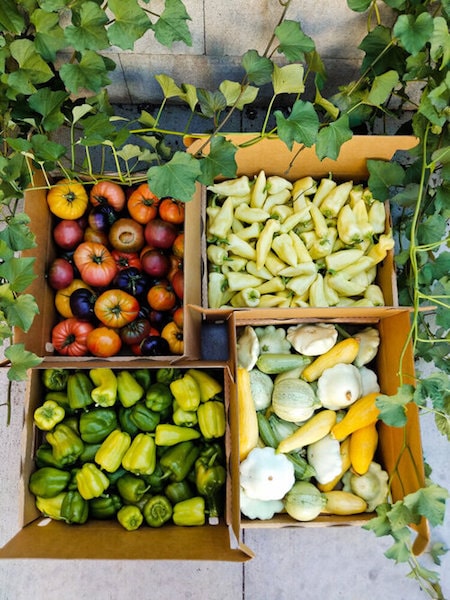
Tucked away on a quiet, residential street in a neighborhood near Foothill Boulevard is an urban farm that supplies produce, cut flowers, microgreens, and more to many of our area’s finest restaurants. It’s called Frog Bench Farms. 

|


Joe and Paula Sargetakis owners of Frog Bench Farms.

You could drive right past it a dozen times and not even know it’s there. But tucked away on a quiet, residential street in a neighborhood near Foothill Boulevard is an urban farm that supplies produce, cut flowers, microgreens, and more to many of our area’s finest restaurants. It’s called Frog Bench Farms

Nearly 10-years-old now, Frog Bench Farms was created in 2012 by Paula and Joe Sargetakis. Prior to that, the couple had been co-owners of a Napa Valley winery. I recently chatted with Joe and Paula about urban farming, amateur gardening, supplying restaurants with boutique produce, and where the name “Frog Bench” came from. 

TS: As former winery owners, are there a lot of similarities to growing wine grapes and growing produce on a farm or is it apples to oranges, so to speak?

Paula: I would say it’s apples to oranges in the sense that if you plant a fruit tree or vine, they just stay there and do their thing year after year. Whereas the majority of what we grow is not perennial. So you’re always maintaining; you’re always harvesting, and then rotating into your next crop there’s constant change.

Joe: Grapevines don’t require as much attention. You’re working a couple of hours every couple of weeks for the most part on the vines. I would say gardening is much more labor intensive and attention intensive.

TS:  When most people think of farming, they think of rural locations. How or why did you choose to put your farm in the middle of an urban neighborhood?

Paula: I remember us talking at my great grandmother’s house on 7th East about how years ago neighbors would all share produce. Some people could grow tomatoes; others would grow cucumbers, and they would share them. But today most people in Utah can’t walk to a grocery store that sells fresh local produce. So it struck me that we needed that in our society and in our community. So we started looking for a spot for an urban farm and we wanted it to be next to a school so that the kids could see where their food comes from. 
TS: What sort of challenges has the pandemic presented to you during the past year or so? 

Paula: Well, business-wise we lost 100 percent of our business in 24 hours, so that sucked. [Laughing] But with restaurants closed we did a pivot and started selling to the public and they have been amazingly supportive. We’ve been really blessed how well things have gone for us.

Joe: We said to our staff, ‘We will keep you employed; we will figure out a way.’ So we got some PPP funds and were able to access some County funds and were able to pay our bills and keep our staff working and now, finally, we’re starting to see some movement again on the restaurant side. It’s been great though our quasi-CSA Public Pick Up Program because people are so appreciative to be able to have really fresh, local produce. They can sign up to get a text once a week from us telling them what we have available and if they want anything they just text us back. It’s really been wonderful, and once COVID is just a bad memory, we’ll still do it; it’s fun to get out of the garden and meet retail customers. 
TS: I know this is a Sophie’s Choice type of question. But, do you have a favorite restaurant dish or two that utilizes Frog Bench Farms ingredients?

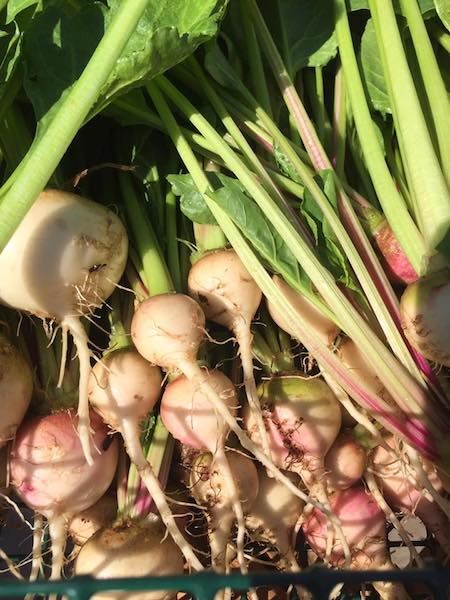
Joe: A couple of my favorites are at SLC Eatery. They take our Tokyo turnips and frost them with chunky peanut butter and miso sauce and we love it so much that now we emulate it at home. And then they do grilled calamari with popped rice that they use a number of our microgreens with, and that is an awesome dish. 

Paula: Microgreens are really underrated. People think they’re just a pretty little garnish, but many of them have very deep flavors, add quite a bit to a meal, and are nutritious as all get out. 

TS: You guys are pros. But what advice or tips do you have for amateur or beginner gardeners to share?

Paula: The first thing to do it to get your soil as healthy and nurtured as it can be, because it will save you time in the end, and whatever you’re growing will be much happier and healthier. And then my second recommendation is just because someone says you can’t grow something, doesn’t mean you can’t. If you want to grow it, give it a try. Pick one thing that you like to eat and grow it in your yard and taste the difference from a store bought vegetable or fruit. And get kids involved in growing and eating fresh foods.  

Joe: And don’t believe that you can’t grow all winter long in Utah. We grow lettuce, spinach, turnips and such in January and February. We supply chefs with their favorite produce, microgreens and so on but basically, we grow what we like to eat. When we started the Farm we didn’t have any clients so we didn’t know what to grow. So we grew what we wanted to eat.  

TS: So now, the really big question: Where does the name Frog Bench Farms come from. 
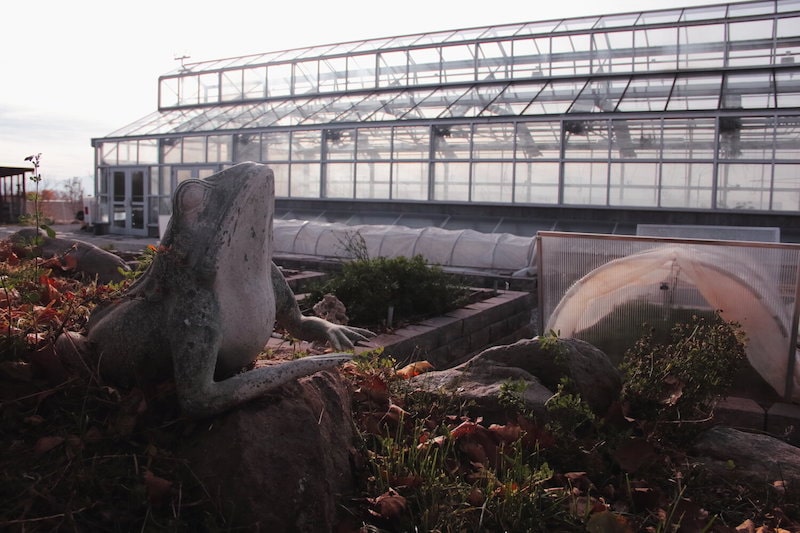
Paula: [Laughing] Well, for some reason my entire life I’ve loved frogs. I don’t know why. And, we’re located up on a bench. And it’s a farm. [More laughter]      

Local restaurants and businesses supplied by Frog Bench Farms include SLC Eatery, Pago, Table X, HSL, Oquirrh, Avenues Proper, Beltex Meats, Brickyard Bar, The Blended Table, Post Office Place, Provisions, Nohm, SLC Pop, Stratford Proper, Zest, Tulie Bakery, White Horse Spirits & Kitchen, and Trio.

Subscribe to Utah Stories weekly newsletter and get our stories directly to your inbox

* indicates required


, , ,


Join our newsletter.
Stay informed.


  • Riverbed Ranch Utah: Cult, Commune, or Utah’s First Modern Homesteading Town?

    Driving out past the town of Delta on a gravel road for a couple of hours, we almost turned around. Following a rain storm, the road is wet and muddy but still decent. Jesse Fisher is worried we’ll get stuck, but we plow through giant puddles of water, and as the clouds lift, we reach the homestead community of Riverbed Ranch, consisting of 1250 acres of reclaimed desert.

    Almost like an oasis, Riverbed Ranch is home to 40 families who decided to depart city life, municipal taxes, congestion, air, light and sound pollution, and live in a place among chickens, goats and cows on self-reliant homesteads. 

    Describing Riverbed Ranch as “bucolic” would be inaccurate at this point. Sometimes there are purple flowers in the valley, but currently it is a desert — still beautiful, but most of the properties in the sprawling valley are still works-in-progress. But the scale of the valley and witnessing in person the first brand new town to break ground in Utah in 75 years is quite remarkable. 

    A few of the 2.5 acre plots consist of a trailer and a fence. Some plots have nice little homes that appear very homemade; others have more complete homes with nice fencing, with nicely organized pens for different animals, orchards and organization. 

    Some homes under construction even appear upscale and modern, where the inhabitants are indeed living as modern homesteaders, not seeking “luxury retreats” like so many other empty homes in Utah being built in hot tourist destinations such as Moab and Park City.

    We start by speaking with Tom and Kathy Barnes, whose homestead is a model for order and function. Turkeys walk around in their pen, excited for feeding time. Beside the turkey pen is another pen for chickens; one for goats, and another for pigs. All of the pens are connected to a large barn. By the look of their operation, the Barnes appear to be seasoned professionals.

    Indeed they are. Tom and Kathy raised their eight children “on a teacher’s salary,” homesteading in Payson, Utah on ten acres, reaching the point where the only store-bought items were toilet paper, shampoo, toothpaste and cashews. Most everything else, including fresh fruits, vegetables, milk and meat were raised themselves.

    Tom had just finished feeding his three hungry pigs when he took a moment to talk to me.

    “What are the advantages to living on a homestead?” I ask. 

    “Listen,” he says. “You can hear a pig eating … Once in a while we will hear a fighter jet pass over but that’s it.” 

    The Barnes are calm and content in their semi-retirement. They set up their homestead at Riverbed Ranch five years ago. They already knew homesteading and they realized even in retirement they could help the other inhabitants here, those with less experience, learn how to take on the demanding but satisfying lifestyle.

    “It’s basically like an extended family,” says Tom. “We are all like-minded out here. We are all going to help one another when our neighbors need help.”

    Tom says he and most of his neighbors are members of the LDS Church, and that most of the city’s LDS members are a part of a ward which makes up their “ward family.” “Out here,” he says, “everybody is our extended family. So we all know we are going to help one another and learn to get along … Like early pioneers in a small town. It’s very much the same thing.

    A wild goose chase?

    “We could live out here like it was 1849, but we have all of the conveniences of modern society, so why not take advantage of the best of both worlds?”

    I wonder how adaptable these modern pioneers are. Raised on a homestead, would these folks ever want to join the modern world again? The Barnes kids are mostly choosing city life, but their kids and grandkids love visiting them, running around free-range. Tom adds, “One of our sons is starting his own homestead in Piute County.”

    We drive around on the hard gravel roads and get a sense of how all of the residents here justify the hard-scrabble, off-grid life, which requires living off pumped well water, solar power for electricity, and propane for heat. 

    We are aiming to get a sense of the  bigger reason why all of these people are out here, far away from freeways and Walmarts. Are they all latter-day preppers?

    Continue reading and support independent Utah journalism with a purchase of Utah Stories (Digital + Print) or 3 month free trial (Digital).


  • How to Start a Garden in Utah: Advice from Local Gardening Experts

    Creating and maintaining a home garden can be a daunting task for beginners. Whether it’s vegetables or flowers you want, starting the journey can seem overwhelming. Kim Clark, co-owner at Lambert Growers, and Heidi Orme, a manager from Millcreek Gardens, give advice to first-time gardeners who are ready to get their green thumbs dirty.


  • Priced Out of Summer Fun? These Activities Cost Almost Nothing

    As summer approaches, many of us start looking for new ways to be active. Whether you’re emerging from a cozy winter of hibernation, or searching for a replacement for skiing and snowboarding, there are inexpensive and accessible ways to get outside, get active, and make the most of summer. 


  • Can Utah Farms Survive the Corporate Food System?

    Local farms and restaurants battle similar economic pressures as they struggle to survive in a tight economy where slim profit margins and increased labor costs and conditions are often beyond their control.