Beer Stories

Are Utah Breweries Transforming into Hard Seltzer Factories?

Craft seltzers have arrived in Salt Lake City. Several Utah breweries have added the fruity, bubbly beverages to their line-up.

|


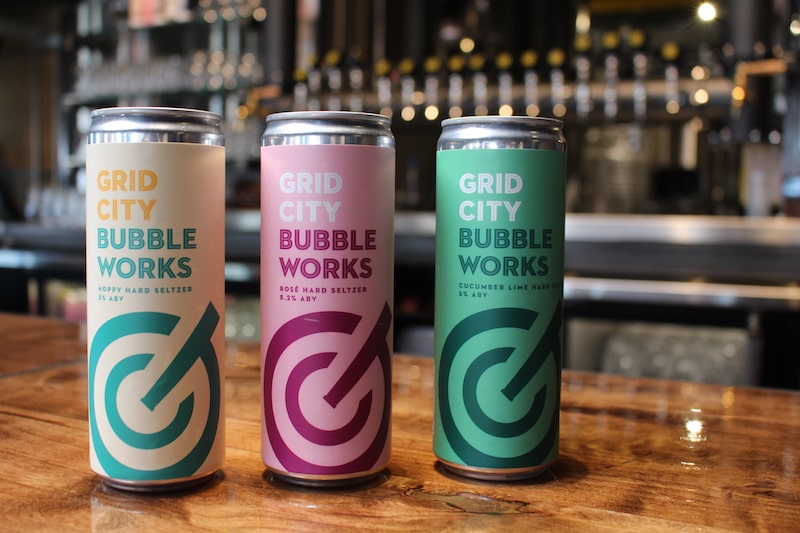
Grid City Beer Works has plans to expand its line-up of hard seltzers with more high-point varieties. Photo by Claire McArthur.

Move over White Claw — craft seltzers have arrived in Salt Lake City. Several Capitol City breweries have recently added the fruity, bubbly beverages to their line-up, joining the ever-growing hard seltzer market that continues to see enormous growth. 

“We tend to make unusual beverages, like crazy sours, so seltzers were definitely up our alley,” said Alexandra Ortiz de Fargher, who owns Shades Brewing with her husband, Trent Fargher. 

Shades launched their hard seltzer line, Livli, a year ago after their director of sales noticed restaurants and bars using half-cans of hard seltzers to mix cocktails and tossing the remainder. The raspberry seltzer was sold in kegs, but when the pandemic hit and buying a keg with a limited shelf life became a risk for businesses, they started canning the seltzer and added in new flavors such as pineapple mint and grapefruit to create a mixed pack. 

“The sales have exceeded our expectations,” said Ortiz de Fargher. After launching in Whole Foods and Harmons, Livli is set to arrive in other retailers this spring. 

It’s no surprise if you take a look at the national numbers. During a three-month period starting in March 2020, hard seltzers accumulated $1 billion in sales, according to data analytics company Nielson. By comparison, hard seltzer sales tallied $1.5 billion in all of 2019. Experts predict sales will continue their meteoric rise. 

New kid on the block, Grid City Beer Works, always had seltzers in the plan for the brewery and restaurant, but they took a backburner to opening the new establishment in March, mid-pandemic. 

“There’s a time and a place for an alternative to heavy beer for our palates, but we were underwhelmed by the seltzers that are out there,” said Justin Belliveau, founder of Grid City. 

Today the brewery has two low-ABV seltzers — cucumber lime and a beer-inspired variety made with mosaic hops. The 8.2% ABV rosé hard seltzer kicked off the line of higher-point bubblies that the brewery plans to expand, most recently with an 11.2% ABV seltzer naturally flavored with botanicals to resemble an aperol spritz (sans any actual aperitif). 

But what is it about making hard seltzers that has craft brewers jumping on board? For one, creating the beverage is not as far-off from making beer as one might think — and it requires the same equipment. 

“Rather than using grain like in beer, it starts with creating a mash — a fermentable base — using water and corn sugar and adding any other flavorings to it along the way,” explained Belliveau. “We use a Sauvignon Blanc yeast that imparts a little bit of wine character and quality to the two [low-ABV] seltzers.” 

The rosé-flavored seltzer doesn’t have any actual wine in it, but contains an organic muscat grape juice and other fruits, such as prickly pear and grapefruit peel to create a beverage that drinks like a wine spritzer. 

Epic Brewing Company released its Pakkā hard seltzer line in April 2020 with four flavors brewed with real fruit, like grapefruit tangerine and cherry lime. With more breweries jumping on the seltzer bandwagon, it’s all about continuing to innovate, according to Gus Erickson, marketing specialist with Epic. 

The company has since released a hard coconut water as well as a hard green tea and black tea. 

“We’re always looking ahead,” said Erickson.

Subscribe to Utah Stories weekly newsletter and get our stories directly to your inbox

* indicates required


, ,

Join our newsletter.
Stay informed.


  • Utah Craft Whiskey: How Barrels and Utah’s Climate Shape Flavor

    Utah’s craft whiskey scene is shaped by more than grain, yeast, and time. The state’s dry climate plays an unusually powerful role in how spirits age, intensifying the relationship between whiskey and the barrels that hold it.

    Low humidity accelerates evaporation during aging, often claiming 14–18 percent of a barrel’s contents as the “angel’s share.” Unlike more humid regions where alcohol evaporates faster, Utah barrels tend to lose more water, concentrating flavor and driving proof upward over time. That accelerated interaction pulls sugars, tannins, and spice from the wood more quickly, creating whiskeys that often taste older and more structured than their age statements suggest.

    To understand how Utah distillers are deliberately harnessing climate, char, and finishing barrels to shape flavor, two producers at the forefront of that experimentation — Sugar House Distillery and Spirits of the Wasatch — shared how barrel choices influence everything from sweetness and spice to texture and proof.

    *The remainder of this article is available to Utah Stories subscribers and includes in-depth reporting from Utah distillers on barrel selection, aging techniques, and experimental finishes.

    To access this post, you must purchase Utah Stories (Digital + Print) or 3 month free trial (Digital).


  • Sugar House Businesses Recover After Prolonged Road Construction

    For nearly two years, construction along 2100 South reshaped daily life in Sugar House, testing the patience and resilience of local businesses. With roads and sidewalks finally reopened, owners are beginning to take stock of what was lost, what changed, and what recovery might actually look like.


  • Why Price, Utah, Needed a Rock and Fossil Shop

    After years in Salt Lake City and an interlude in Oregon, Kathie Chadbourne settled on Price as the location for her new rock shop. The town appealed to her because of its strong ties to geology and archeology, and its place within the Dinosaur Diamond. At first, she wondered whether a shop like hers might already exist there.


  • An Argentine Food Tradition Finds a Home in Sugar House

    In Sugar House, Maria Florencia Farr makes empanadas that carry more than filling. They carry memory. Each one recalls suburban Buenos Aires, where families gathered late at night and meals were unhurried, familiar, and shared.

    “In Argentina, dinner doesn’t happen at five,” she says. Empanadas were a constant in her childhood, as ordinary and dependable as cookies in an American home. Learning to seal them, shaping the distinctive repulgue by hand, marked a small but meaningful rite of passage.

    When Florencia moved to the United States 18 years ago, food became one of the clearest reminders of what she had left behind. She missed the everyday tastes of home and kept searching for them. Over time, that longing evolved into something larger, shaping the decision to build a place rooted in tradition, meant to be shared.

    The remainder of this story is available to subscribers.

    To access this post, you must purchase Utah Stories (Digital + Print) or 3 month free trial (Digital).