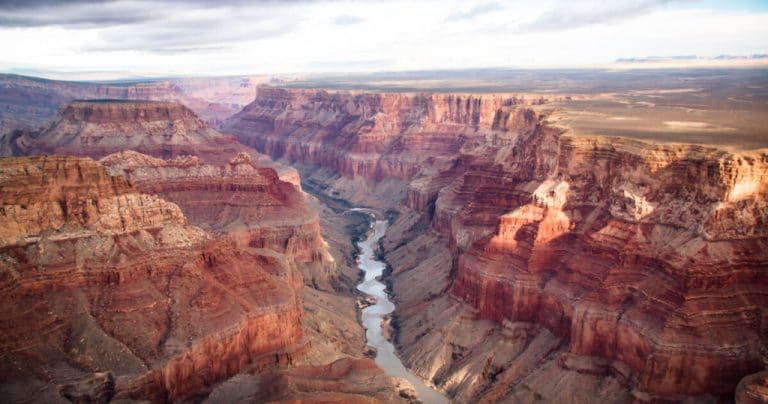
We are all standing over the Grand Canyon of political chasms. Two completely different landmasses are separating further and further and it seems that the distance apart is growing because neither of the two sides is on speaking terms, instead, they are speaking past each other.
While the mainstream media networks are the most obvious examples of these distancing lands, the polarization of our country in this presidential election year is becoming stark and binary. The most disturbing trend is that –as a person who has resided mostly in the center– it seems that both camps are only offering a “winner-take-all” solution and strategy in winning the upcoming election.
What The Left Believes a Trump Reelection Will Produce
On the left, if Trump wins, then fascism wins. Climate change will certainly run out of control. We will get past the tipping point where we can kiss our world goodbye: rising oceans, tornados, and violent weather will be the norm. Furthermore, the left says that Trump is a white supremacist, and a vote for Trump is a vote in support of white nationalism, bigotry, racism, homophobia, and xenophobia.
The “radical left” goes even further and says, America is a racist nation. Even before our founding, in 1619, America’s police system was established primarily to “catch slaves.” And even today corporations are in business to enslave and take advantage of the working poor. The corporations have been enriched thanks to the institutions of slavery that have never actually ended. This is according to social activist guest on the Utah Stories show, Darlene McDonald.
Even if you are a person who doesn’t believe this to be true, it’s worth listening to attempt to understand their point of view. This point of view, encompasses much of the 1619 Project, Critical Race Theory, and the national Black Lives Matter Movement. Supporters also maintain that a form of socialism should replace our free market economy and capitalism in this country. Further, more people of color on the left are calling for slave reparations to blacks who can show a lineage of slavery in their family.
What Conservatives Believe the Radical Left or a Biden Win Will Produce
On the right of the chasm, there is another landmass where the main agenda item is to prevent a socialist, Marxist agenda from finally destroying America as we know it. They contend that the burning and looting of our cities, by anarchists and Antifa, needs to end before the lawlessness and perhaps a civil war ensues. The right contends that the left wants Socialism akin to Venezuela and essentially extreme statism. The left wants to impose an America similar to George Orwell’s 1984 account: a totalitarian state where free speech is no longer tolerated, guns are confiscated and free thought and “diversity of opinion” are gone.
Furthermore, the right says: we must continue to protect our borders from criminals, gangs, and cartels from South America and build the wall and be careful of who we allow in. We need to protect our second amendment so that we can protect ourselves and our families. Currently, our Constitution, courts, representative government, and Supreme Court are in great jeopardy of being uprooted and replaced by postmodernism: where “truth” is pliable, where everyone has “their truth.” Traditional Judeo-Christian values will be replaced with an all-powerful atheist state that promotes abortion and murdering babies.
Like the left, the right believes that the situation is now more dire than ever. Because if we don’t stop the liberals who are actually controlled by the radical leftists, we could literally be facing rioting, looting mobs who want to take our property; burn our flag and destroy our founding documents and principles and install a totalitarian Marxist government, unrecognizable from America’s founding principles and traditional values.
WATCH THE VIDEO
Who is Right? Who is Lying? And Where is the Truth?
If you don’t find yourself in either camp. Or if you don’t believe that either side is accurately portraying the opposing side, then you might feel lost. If you happen to be a free thinker and not tied to either party ideology the waters have never been more muddy when simply attempting to find the truth. It’s baffling that our country and media narratives have become so hysterical, alarmist, and dire. If you stop and turn off the TV. These narratives are very unrepresentative of what we see actually happening around us.
I’ve been attempting to understand how this chasm has formed. How views and viewpoints have become so polarized and seemingly radical. America has always had polar divides, but we have been a country that has balanced powers, and balanced opinions. Does anybody really believe that a totalitarian neo-Marxist, fascist state is the answer? I don’t think so.
The best documentary I’ve seen that offers an explanation, as to how and why things are so polarized is a new Netflix documentary the Social Dilemma. Former Facebook employee Tristan Harris as well as several other former big social media employees explain how and why the algorithm of the Facebook and Twitter platforms essentially firmly place everyone into their own echo chambers. These platforms segregate our society, so we only see things one way or another. And since most of the mainstream media now get their “news” now from social media, the effects are only amplified on our national news networks.
Social commentator and podcaster Sam Harris describes it as, “Most people are now living in a sea of disinformation.” Most people are completely unaware that what they believe as essential truth is actually completely false. And one of hallmark signs of a failed state is where it becomes impossible to obtain truthful information outside of the propaganda campaigns.” Are we a failed state in terms of our information bias?
Some examples of “Fake News” from Both the Left and the Right
Joe Biden said during the debate that “A white supremacist came to a peaceful protest in Kenosha and shot two protestors.” I found news headlines to the effect. The story goes that 17-year-old Kyle Rittenhouse fatally shot two protesters in Kenosha during a peaceful protest for James Blake.
The facts:
Kyle Rittenhouse did kill drive from Illinois to Wisconsin and did end up killing two protestors, due to a call out from a Facebook post from a Wisconsin militia. He fired shots (which could be argued were in self-defense), but this was because he was extremely careless and thoughtless to take an AR-15 to a protest, under the assumption that he could help small business owners defend their properties.
Rittenhouse is not a white supremacist, nor does he have any ties to any white supremacist organization or movement. Militia groups are forming in most states, but the left wants to portray all militia members as white supremacists.
Rittenhouse’s actions (with the white supremacist angle tossed in) provided CNN and the New York Times (and in turn the DNC) useful fodder to support their ongoing narrative that there is a radical violent right-wing uprising of white supremacists who are killing people in riots.
The complete narrative to further their agenda is that Donald Trump is driving white supremacist groups. It’s not true. Also, there is a group called the “Proud Boys” who have also been called white supremacists, but it just so happens they are not white supremacists.
The current Proud Boys leader is named Enrique Tarrio, he is (black) Afro-Cuban, and says the group has “longstanding regulations prohibiting racist, white supremacist or violent activity,” But if you don’t believe me, please do your own research.
But disinformation runs rampant, just like when I attended the rally at the UofU campus of demonstrators against Ben Shapiro. They were calling him a white supremacist, even though he is an Orthodox Jew.
On the other side of the aisle, Donald Trump has told a lot of lies and/or made inaccurate statements. “We are going to build a wall and make Mexico pay for it.” How could this possibly happen? But it rallied up the base, just as the white supremacist angle fires up the liberal base.
Trump is a president with a loose relationship with the truth. But he hasn’t told any whoppers as big as what Antifa tells themselves about Trump every day and what the liberal media tries to spin as being the gospel: which is that Trump is a fascist. The left also doesn’t see Antifa as an actual threat because it is said in their name is “Anti- fascists”. Really?
What is Fascism?
If you or someone you know enjoys throwing around the word “fascist” to describe Donald Trump please do some research on what this word actually means and what actual fascists have done in history.
Fascists always want more state control. Socialism and fascism have always gone hand-in-hand. Fascists want entire industries or sectors of the economy under state control so they can assert their authority and agenda and maintain power.
The “Green New Deal” is the most fascist agenda item to ever come out of Washington DC. The government mechanisms and regulations they are describing in order to pay for the Green New Deal would require the United States to essentially become a fascist state– because it requires the belief in a rigid ideology (that we can stop climate change if we stop burning fossil fuels) to support state control of an entire sector of our economy. The Green New Deal would require power companies to end the practice of burning fossil fuels to generate electricity in a few short years. Really an impossible goal in most states. This would only happen by allowing our federal government to essentially control the free market. Make no mistake a takeover of an entire sector of our economy makes our country appear far more fascist than anything Trump is proposing.
My main point is: stop trusting the news media; stop trusting Facebook rants by your “friends.” Start researching facts on your own. Find actual primary sources and facts. Cross-check your facts before you make assumptions or draw conclusions. If we don’t become better thinkers and consumers of news collectively as a nation, there is no doubt the most loyal and uninformed followers will be used as pawns to start a civil war and further divide our country.
Two weeks ago we had an interesting conversation with Lex Scott, who is the President of the Utah Chapter of Black Lives Matter. Lex was nothing like what I imagined. She was articulate about her goals here in Utah and nearly all of her goals I agreed with. I agreed with the president of Black Lives Matter Utah. Why? Because we sat down and had a conversation. Conversation and thoughtful journalism is what is lacking in our country right now. Opposing sides need to sit down and have a civil discourse.
Whether it is in debates, podcasts, Op-Ed columns, or support of honest journalists who wants to truly understand, rather than indoctrinate. The conversation needs to happen on a national level. Civil discourse needs to return to our living rooms more than ever.
Seek first to understand before seeking to be understood. (a famous quote from the late Steven Covey), would be very helpful in these times.
We seek to gain more opposing points of view presented, with accuracy, without hysteria in order to find common ground and understanding. As the great William Safire wrote (paraphrasing). Everyone is biased. We all view the world from our own distorted lens. This is okay, but what we need to be journalists and consumers of the media is to be honest. Unless we begin to attempt to talk to each other and promote rational honest facts by removing ourselves from the echo chambers of social media, there is something to fear in the future: Mass misunderstanding, and mass mischaracterization, and growing divide.
RELATED STORIES:
Black Lives Matter Utah: This is the Calm before the Storm
Getting to the Heart of Black Lives Matter Movement
FOR MORE UTAH STORIES PODCASTS GO HERE.