Utah Stories

Will The PRIME Act Save Local Utah Ranchers And Rural Utah Economies?

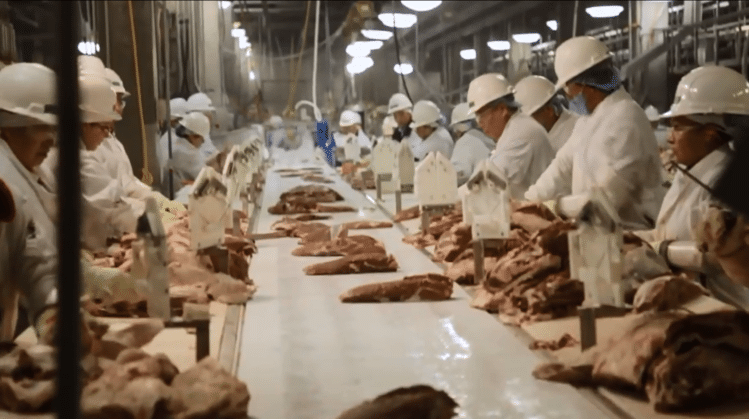
All over the United States massive meat processing facilities have been the hotspots for coronavirus outbreaks but there is other news concerning JBS that isn’t widely reported. They are currently under investigation by the SEC for price-fixing.

|


JBS corona virus hotspots, price fixing.

Utah’s Largest Meat Processing Facility (owned by JBS) is under investigation by the SEC for price-fixing. 

JBS USA has a regional beef processing plant located in Hyrum which employs over 1,500 people to process up to 1,700 cattle per day into cuts of beef that end up on grocery store shelves. A total of 287 workers in the Utah facility just tested positive for Covid-19 last week. Many more family members of the workers tested positive, which was the major reason for the recent spike in Covid-19 cases in northern Utah. JBS is one of the biggest meat processors in the world. Their largest operation is located in Greeley Colorado, where they have both the largest cattle feedlot in the U.S. as well as the largest meat processing facility. As of May 18th, the Denver Post reported that the 8th worker from that plant had died from Coronavirus.

All over the United States massive meat processing facilities have been the hotspots for coronavirus outbreaks but there is other news concerning JBS that isn’t widely reported. They are currently under investigation by the SEC for price-fixing.

When just four companies control nearly 80% of the market for beef, competition and a free market become next to impossible. Ranchers know this, and they have been fighting for changes for years, but political leaders have either ignored the small ranchers or have been slow to respond. 

The PRIME Act

For the past four years The Processing Revival and Intrastate Meat Exemption Act, or PRIME Act, has failed to pass in Congress. The PRIME Act would give individual states the freedom to permit intrastate distribution of custom-slaughtered meat. This way beef, pork, goat or lamb could be sent directly to consumers, restaurants, hotels, and grocery stores.

This bill was introduced by U.S. Senators Angus King (I-ME) and Rand Paul (R-KY) in 2018. The bill addresses two issues. First, there is a growing demand by consumers to buy locally-produced meat. Customers want to see and visit the farms where their meat originates. Second, the bill could aid small ranchers and rural ranching communities by allowing them to bypass the massive processing expense if they wish to sell directly to their customers.

Shayn Bowler is the owner of Utah’s Natural Meat. He was on the Utah Stories podcast where he addressed this problem. “Right now I’m allowed to do everything with my animals except harvest them. I can butcher them, process them, store them, age them, but currently, I need to pay to put them on a truck to send them to a licensed facility to have them killed then brought back to me. This is a waste of time and money. I could do it just as safe as they can.”

Bowler added that if he could slaughter his own animals he could pass on the savings to his customers, and it could have a huge impact on the entire industry. Instead, the law has not changed, but instead the major meatpackers control and dominate the market and set prices for most ranchers.

The majority of ranchers in the state of Utah don’t operate like Utah’s Natural Meat, but instead, sell their meat to a feedlot buyer or directly to the slaughterhouse. While beef prices have been skyrocketing in stores, ranchers are getting paid less than ever for each head of cattle due to the glut of supply of cattle due to coronavirus-caused closures of meat processing facilities.

The system is broken. It needs to be changed. It makes no sense that these facilities are so large and are so integral to our food supply. Joell Salatin said words to the effect on the Joe Rogan podcast in May, 2020. Salatin operates one of the largest pasture-raised beef operations in the United States at his Polyface Farms, located in the Shenandoah Valley of Virginia.  

RELATED CONTENT:
Why Are Beef Prices Skyrocketing? Can Utah Ranchers Survive?
How to Succeed in Farming on Very little Land in the 21st Century
Farmers Feeding Utah: Utah Farm Bureau launches program to support farmers and feed those in-need



Join our newsletter.
Stay informed.


  • Highway 6 and the Midland Trail: Utah’s Transcontinental Highway History

    From Price Canyon to Delta’s desert stretch, Utah played a central role in building the Midland Trail, one of America’s earliest transcontinental highways and the foundation of today’s Highway 6.


  • Whiskey, Bullets & a Buried Town: Archaeologists Reveal Alta’s Wild Past

    Before Alta was known for powder days and lift lines, it was a silver mining town clinging to the side of a narrow canyon. In the late 1800s, men lived at 8,000 feet, went underground each day, and endured winters that regularly buried buildings in snow. This past summer, that mining town resurfaced — literally — during construction at the Alta Ski Area.

    To understand what Alta really looked like, you don’t begin with legend. You begin with its trash — and this time, that happened almost by accident.

    Alta Ski Area was installing underground water reservoirs to support snowmaking. Because the project sits on Uinta-Wasatch-Cache National Forest land, an archaeologist was required to monitor the excavation. No one expected the trench to produce much.

    But, It did.

    Artifacts began surfacing almost immediately. Enough that the Forest Service contacted the Utah State Historic Preservation Office for help. Lexi Little, who coordinates the Utah Cultural Site Stewardship Program, helped mobilize nearly 30 volunteers to assist with what quickly became a focused two-week excavation.

    Winter deadlines were approaching. The pipes for the reservoirs had to go in the ground. There wasn’t time for a slow, extended dig.

    “It was two weeks of digging in the dirt and helping figure out exactly what we were looking at,” Little said.

    Most of the people screening soil weren’t professional archaeologists. They were trained stewards from around Utah — part of a statewide volunteer network that now approaches 500 people. They poured dirt through shaker screens, scanning for fragments that could piece together a town long buried.

    “Archaeology is human trash,” Little explained. “Archaeologists are very into trash.”

    Alta had left plenty behind.

    https://youtu.be/hzIHzx3OGoo?si=dKcl2CEz-t6FZzYw

    Victorian-style ceramics appeared first — the kind typically used in hotels. Medicine bottles followed. Ink bottles. Hand-blown glass. A porcelain doll’s foot surfaced from the soil, a small detail that shifted the mental image of the town. Families were here. Children were here. This wasn’t only a camp of miners.

    The bottles helped establish time. Manufacturing details — whether glass was hand-blown or mold-made, whether a maker’s mark appeared on the base — allowed archaeologists to date many of the artifacts to the 1870s through the 1890s, when Alta was booming as a silver mining town.

    “That gives you that range of dates for when Alta was really booming,” Little said.

    One reusable soda bottle clearly stamped “Salt Lake City” connected the canyon to the valley economy below.

    Then something unusual rolled out of a dirt pile.

    A corked bottle. Intact. Liquid still inside.

    To access this post, you must purchase Utah Stories (Digital + Print) or 3 month free trial (Digital).


  • The Only Full Bottle of Alcohol Ever Found in Utah Was Unearthed in Alta

    When a backhoe rolled a corked bottle out of the dirt at Alta this summer, no one immediately grasped what they were holding. It wasn’t empty. It wasn’t shattered. It was full. “The bottle that was discovered up at Alta is the only bottle of alcohol ever discovered in an archaeological excavation in the state…


  • How Horses Help Kids Heal: Inside Utah’s Equine Therapy World

    Kelty Johnson trains horses for a living, but her deeper work happens in the quiet space between animal and human. On the Utah Stories podcast, she explains how equine therapy helps children regulate emotions, build confidence, and reconnect through presence rather than pressure.