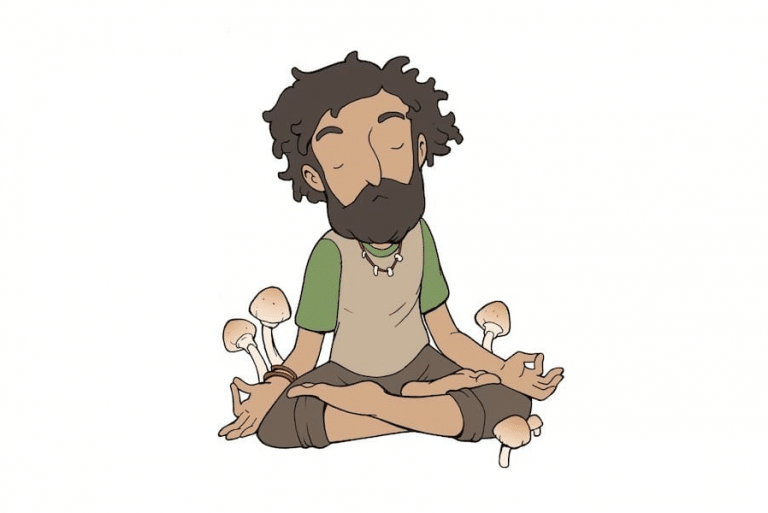
Today, you can find mushrooms in nearly every health store and supplement aisle. But 2,000 years ago, these mushrooms reigned supreme as powerful sources of physical and spiritual strength that only grew on sacred mountains. You could say they were “magic” mushrooms (though without the psilocybin). Traditional Chinese Medicine (TCM) healers named the mushrooms lingzhi, which literally translates to “divine mushroom.”
Fungi are so entrenched in TCM that over 90 percent of the world’s mushrooms come from China. Even though our relationship with mushrooms is vastly different than that of the ancients, we can still reap the full benefits of fungi by using modern practices. We can understand the chemical and nutritional composition of mushrooms, how to grow, harvest, and process mushrooms for the most medicinal benefit and how to accomplish this with little ecological impact.
Fungi grow from decay. They absorb nutrients through a root-like structure called mycelium and sprout an annual fruiting body above the ground. The fruiting bodies release the fungi’s reproductive spores, after which the whole life cycle begins anew. Fruiting bodies vastly differ between species. It’s how we get the humble Shiitake, the glossy Reishi, the kaleidoscopic Turkey Tail, and even the alien-like Stinkhorn. Researchers have documented over 140,000 fungi species, and they suspect that number is merely 10 percent of all fungi.
Opportunistic companies looking to cut costs might claim that growing mushrooms on brown rice or oats is an appropriate substitute for fungi’s native substrates. However, rice and oats are filled with their own starchy polysaccharides and don’t decay the way logs do. During growth, fungi are deprived of the proper decay they need and absorb the starches from the growing substrate. All that extra starch can create false-positive tests for medicinal compounds.
Sure, the package might say the product has a 40 percent concentration of beta-glucans, but there’s no way of knowing those beta-glucans are actually medicinal without proper testing. Megazyme testing is truly the only way to determine that a mushroom product has the medicinal properties you desire. This kind of test detects the different structures of polysaccharides so that growers and producers can ensure the final mushroom product has only the naturally-occurring, medicinal beta-glucans instead of extra starches.
Inside the tough cell walls of fungi are masses of beta-glucans, large molecules made of multiple sugar molecules. They are key components that make mushrooms such valuable therapeutic tools. The beta-glucans act like soluble fiber if they are properly extracted, slowing the passage of the mushroom through the digestive tract.
But there are more medicinal compounds inside fungi than beta-glucans. Vitamins B and D, folate, antioxidants, anti-inflammatory agents, and immune-boosting compounds are also abundant in mushrooms, depending on the species. Turkey Tail and Shiitake are top favorites during cold and flu season because of their ability to assist with antibody production.
Thanks to modern technology, we can commercially grow mushrooms to have high naturally-occurring levels of beta-glucans and other medicinal components, harvest them at peak potency and process them in a way that preserves their natural medicinal benefits. First, medicinal mushrooms must be grown on their preferred logs (also referred to as substrates).
Chaga, for example, can only produce its beneficial aspects if grown on its native birch log. Growers must harvest the mushroom crop at the point of its life cycle where the medicinal properties are the most potent. Finally, the mushrooms must be processed correctly to break out the beta-glucans tucked inside the tough cell walls. This is accomplished using a heated treatment of steam or, better yet, a complete hot water extraction. Some species such as Lion’s Mane, Reishi, and Chaga have thicker cell walls and require additional alcohol extraction.
So, the next time you are considering which medicinal mushroom is right for you, ask yourself: how was the mushroom grown? How was it extracted? Am I certain I am getting all the medicinal benefits? But don’t let all that stop you from exploring fungi. As we approach them with curiosity and respect, we may bring even more ancient wisdom into our modern world.
Disclaimer:
The statements in this article have not been evaluated by the Federal Drug Administration. The information provided is for educational and informational purposes only.
About the Author:
Jme Bonfiglio is the Founder, Owner, and Formulator for WholeSun Wellness, a medicinal mushroom company offering clinically-potent full-spectrum mushroom extract with verifiable therapeutic levels of naturally-occurring medicinal components. She is a passionate advocate for women in mycology and is currently working with partners to build the largest medicinal mushroom farm in the United States. For more information visit the Utah Fungi Festival website.