Mormons in Mexico
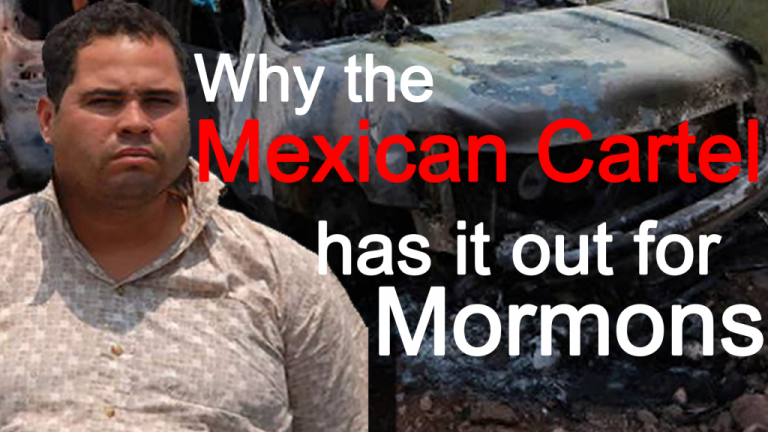
The horrific attack killing members of the Langford family near the Arizona border is suspected to be perpetrated by the Mexican drug cartel. Three mothers and six children, including twin infants, were shot and burned. Four more wounded. A wounded fourteen-year-old boy walked fourteen miles to safety after telling his brothers and sisters to hide in the bushes. He saved his infant sister from dying who was grazed in the chest with a bullet.
Last week a caravan of the Langford family and community from La Mora loaded ten SUVs with all of their possessions and left the dust of their ranch and home behind. The Langfords are one of many Mormon families who settled in Mexico in the past century to escape religious persecution for their practices of polygamy.
However, the media describing them as “Mormons” isn’t exactly accurate. None of these families are associated with the modern Church of Jesus Christ of Latter-Day Saints. The term “Mormon” is one that the LDS Church is removing from it’s preferred lexicon and self-identification, possibly because the term contains a strong connection to their early practices of polygamy. There is no statistical information on how many fundamentalist Mormons live in Mexico, but The Langfords, the LeBarons and the Romneys (who are the second cousins of Mitt Romney) reside there, and their history and background in challenging the Mexican drug cartel is fascinating.
A History of Struggle
The history of the struggle between the cartel and the Mormons appears to be a major cultural war that has escalated over the years. The Langford family’s decision to relocate to the United States and flee their Mexican ranch consisting of several homes and hundreds of acres demonstrates a major capitulation and a victory for the cartel. With the FBI’s current involvement in the investigation, it’s becoming clear that this is much more than just a Mexican problem. The rising power, money and influence the cartel has over Mexico is making it much more of a threat to American citizens. There are big questions regarding how the future will unfold.
Will the Mexican government offer any real protection to these polygamist families? Does the cartel have an ongoing battle with the Mormons who live in Mexico? Will Mexico ever gain control over the cartel and the atrocities they are frequently engaged in? What does this mean if these violent attacks creep into the United States and our own military and armed forces need to be further involved? And what does this mean for the hot-button American political issues of gun control and Second Amendment rights?
Let’s examine the last major run in that the Mexican Drug Cartel had with the “Mormons.”
In 2009, 16-year-old Eric LeBaron was kidnapped by the cartel. Members demanded a one million dollar ransom from the well-known family. Rather than pay the ransom the LeBaron family decided to take a different tactic. They urged residents and political leaders to condemn the kidnapping of innocent children for money. This unprecedented move worked and the cartel released young Eric LeBaron under perceived public pressure. This rare success empowered Mexican residents to have hope that perhaps they could stand up to the cartel and affect meaningful change. We will return to this story, but before we do, let’s examine how Mormons ended up in Mexico in the first place.
Utah’s Mexican History
Before Utah became a state, and even before the territory of Utah was considered a part of the United States, it was Mexican territory. Mormon pioneers named the area the new Zion and termed it “Deseret.” In a way, all Mormon pioneers were Mexicans before they were Americans.
All Mormon Pioneers were Mexicans before they were Americans.
Mormons began settling in Mexico in earnest in the 1870s due to the federal ban and crackdown on polygamy. In 1875 the first expedition of Mormons settled and homesteaded an area they called Colonia Juarez.
Alma Dayer LeBaron (1886-1951) was the founder of Colonia LeBaron. The epitaph on his tombstone reads:
“The time will come when they will beat trails from the four corners of the earth to this place because of the work that will take place here.”
Alma was a fundamentalist Mormon with two wives. He fathered 17 children including Ervil, Joel, Verlan, Alma and Floren. If the LeBaron name sounds vaguely notorious, it is indeed. Ervil LeBarron had 13 wives and over 50 children.
He used his children to assassinate and murder his enemies. Joel LeBaron was killed by his brother Ervil for “blood atonement” which under fundamentalist belief is the right to kill in the name of God. Ervil went on a killing spree across the U.S. and Mexico. He was finally caught and convicted in 1979. But the victims continued to accumulate even after Ervil was sent to prison. His children continued to fulfill their father’s post mortem murder wishes.
But of the hundreds if not thousands of families in Mexico that have Mormon roots the story of Ervil LeBaron is a rare exception. Most fundamentalist Mormon families are peaceful farmers, focused on their community and families.
[Top distance between Colonia Juarez from Colonia LeBaron. Above left Colonia LeBaron (Google satellite) Above right: Colonia Juarez
Colonia Le Barón
A small cattle ranching community, Colonia Le Barón was settled by three of the LeBaron brothers in the 1940s. There they founded The Church of The Firstborn. The LeBarons are one of the most famous and large families located in Northern Mexico near Chihuahua. It’s unknown how many descendants still reside in the area, but it is in the hundreds. They all speak English and Spanish fluently. Many use their dual citizenship to work in the United States when they need to supplement their ranching and farm income.
Colonia Juarez
The home to most of Mitt Romney’s remaining family lineage still located in the region is Colonia Juarez. Miles Park Romney, Romney’s great-grandfather, had four wives and came to the Chihuahua desert in 1885 to escape U.S. laws against polygamy. Kidnappings and extortion tactics are not uncommon in this area, which requires the Romneys to be vigilant and strong.
Some of their orchard managers have been abducted and killed, and one of Mitt’s cousins, a tough 70-year-old rancher named Meredith Romney, was kidnapped two years ago, then tied up and held in a cave for three days, according to the Washington Post.
Mitt Romney’s family (his second cousins), also have inhabited a large town reminiscent of many of the LDS communities that were settled in Utah featuring grid-patterned town blocks, the tall “Mormon” Lombardy poplar trees and the neat and orderly nature of the community, complete with a gleaming white Mormon Temple. These communities resemble many of the original values that the Mormon pioneers espoused. They flourished by raising cattle and produce.
The Romney and LeBaron families have made attempts to fulfill Brigham Young’s vision for an ideal utopian Mormon community, which was to maintain a strong level of self-reliance by producing as much of their own food and “home industry” as possible. The Romney ranch has been described as “Powerful farmers”. They grow vast fields of peppers, peaches, pears, and apples. Through a farm cooperative called Paquime, they export high-quality products to the United States,” as reported by the PRI news service.
Back to our 2009 story about the LeBarons kidnapped son:
When the cartel made it clear they were going to be a force in all towns in and around northern Mexico, and that they would commit the same kidnapping and ransom practices in La Mora and Colonia Le Barón, the families decided they would use their power in numbers to resist the blatant lawlessness. In 2009, nearly 50 kidnappings were occurring every day in Mexico, mostly by cartel members.
Benjamin LeBaron, whose son Eric was kidnapped, decided they wouldn’t pay the ransom to get their son returned. “Otherwise when would it ever stop?” his brother Brett LeBaron told VICE TV when they visited in 2012 to produce a documentary. Instead, they decided to take political action and bring their grievances to the elected leaders.
The entire town of LeBaron, all of the family members and extended family descended on the nearby city of Chihuahua to protest. They held signs for motorists to honk if they supported the release of their son Eric. Likely due to overwhelming governmental and resident pressure, the cartel kidnappers relented and released Eric LeBaron unharmed. This was unprecedented. Most kidnappings either resulted in payment or the killing of the victim. It’s still unknown how or why the cartel released 16-year-old Eric, but it later became clear that the cartel was not going to allow this demonstration of perceived weakness to go unchecked.
Jose “El Rikin”
Jose “El Rikin” Escajeada was a high-ranking boss of the Juarez cartel. He showed up in the middle of the night at Benjamin LeBaron’s home in Galena, Mexico along with 20 cartel members. They forced themselves into LeBaron’s home while his wife and children were sleeping. They got in by shooting at the door and threatening his family with a hand grenade. They began molesting Benjamin’s wife Miriam. Defenseless, she agreed to do whatever they wanted but to not do it while her children were watching. Mirium LeBaron told Univision in an interview that she felt lucky they left her and her children unharmed.
Luis Widmar and Benjamin LeBaron were taken by Rikin and his group. Each was shot four times in the head. El Rikin was eventually extradited to the US. None besides Rikin were ever charged by the Mexican police or federal officers. Ten children under the age of seven were left orphans after this murder.
Fighting Back
Benjamin’s brother Julian took up the activist role after his brother’s murder. They realized that Mexico’s policy of prohibiting individuals to possess firearms was not going to work if they were going to defend themselves.
“We have illegal weapons in our community, come and find them if you want.” Julian LeBaron told VICE when they filmed their 2012 documentary. Julian and Javier Cicilia have continued to organize marches. They also appealed to Mexican President Julio Calderon directly who was open to listening to the LeBarons. As far as getting help from their neighbors to the North, prior to the current incident, Julian was not optimistic,
“Americans don’t care about the fact that 50,000 people have been murdered in the last four years in this country,” said Bret LeBarron.
The LeBarons built a watchtower over their community that they constantly keep manned to protect themselves from further violence. Brett LeBaron told VICE, “We know pretty much every car that is in this area. If we see something suspicious we can take action.”
“The rumor spread that we have .50 caliber rifles,” said Brent LeBaron. When it comes to protecting our family, if we have to die doing it, we will do it.”
Fast And The Furious
Mexican law allows only members of gun clubs or shooting ranges to own firearms. The LeBaron’s made an attempt to start their own gun range, but a corrupt political leader prevented them from ever obtaining the license. Mexico prohibits its citizens to bear arms. Due to this policy, it’s not uncommon that citizens feel completely defenseless against the cartel when they come with the same guns that the Obama administration released into the country under the “Fast and the Furious” program which was an attempt by the United States to track cartel members.
The bullets that killed the Langfords are American bullets from the same type of assault rifles that were sold in the Fast and the Furious campaign. CNN reports that 2,000 firearms were sold by the United States to the Mexican drug cartels in the Fast And The Furious Mission, just 200 of those assault rifles have been recovered.