Utah Stories

Swedetown

Swedetown once had several hundred dwellings and was the center of a vast community of Mormon Swedish converts who came to the Salt Lake area in the latter half of the 19th Century. Swedish culture and even a Swedish newspaper, The Svenska Haroden, thrived.

|


Welcome to Swedetown

Salt Lake City, Utah—Swedetown is several thousand miles from Stockholm, and in many ways, it is also a couple thousand miles from downtown Salt Lake.

If you haven’t heard of it, don’t be surprised. It is truly a hidden part of Utah.

It is a several block section around Hot Springs Road and 1500 N. Still can’t place it? Try thinking about the oil refinery as you head north on Highway 89. 

At present, it is little more than a score of single-story homes and a small park surrounded by industrial salvage. But it was not always that way.

Swedetown once had several hundred dwellings and was the center of a vast community of Mormon Swedish converts who came to the Salt Lake area in the latter half of the 19th Century. Swedish culture and even a Swedish newspaper, The Svenska Haroden, thrived.

Alas, there are no more Swedes. But there is a collection of individuals who appreciate the area’s quirky charms.

“We don’t have any sewer, internet, or curbs and gutters, but it’s home,” laughs Matt, who has lived there his entire life. His brother Andy chimed in. “Yeah, you wind up here when you’re broke and can’t afford to live anywhere else and then you get out.” 

Neither of them is in any hurry to move to a high rise. Greg’s wife Nicole said she feels at home. “It might be sketchy, but it’s safe.” She also said the only noticeable odors come from the local sulfur hot springs, not the refinery.

Swedetown is where development stops.

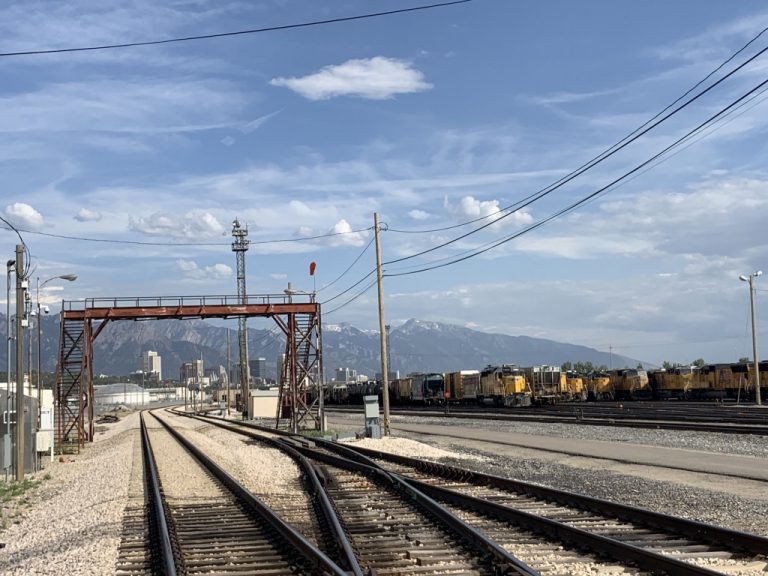
It is tough to imagine a pricey apartment complex advertising easy access to the Union Pacific train tracks or vast scrap yards. Social life used to center around the Swedetown Pub, but that closed in 2016. The city health inspection report noted that it had “variable floor surfaces that are not smooth or easily cleanable.” Actually, that was part of its appeal. 

The outstanding architectural feature is a dilapidated Mormon meeting house that at one time housed race cars and now is a local hangout where a beer can still be enjoyed between friends.

   But maybe fortunes here are changing. Greg mentioned that a house in the area is for sale in the range of 250. That is thousands. Not dollars. 

Read more of Al Sacharov at Utah Stories. 

, ,


Join our newsletter.
Stay informed.


  • The Reality of Meth Psychosis on Utah’s Streets

    On the streets of downtown Salt Lake City, psychosis has become part of the landscape.

    People scream at invisible enemies. Some believe they are prophets. Others wander through traffic carrying conversations with voices nobody else can hear. To passersby, it can look theatrical, bizarre, and absurd. But behind many of those episodes is a darker reality few people want to confront directly: methamphetamine-induced psychosis, prolonged sleep deprivation, trauma, addiction, and the slow destruction of a person’s ability to distinguish reality from delusion.


  • The Utah Bombings That Exposed One of America’s Greatest Forgers

    On an ordinary October morning in 1985, downtown Salt Lake City was shattered by a blast that killed businessman and document collector Steve Christensen. Hours later, a second bomb tore through a quiet Holladay neighborhood, killing Kathy Sheets, the wife of Christensen’s former business partner. The next day saw a third explosion. This one was in a car near Temple Square that nearly killed rare-documents dealer Mark Hofmann. 

    Rumors swirled instantly, tying the attacks to money, religion, and shadowy early-Mormon documents Christensen had recently acquired. For days, Utah held its breath. What unfolded was stranger and darker than fiction. The bombs weren’t the work of religious extremists or enemies of the Church of Jesus Christ of Latter-day Saints, but instead, the doings of Mark Hofmann himself. Hofmann was a nerdy, soft-spoken dealer who had secretly become one of the most skilled document forgers in American history. 

    His creations were so convincing that they reshaped historical narratives, fooling scholars, collectors, and church leaders. When the lies began to close in, the bombs became his final, desperate attempt to keep his world from collapsing.

    Hofmann had been fabricating Mormon and American historical documents for years. He was a prodigy of deception, sourcing period paper, mixing inks that cracked just right, and mimicking handwriting with obsessive precision. Most of all, he knew how to read people. Utah in the 1970s and ’80s was a collector’s paradise. As bookseller Ken Sanders told Salt Lake Magazine, it was “a consciousness shift,” a recognition that rare Utah history was a treasure worth pursuing. It was also, he notes, fertile ground for affinity fraud.

    Nothing captured that vulnerability more than the Salamander Letter, a supposed 1830s correspondence which claimed Joseph Smith encountered a magical white salamander rather than an angel. The document shook Latter-day Saint circles. Church leaders, worried about its implications, quietly purchased it along with other materials Hofmann dangled before them. Many reasoned that if the church was willing to buy it, then it must be authentic and true, and Hofmann understood that psychology perfectly.

    Continue reading and support independent Utah journalism with a purchase of Utah Stories (Digital + Print) or 3 month free trial (Digital).


  • Why Restaurants Like Mazza Are Disappearing

    Across Salt Lake City, luxury restaurants continue to open. High-end dining rooms remain packed. Investors continue buying buildings in formerly quirky neighborhood districts. Chains increasingly move into areas once dominated by independent businesses. Meanwhile, many middle-class restaurants, the kinds of places that helped shape Salt Lake’s local identity over the past two decades, are struggling to survive.


  • A Simple Prepaid eSIM Setup for Smoother International Trips

    International travel feels easier when mobile data works the moment a trip begins. Maps, booking details, local transport apps, translation tools, and messaging services have become part of the travel routine. When access to these essentials is delayed, even a short airport transfer can feel more stressful than it should. That is why many travelers…