Community Relations

KRCL community radio: RadioACTive host Lara Jones

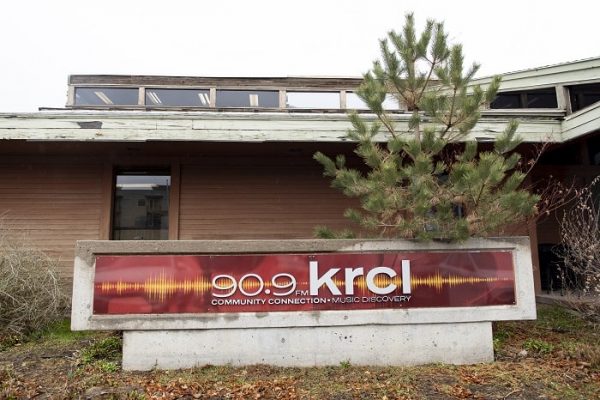
  KRCL radio & Lara Jones When KRCL (90.9 fm) community radio host, Lara Jones, first entered the world of broadcasting in 1984, radio broadcasting was very much a man’s world. “There were not a lot of women doing this when I started,” she said. “When I got into radio broadcasting in the 80s, it…

|

KRCL community radio: RadioACTive host Lara Jones


KRCL community radio: RadioACTive host Lara Jones
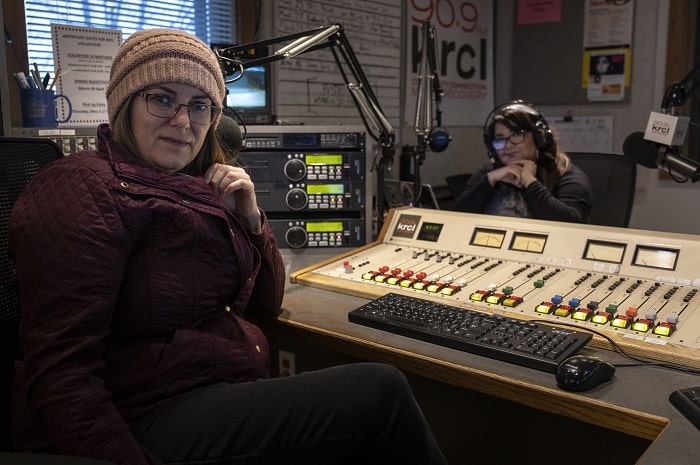
Lara Jones of KRCL. Photo by Braden Latimer.

KRCL radio & Lara Jones

When KRCL (90.9 fm) community radio host, Lara Jones, first entered the world of broadcasting in 1984, radio broadcasting was very much a man’s world.

“There were not a lot of women doing this when I started,” she said. “When I got into radio broadcasting in the 80s, it was very much a boys’ club and the sexism was rampant.”

In 1984 Lara received $3.35 an hour, minimum wage.

In December of that same year, she was due a $0.25 pay increase. But, she said, “He tried to tell me that I would be in a higher tax bracket and advised against taking the pay raise.”

It never occurred to Lara that she could get paid less than a man for doing the same job, “or that I was the only one being pressured to turn down a pay raise.”

Higher tax bracket be damned—Lara risked it.

After years of working against the grain of the good ole boys’ club, Lara finally found her place in broadcasting, and that place is called:

RadioACTive—grassroots, community builders

Lara is now the executive producer and co-host of the Utah community program, RadioACTive. It focuses on grassroots activists and community builders.

“We pretty much have an hour each weeknight and cram in as much as we can; grassroots activism from community members,” she said, which she thinks includes anyone who is a part of a true community.

Since beginning her journey into the mercurial world of radio broadcasting, Lara knew where she wanted to end up.

She said, “I always loved community radio and always thought I would end up at KRCL.” And added, “I’m really just a part of the team that stewards affairs. I could not do the show without Billy Palmer, Ma Black, and so many other people.”

Lara’s vision, her hope for RadioACTive is identic to community radio’s in general: “ … to expand the definition of community, who is in our community …” and giving voices with stories a conduit through which to speak.

Radioactive broadcasts on weeknights from 6-7 on 90.9 KRCL
KRCL community radio: RadioACTive host Lara Jones

(Got a story you’d like to share on the RadioACTive? Record a voice memo on your smartphone, email it to radioactive@krcl.org. Please keep it under 3 minutes, and be sure to include a name and phone number in the message.)


,

Join our newsletter.
Stay informed.


  • Utah Youth Ice Climbers Win World Championships Thanks to Millcreek Common Wall

    Utah is home to two new World Champion youth ice climbers, and the ice climbing wall at Millcreek Common is getting credit for helping them win. 


  • A Ski Village or a Tipping Point? Nordic Valley Expansion Divides Ogden Valley

    The project, known as Nordic Village, is expected to roll out over the next decade and represents one of the largest tourism developments in the valley’s history.


  • The End of an Era? FanX and the Salt Palace Closure

    For more than a decade, FanX has called the Salt Palace home. With the convention center set to close for a massive renovation, founder Dan Farr is preparing for a new chapter while planning one final celebration in its longtime venue.


  • The Stratos Project and Corporate Power: Who Controls Utah’s Future?

    If we were all just consumers, Governor Cox, Mike Lee, Speaker Schultz, and Kevin O’Leary would have it easy. If we were just more concerned about money, jobs, and tech, and less concerned about raising our kids in communities (not in front of screens), culture, the environment, and water, those smart dudes would get exactly what they want — Stratos: a city of the future, buzzing with processors and transistors, making all of our AI dreams come true! 

    The world we could live in would be a dazzling, Mr. Wonderful kind of place. We would beat those pesky Chinese in the AI war; our AI robots could do all of our farming and ostensibly harvest the water we need for the Great Salt Lake out of thin air. But apparently, we just don’t get it. We haven’t yet reached the point predicted by Aldous Huxley’s vision in Brave New World, where we are completely distracted, dopamine-driven consumers who only need sex, drugs, and stuff to remain happy.

    Maybe Stratos will be an amazing marvel, and somehow, as Governor Cox claims, “. . . add more water to the Great Salt Lake.” But we aren’t sold. While this Stratos project has received considerable attention, it’s worth taking a step back to attempt to understand how corporate power appears to have usurped civic power.

    Civics is the practice of shaping our society through our collective voices and community involvement. Ask the residents in Tremonton, Utah how well that is working out for them. Can we still shape our world through our elected leaders? Does it matter who we vote for at the ballot box if organizations like UDOT, UTA, and MIDA can supersede our local government authority and citizen backlash? 

    The corporatization of our communities and the interests that impact our political leaders’ decision making processes are seen as far more of a concern than the average Utah resident’s concerns. Special interests and corporate power are shaping Utah’s future more than ever. 

    It’s worth asking: ‘How can we regain control over shaping Utah’s future in light of the growing power and billions that the technocrats now wield in shaping our world today?’ Amazon’s market cap exceeds the GDP of Canada. The “Magnificent Seven” tech stocks now have a greater market cap than the entire GDP of Europe ($23.6 trillion. EU countries have $19.3 trillion GDP). Will tech companies become their own nation-states and dominate their own chunks of various states? Will we become their subjects?

    There are two sides to this coin: We love Utah not just because we have the most outdoor wilderness playgrounds, but also because of Utah’s prosperity and job market. This is because Utah has become a tech hub. Our tech leadership has minted several billionaires and billion-dollar businesses. Utah offers a market and an educated workforce that more businesses and giant corporations want to be a part of. This is a benefit for even non-tech Utahns.

    The problem with this success is that as we dole out more money to attract more tech businesses, data centers, fulfillment centers, and big corporate retailers, it becomes more difficult to carve out our “sense of community.” As corporate sovereignty replaces local business sovereignty, we see that our voices and our votes matter less.

    Ask who our politicians work for, and nearly every Utahn believes they work far more for their corporate donors than they work for the average Utah citizen. So how do we best regain control over our communities?

    Continue reading and support independent Utah journalism with a purchase of Utah Stories (Digital + Print) or 3 month free trial (Digital).