Utah Stories

Parowan Gap: Secrets of the Past

When considering the greatest archaeological treasures and the sophistication of the former ancient inhabitants of Utah, the small town of Parowan may not come to mind

|


Photos by Nicole Anderson.

When considering the greatest archaeological treasures and the sophistication of the former ancient inhabitants of Utah, the small town of Parowan may not come to mind. But in Southern Utah there is a mysterious place known for its sliding sunsets, moon maps, and a strange outcropping of rocks known as the Overseer. Welcome to the Parowan Gap. The Gap is the first complex calendar system in North America dating back to 3000 B.C.

The Gap, as it is known by locals, is a natural 600-foot gap in the mountains and is culturally significant based on a collection of stories from early Hopi, Paiute and other Native American tribes who lived here. Here you will find a gallery of 90 pieces of artwork with roughly 1,500 petroglyphs such as the Zipper Glyph that tell countless stories of the past.

The Zipper Glyph seen from a distance appears to replicate the Gap’s appearance. To the untrained eye it looks like an unzipped zipper on an old pair of jeans and nothing more. Upon closer examination, alongside an experienced guide, one learns that this and other nearby petroglyphs actually depict the monthly lunar cycle with quarter moons and the full moon all shown in detail.
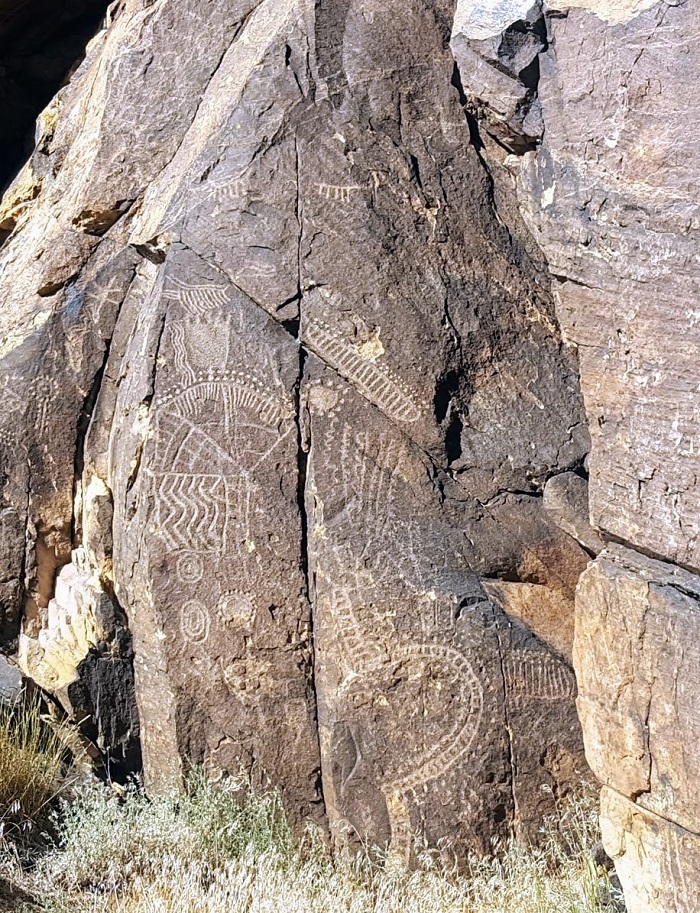
Currently, there is a small group of archaeologists focusing on the calendar system and the alignment of lunar and solar patterns in the area. When visitors come to celebrate the summer solstice they witness the sun rolling down the side of the outcropping of rock, sitting in a notch between the two mountains for a moment before it drops out of sight. In ancient times, it was like a modern-day alarm clock signifying to archaic tribes that summer had begun.

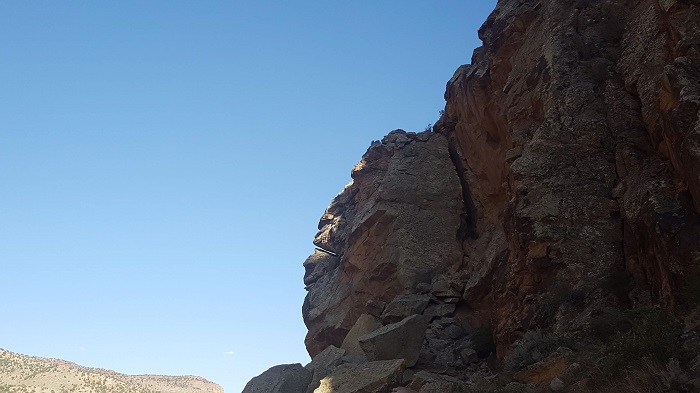
Visitors should look at the horizon for an outcropping of rocks that resemble a face. This is the Overseer. During certain times of the year, the sun sits in the mouth, and then ‘gulps’ as the Overseer seems to swallow the sun, as if to say, “winter is coming” and if visitors are lucky enough to be there in on the right day, they may even see the Overseer swallow the moon.

The Parowan Heritage Foundation currently works alongside the Bureau of Land Management (BLM), the Paiute Tribe of Utah, and the Hopi Tribe, among other organizations and countless archaeologists and volunteers who desire to protect the area.

Witnessing a sliding sunset or the Overseer swallow the moon, you will realize that you can’t take The Gap in isolation, but you must take it in as a whole. The people. The stories. The rocks. The history. The Zipper-Glyph, and the Overseer—they all come together as one, and as we decipher more of the petroglyphs and stories, we come to a greater understanding and appreciation for the ancient’s way of life.

, ,


Join our newsletter.
Stay informed.


  • Whiskey, Bullets & a Buried Town: Archaeologists Reveal Alta’s Wild Past

    Before Alta was known for powder days and lift lines, it was a silver mining town clinging to the side of a narrow canyon. In the late 1800s, men lived at 8,000 feet, went underground each day, and endured winters that regularly buried buildings in snow. This past summer, that mining town resurfaced — literally — during construction at the Alta Ski Area.

    To understand what Alta really looked like, you don’t begin with legend. You begin with its trash — and this time, that happened almost by accident.

    Alta Ski Area was installing underground water reservoirs to support snowmaking. Because the project sits on Uinta-Wasatch-Cache National Forest land, an archaeologist was required to monitor the excavation. No one expected the trench to produce much.

    But, It did.

    Artifacts began surfacing almost immediately. Enough that the Forest Service contacted the Utah State Historic Preservation Office for help. Lexi Little, who coordinates the Utah Cultural Site Stewardship Program, helped mobilize nearly 30 volunteers to assist with what quickly became a focused two-week excavation.

    Winter deadlines were approaching. The pipes for the reservoirs had to go in the ground. There wasn’t time for a slow, extended dig.

    “It was two weeks of digging in the dirt and helping figure out exactly what we were looking at,” Little said.

    Most of the people screening soil weren’t professional archaeologists. They were trained stewards from around Utah — part of a statewide volunteer network that now approaches 500 people. They poured dirt through shaker screens, scanning for fragments that could piece together a town long buried.

    “Archaeology is human trash,” Little explained. “Archaeologists are very into trash.”

    Alta had left plenty behind.

    https://youtu.be/hzIHzx3OGoo?si=dKcl2CEz-t6FZzYw

    Victorian-style ceramics appeared first — the kind typically used in hotels. Medicine bottles followed. Ink bottles. Hand-blown glass. A porcelain doll’s foot surfaced from the soil, a small detail that shifted the mental image of the town. Families were here. Children were here. This wasn’t only a camp of miners.

    The bottles helped establish time. Manufacturing details — whether glass was hand-blown or mold-made, whether a maker’s mark appeared on the base — allowed archaeologists to date many of the artifacts to the 1870s through the 1890s, when Alta was booming as a silver mining town.

    “That gives you that range of dates for when Alta was really booming,” Little said.

    One reusable soda bottle clearly stamped “Salt Lake City” connected the canyon to the valley economy below.

    Then something unusual rolled out of a dirt pile.

    A corked bottle. Intact. Liquid still inside.

    Continue reading and support independent Utah journalism with a purchase of Utah Stories (Digital + Print) or 3 month free trial (Digital).


  • Helper, Utah: The Coal Town Reclaiming Its Glory

    Recently featured in The New York Times, Helper is now more than a sleepy little drive-by on the way to Moab. It’s becoming a destination in and of itself.


  • How Horses Help Kids Heal: Inside Utah’s Equine Therapy World

    Kelty Johnson trains horses for a living, but her deeper work happens in the quiet space between animal and human. On the Utah Stories podcast, she explains how equine therapy helps children regulate emotions, build confidence, and reconnect through presence rather than pressure.


  • Angela Brown: The Woman Behind SLUG Magazine and Craft Lake City

    Angela Brown is the publisher and owner of SLUG Magazine, one of the city’s longest-running independent publications and a central voice in Utah’s alternative arts and music scene. She is also the founder of Craft Lake City, a nonprofit that has grown into one of the state’s largest platforms for local makers and creative entrepreneurs.