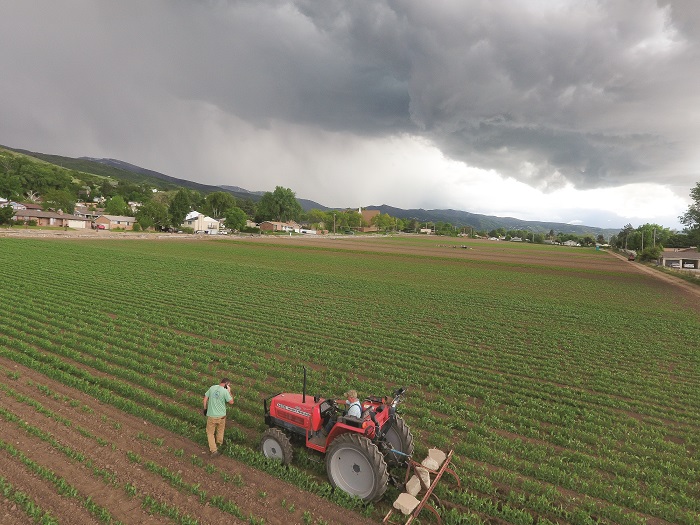
A local former state leader said to me last month, “Utah is for certain in the top three states when it comes to corruption in the form of crony capitalism.” I might have guessed this, but to hear it confirmed by a former state employee of a high rank was a surprise. He didn’t wish to have his name on the record. But this issue is very closely related to our farm issue because when there is open-space in any form we can be assured that the moneyed interests and corrupt political leaders will do everything in their power to acquire this land even in the most nefarious ways.
But we actually have some power in this arena if we step outside and see what is going on around our neighborhoods in our few remaining farms. It’s nearly certain that if we don’t get involved our political leaders will decide for us that bland suburbs and strip-malls, rather than farms and local food security will be our future. They will certainly decide political and economic power will be divided into the hands of the few, rather than the many. So how do we make a difference?
By voting with our dollars. We need to support local farmers for our produce and decide we will pay a bit more for healthier vegetables. Stop settling for far less healthy days old veggies which have lost up to 60% of their nutritional value if they are more than five-days since harvest.
We can support our local farmers at both the farmers markets, roadside stands and supermarkets by requesting local more often. Supermarket produce managers will listen if you request more local veggies. These might be the only ways we can truly make a difference. City Council members vote with their pocketbooks and so should you!
Over 300 Bountiful residents showed up to demonstrate their displeasure when their City Council and planners decided it would be a good idea to kick out one of the last family farmers in their area to make room for soccer fields and a freeway expansion. “It was almost pitchforks and torches…they gave the City Council a real tongue lashing,” said Alan Bangerter. See the complete story in our June issue.
Residents made it extremely clear they would rather the Bangerter family continue their over 100-year legacy of growing vegetables in the fertile soil between the benches and the former floodplain of the Great Salt Lake. It’s taken the Bangerter family years to remove the alkaline salt from the soil. Today it’s one of the most productive farms in Utah and it’s a sad fact of how rare it is to see row crops now near suburbs, when a majority of kids today don’t actually know how food is produced.
But more than supporting family farms this issue is about innovation in farming. There are some incredibly innovative entrepreneurs entering into the agricultural arena providing healthy farm-fresh produce and meat directly to customers, circumventing the regular distribution channels, which allow them to exist. We have stories about the Bill White Farms in Park City, which supplies his several area restaurants with freshly picked veggies and meat.
The Snuck farm is a year-round farm offering an innovative way of producing veggies hydroponically in greenhouses, heating their facilities using passive solar, for corporate cafeterias and restaurants.
Utah State University is Utah’s agricultural college with extensions throughout the state. We profile what the aggies are up to in helping push innovation when growing local food.
One major innovation in farming that has seen stalled progress is food producers working towards reducing water consumption. Farms use about 75% of our water. Driving around the Uinta basin area, where thousands of head of cattle are raised, farmers were flooding their fields beyond what is healthy for the soil or their farms. The problem with water policy is that is still operates under the “share system” under a “use-it-or-lose-it” policy. If farmers don’t waste water they risk losing their shares.
Currently the State of Utah is conducting a “Water Rejutification Program” where they are working towards gaining water rights that are not used by making farmers fight for their right to save their water. This creates further tensions and farmers have a correct position when they see this as the government overstepping personal property rights. But at the same time all farmers would agree that it would be a good thing to allow more water to end up in reservoirs and rivers to support wildlife and the further deterioration of the Great Salt Lake. This won’t happen under our current model.
We hope that this debate gains more attention and that a policy is examined that doesn’t essentially cause all farmers who consume excess water fear for their rights to consumption. The policy makers should find ways to reward farmers who implement innovative methods to use less water, rather than threatening them against taking their water if they don’t.
We have one last callout: Take the initiative to buy from your local farmers and let your City Council members know you want to keep farms and open space around.
We appreciate your comments, more of which are showing up on our Instagram account than anywhere else. Be sure to follow us on Instagram @UtahStories.
SEE MORE STORIES ABOUT UTAH FARMERS HERE