Moab

Lin Ottinger: Moab Dinosaur Hunter

Lin Ottinger’s  life has been marked from one rock story after another. Lin first learned of the value of his arrowhead and rock collections as a boy living in Tennessee. Back then he was hulling corn for $10 per week. And as he puts it, “My mom told me I had to get rid of…

|


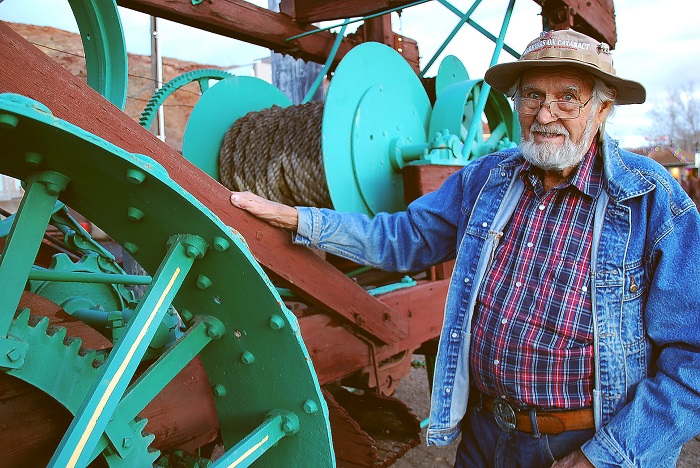
Lin Ottinger—Photo by Richard Markosian.

Lin Ottinger’s  life has been marked from one rock story after another.

Lin first learned of the value of his arrowhead and rock collections as a boy living in Tennessee. Back then he was hulling corn for $10 per week. And as he puts it, “My mom told me I had to get rid of my arrowheads.” By selling his collection to a local barber he learned he could earn more money selling arrowheads than hulling corn.

Lin said selling his arrowhead collection for several hundred dollars enabled him to move to Oregon, where he was a part of a traveling carnival. We didn’t digress too deep into this story, there were just too many rock stories to tell.

Lin came to Moab after he learned at a rock convention that a place called Cane Creek, in a place called Moab has a lot of great Uranium specimens.

He was working on collecting uranium at the time, so he decided to make the trip in 1960. From a fortuitous event of a backhoe driver losing his keys, and Lin having the know-how to hot wire the bacco and get it back on the trailer, he was offered a job. “This was the prettiest place I’d ever seen, and the strangest, So when they offered me a job driving a truck, and my wife a job cooking, we decided to move from Oregon to Moab.

For over an hour Lin took me from one collection to another. He collects tractors, mining equipment, monkey wrenches, bottles, not to mention fossils, minerals, geodes and dinosaur bones. Here is a guy who really likes rocks! How often does Lin go out at 85 to find new specimens? “Every chance I can get, these guys just got me working too hard right now.”

Besides Moab Rock Shop, Lin owns a claim on a copper mine. He also has deals with many private ranches to go collect from their acreage. More facts pour in: Lynn gave slideshows along with his touring company for 30 years taking visitors down into the White Rim area to point out all of the rock formations and dinosaur fossils.

To see our full story about Lin Ottinger, dinosaur hunter, visit Moab Stories.



Join our newsletter.
Stay informed.


  • Where to Go in Utah This February

    A change of scenery that doesn’t require a plane ticket or a complicated itinerary. Sometimes the best reset is just a few miles from home.


  • Sheri Griffith and the Moab Rafting Company That Put Women on the River

    –Long before “women-only adventure travel” became a category, Sheri Griffith was loading rafts in Moab, building a business that made space for women in a landscape long dominated by men — doing it quietly, stubbornly, and on her own terms.


  • Moab Rustic Inn: Walkable Lodging Near Mill Creek Trail

    Moab Rustic Inn is a locally owned motel near Mill Creek Trail, offering walkable access to downtown restaurants, shops, and Moab’s trail system.


  • Moab’s Identity Crisis: Off-Road Adventure, Tourism, and the Fight Over Utah’s Desert Trails

    our dogs has been our escape for the past twelve years. (If you don’t like dogs, take your kids, your bikes, your jeep, your UTV or ATV and have a blast. Just don’t bring your cats.

    Sandwiched between Canyonlands and Arches National Parks, Moab has attracted international attention for its rare accessible beauty. We met a Parisian lady at the Hoodoo Hotel sitting in a hot tub under the stars. “I just love it here,” She told us. She jets from Paris to Moab to relax. 

    When I spend time here, my asthma is at bay. We go on long walks, take in scenic vistas; the massive starlit night; no freeway noise, and less anxiety.

    Last season, I had the pleasure of experiencing River rafting the Green and the Colorado Rivers with two of Moab’s most trusted river rafting companies: Navtec and Sheri Griffith. We took our kids down the Green River. Disneyland’s long lines for Splash Mountain have nothing on The Gates of Lodore’s whitewater rapids.

    Like everyone who comes to Moab, I am a nature and quiet lover. Permeating our cities are noise, pollution, road rage and anxious vibes. Moab is a great escape. After covering Moab for more than 15 years, I’ve become aware how city-dwellers’ proclivities and priorities – with all of the best intentions – can destroy small, quaint places economically for working class families. 

    In our last issue we profiled people who have made their lives in Helper, Utah. We pointed out how Helper and Carbon County only function due to the coal mining industry and hard-working class residents. Without capitalism, with its sometimes dirty, polluting and soul-sucking work, there would be no working class and family economic viability.

    Perhaps it goes without saying that towns can’t function as tourist destinations without the risk taking of small entrepreneurs and family-operated businesses. So why am I saying it? Because there are fewer places than ever in Utah where families can afford to live. Moab is quickly becoming one of those unaffordable places. Homes here average $500K and there are an excess of properties in Moab costing more than $1 million.

    To access this post, you must purchase Utah Stories (Digital + Print) or 3 month free trial (Digital).