Moab

Have Fun in Moab, Utah

The editorial staff at Utah Stories magazine has been covering Moab for six years and we love sharing our knowledge. We guarantee the following itineraries will make your next visit a fantastic one.

|


Photo by Richard Markosian.

The editorial staff at Utah Stories magazine has been covering Moab for six years and we love sharing our knowledge. We guarantee the following itineraries will make your next visit a fantastic one.

Jeeps (families)
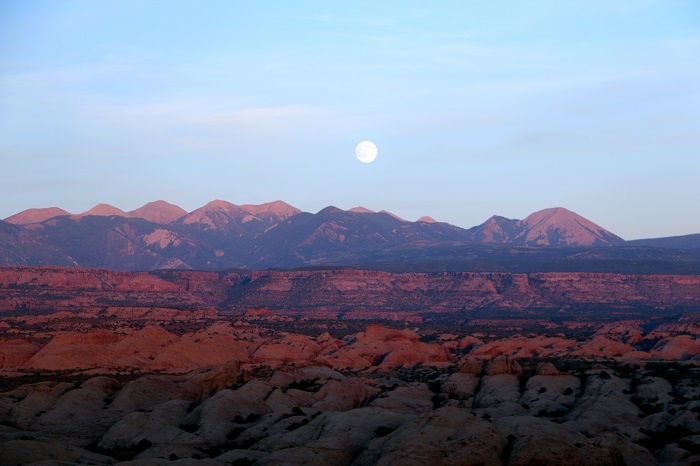
Sundown over slickrock taken on a Jeep tour with Moab Adventure Center. Photo by Richard Markosian.

From March 24 to April 1, Jeeps of all grades and conditions will converge on Moab for the annual Easter Jeep Safari. Jeep Safari was started in 1967 by the Moab Chamber of Commerce, and has grown bigger every year. The event is now sponsored by Red Rock 4-Wheelers, who sponsor other events throughout the year, as well as mark and clean the trails. Guided trips are available with pre-registration .

Jeep Safari isn’t the only time to enjoy backcountry adventures. Moab offers Jeep rentals at Moab Adventure Center, Canyonlands Jeep and Car Rental, Twisted Jeep Rental and Tours, and Cliffhanger Jeep Rental.

Trails vary in difficulty from easy to difficult and everything in between. Try Picture Frame Arch trail for an easy, stress-free ride leading to two impressive arches and an overlook into Kane Creek Canyon. For something a little more adventurous, there is Hidden Canyon Overlook. This trail can be narrow in spots, with several rock ledges that require careful tire placement. And for those looking for an adrenaline rush, Poison Spider Mesa can’t be beat. This trail is usually combined with Golden Spike and Gold Bar Rim for an all day excursion. Be advised that the more difficult trails require equipment such as lockers, large tires, and high clearance.

It is always good to have a detailed trail map, plenty of water, some food, and basic repair equipment. It is advisable to go with other parties and stick to designed trails. Beginners may want to try a guided tour.

Hikers & Bikers (Younger couples)
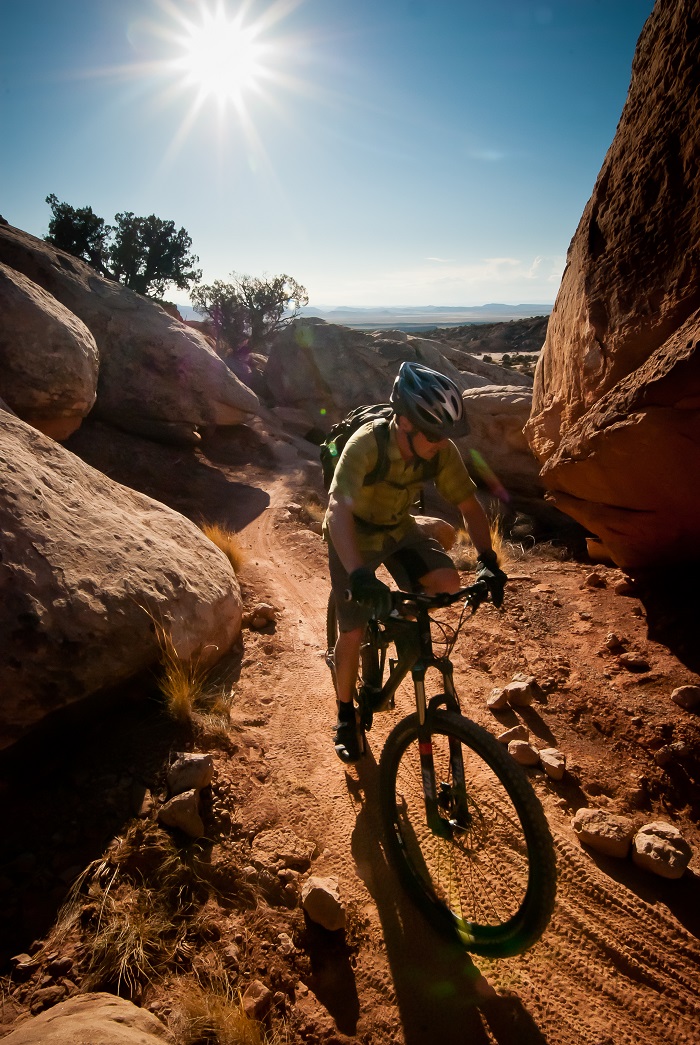
Photo by Robby Miller.

Two Amazing Days in Moab: Wake up at 8am and eat breakfast at Ekleticafe. It’s a tiny little place, but with an amazing patio and excellent food. Peruse the main drag in Moab, and grab a juice and a sandwich to go from Peace Tree, another topnotch restaurant in town, then head out for a long, adventure-filled day.

Rent bikes from Poison Spider Bike Shop. Advanced and daring mountain bikers will want to try the Porcupine Rim trail, accessed from Kane Creek Road. It’s an amazing cliff-side trail. For an easier route that is still spectacular, ride Amasa Back. Be sure to take plenty of water and some food. It’s also a good idea to have cell phones for both riders in case of emergencies.

The Porcupine Rim trail is a bit off the beaten path, making it far less crowded than more popular trails such as Slickrock and other branded trails, but if you aren’t into technical single-track, ask your rental shop about the best ride for your skill level.

After an exhilarating ride, stop at Miguel’s Baja Cantina. They have top-notch margaritas, made with fresh lime and top shelf tequila. We usually order their chips and salsa and add guacamole. I relish their fish tacos, and their fajitas are on par with any big city fresh Mex.

The next morning, enjoy a sit-down breakfast at Peace Tree. Try their vegetarian and vegan options for juices and scrambles. Pre-book a horseback ride at Red Cliffs Lodge. After the 60-90 minute ride, tickle your palate by tasting the local wines. Castle Creek Winery is the largest winery in Utah, and their Cab, Merlot and Outlaw Red are some of our favorites. Take home a case—it’s legal!

In the evening, book a trip with Red Tail Aviation to see Canyonlands in all its glory from the air, bathed in the golden light of sundown. If it’s not sky but water you’re after, try a jet boat tour on the mighty Colorado with Moab Jet. This will make for a jam-packed day.

If you can’t fit it all in to one day, make it a three-day weekend and save a huge amount of money by renting a Wandervan and booking a campground. Wandervans are spacious enough for up to eight people. And if you can’t imagine pitching a tent, they are a great alternative for budget-conscious visitors when hotel rates in Moab are in excess of $300 per night.

Show us photos of your Moab trips by hashtagging us #utahstories on Instagram.

FOR MORE STORIES ABOUT MOAB GO HERE

 

Join our newsletter.
Stay informed.


  • Inside Moab’s Political Divide: Land, Tourism, and the Future of Grand County, Utah

    In the late 1950s, Edward Abbey took a job as a park ranger at Arches National Monument, just outside Moab. What he found there, and what he watched happen to it, would shape the rest of his life. Roads were being cut into the canyon country. Cars were replacing foot traffic. The National Park Service, in the name of accessibility, was engineering a kind of industrialization of the wilderness he’d come to love. Abbey wrote about it in Desert Solitaire, published in 1968, and the anger in that book wasn’t abstract. It came from watching something specific be changed by people who either didn’t understand what they had or didn’t care.

    Grand County has long been the most reliably left-leaning county in the state, a fact that puts it in sharp contrast to nearly everything around it. To understand how that happened, and where things stand now, I spoke with longtime residents and politicians who’ve watched it from the inside, people who’ve served in local government and lived through the shifts firsthand.

    Robert Greenberg.

    Bob Greenberg came from New York in 1976, took a job at the community mental health center, and never left. He went on to chair the Grand County Democratic Party and serve on the county council. When he arrived, he said, “the Democratic Party was said to be able to meet in a phone booth” — and even then, its members were a contradictory bunch. Yellow Dog Democrats from the oil patch were fiscally conservative but surprisingly open socially, allowing different demographics to feel safe moving to the county. 

    “The town fathers were desperate to have new people come to town,” Greenberg recalls. “They just didn’t want the people who actually showed up. They wanted some other people.”

    What followed was a demographic shift nobody planned. The people who filled the gap left by the bust were river guides, federal agency workers, artists, and eventually waves of outdoor recreationists discovering that southeastern Utah was among the most spectacular landscapes on earth. Tourism ended up being the only economic development avenue that actually worked. Manufacturing never had the labor force or market access, sewing factories came and went. The people the tourist economy attracted tended to be younger, more outdoor-oriented, and more liberal.

    Kevin Walker.

    Kevin Walker, a former Grand County commissioner who moved here in 1990 for the landscape, puts the county’s diversity in context. “Moab [is] a pretty diverse place since, I think, at least the 1950s with the uranium mining boom,” he says. “So it’s not a typical Southern Utah town.” 

    Part of what makes Grand County distinct is self-reinforcing. Federal agencies like the Park Service, the Forest Service, the BLM, have large presences here and pull in a different demographic than surrounding counties. People looking to live in Southern Utah with certain values gravitate toward the place where those values already have a foothold. Over time, that critical mass has made Grand County what it is politically, while neighboring counties went in very different directions.

    The defining conflict in Grand County has always been over land.

    In the 1970s and 80s, it was extraction versus preservation in the starkest terms. County commissioners floated toxic waste incinerators. A plan emerged to site a high-level nuclear waste repository at the entrance to Canyonlands National Park. 

    “It really, really galvanized environmentalists everywhere, but particularly in Grand County,” Greenberg says. Activists put up signs at the park entrance, watched them get chainsawed down, and came back with steel reinforcement. That stubborn, physical, unglamorous persistence became part of the local political character.

    Continue reading and support independent Utah journalism with a purchase of Utah Stories (Digital + Print) or 3 month free trial (Digital).


  • Moab Trail Closures: The Fight Over Public Land Access and Off-Roading

    Trail closures threaten livelihoods and slowly limit access to ordinary families, says Dave Hellman, owner of Xtreme 4×4 Tours in Moab. Wilderness advocates argue that stronger protections are necessary to preserve fragile landscapes. As lawsuits reshape trail access across southern Utah, Moab increasingly sits at the center of a growing conflict over who public lands are really for.