Ogden

Do Tunnels Run Under Ogden’s 25th Street?

Are Ogden’s tunnels real or legend?

|


speakeasy2
Illustration by Chris Bodily

As a railroad hub and industrial center, Ogden has seen its fair share of colorful and sometimes questionable history. At the heart of that history is 25th Street. Infamous for everything from opium dens and bootleggers to prostitution and gambling, 25th Street has been home to a thriving underground. Perhaps that is why legends persist to this day of a series of tunnels that once connected the entire street beneath the surface.

Allegedly dug by Chinese immigrants in the late 1800s as opium dens, these tunnels have captured the imaginations and memories of Ogden residents. But were there really tunnels stretching from First Security Bank to the Union Station and zigzagging back and forth beneath the street?

In a project to gather the stories of Ogden’s older residents, researchers and professors from Weber State University interviewed people who had grown up in and around the city. Several mentioned the tunnels, though none of the interviewees could say that they had personally been in the tunnel network. Ray Mora, born in 1926, said he had heard of a tunnel going from the Ben Lomond Hotel to the train station, but that his brother would know far more about it. James Ritchie, born 1925, said he understood there were tunnels connecting much of 25th Street, but also said, “I never saw a tunnel. I couldn’t prove it. That’s just rumor.”

Others say they had heard of the tunnels, but assumed people had blown things out of proportion. Claire Knight said, “Tunnels under the street? I don’t believe there were any—I know there was tunnels under the sidewalk.” He went on to describe freight elevators that would rise up through the sidewalk to move goods into basements. Frank Zampedri described large, interconnected basements that could cover up to an eighth of the block and said “maybe that’s where they get this tunnel system.”

There are plenty of stories about the tunnels, but what evidence is there? Greg Montgomery, planning manager for Ogden City, thinks the tunnel legends come from a mixture of fact and fiction. There were definitely freight elevators, connected basements, and stairs leading down from street level. He explains, however, that “When we did the reconstruction of 25th street to put the sidewalks and sewer lines in we came across some of these basements but we never came across any that connected across the street.”

So where do the stories come from? Montgomery says, “We don’t have real evidence other than these minor connections, but you still have people who claim these things. What is the real story? We don’t know. Yeah, there were connections, there were spaces underneath the sidewalk, and to a little kid they looked pretty big.” Perhaps people remember walking in the tunnels under the union station to get to their train platform, or going down to a basement and seeing a door leading out under the sidewalk. These memories could have expanded and created a narrative of long, elaborate tunnels. Or perhaps we just haven’t found the right evidence yet.
img_8921
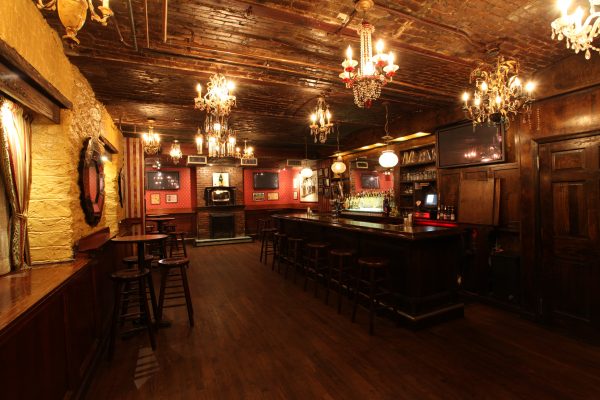
Rumors of underground speakeasies in Ogden fuel the debate about 25th Street tunnels.

But even if the basements of 25th street weren’t really part of a tunnel system, they saw plenty of excitement in the first half of the twentieth century. The city has pictures of officials bringing slot machines up to the street after conducting gambling raids and accounts of police officers busting opium dens. Many residents remember seeing Rosie, a prostitute at the Rose Room who (according to some) would walk her pet ocelot down the street. Some laugh about bars and restaurants that would have a switch to change the tubes to a water barrel if officials came looking for illegal alcohol during Prohibition. So whether or not the tunnels ever existed, they certainly add to the story of a city whose truth is just as bizarre as its fiction.


, ,

Join our newsletter.
Stay informed.


  • The $7 Million Recruit: How NIL Changed College Athletics Forever

    In 2012, Jabari Parker, a top high school prospect and member of the Church of Jesus Christ of Latter-day Saints, was facing his biggest decision to that point in his life: where to play college basketball. 

    Fans of BYU athletics hoped and perhaps prayed that Parker would pick the school owned by the church he was raised in. BYU was listed as one of his final choices. But he ultimately chose to spend his college years at Duke before attempting a career in the NBA. BYU fans were disappointed, but no one was truly surprised. Duke over BYU was the best choice for a young prospect in 2012. 

    A.J. Dybantsa.

    What changed between 2012 and 2024 when A.J. Dybantsa, the number one high school prospect, chose BYU over every other school? The answer is roughly $7 million dollars. That is what Dybantsa is reportedly making to play basketball at BYU. 

    The deal was supported by Utah Jazz owner Ryan Smith, who met multiple times with the Dybantsa family in multiple attempts to bring the young player to Provo. 

    According to Smith, he had no financial role in bringing Dybantsa to BYU, but the influence of Utah’s most famous billionaire acting as a “booster” or unofficial recruiter certainly swayed the decision.

    Prior to 2021, boosters acting as recruiters was taboo to the NCAA governing body. It was called improper recruiting. But in 2021, California began the modern era of NIL, or the ability of a college athlete to benefit from their name, image, or likeness, when they passed the “Fair Pay to Play Act.” 

    This new law gave college athletes in California the ability to benefit from their NIL, something that was banned in the rest of the country to that point. The NCAA saw that this law would create an unfair advantage for California schools that could now give young athletes the chance to make money off their talent and image while still in college. 

    The NCAA knew they needed to do something quickly, so they rushed through a policy that opened up NIL to all college athletes in the country, and it has been expanding and evolving over the last four years. 

    Grant Duff, who has coached at the University of Utah, Weber State University, and is now the defensive coordinator for Idaho State University, says, “The best part of NIL is that athletes have an opportunity to make good money. The downside comes with the free-for-all that money causes.”

    Dybantsa confers with BYU Head coach, Kevin Young.

    One of the biggest current examples of what a school can do when the boosters are willing to pay for success is Texas Tech University. From 2020-2024, Texas Tech had 34 wins, which works out to 6.8 wins per year with a low of 4 wins and high of 8. Then Texas Tech’s boosters got involved, led by Cody Campbell, an oil industry businessman and Chairman of the Texas Tech board. The football program was given 28 million dollars for NIL with a simple message attached to the large pile of money: Win. And win now. And win they did. 

    By signing NIL deals with athletes in the transfer portal, Texas Tech went from a middle-of-the-pack school in their conference to one of the top 12 teams in the country. They didn’t just win games in 2025, they made many of their opponents look like they didn’t belong on the same field, including the University of Utah and BYU twice. That is what money can buy.

    Continue reading and support independent Utah journalism with a purchase of Utah Stories (Digital + Print) or 3 month free trial (Digital).


  • Ogden Utah: Boomtown, Bargain, or Utah’s Next Unaffordable City?

    With its reinvigorated downtown and close proximity to mountains and river pathways, this northern Utah city is enjoying a renaissance. Ogden’s stock of affordable housing — compared to other metros along the Wasatch Front — currently draws people in for a closer look. 


  • The Reality of Meth Psychosis on Utah’s Streets

    On the streets of downtown Salt Lake City, psychosis has become part of the landscape.

    People scream at invisible enemies. Some believe they are prophets. Others wander through traffic carrying conversations with voices nobody else can hear. To passersby, it can look theatrical, bizarre, and absurd. But behind many of those episodes is a darker reality few people want to confront directly: methamphetamine-induced psychosis, prolonged sleep deprivation, trauma, addiction, and the slow destruction of a person’s ability to distinguish reality from delusion.


  • The Utah Bombings That Exposed One of America’s Greatest Forgers

    On an ordinary October morning in 1985, downtown Salt Lake City was shattered by a blast that killed businessman and document collector Steve Christensen. Hours later, a second bomb tore through a quiet Holladay neighborhood, killing Kathy Sheets, the wife of Christensen’s former business partner. The next day saw a third explosion. This one was in a car near Temple Square that nearly killed rare-documents dealer Mark Hofmann. 

    Rumors swirled instantly, tying the attacks to money, religion, and shadowy early-Mormon documents Christensen had recently acquired. For days, Utah held its breath. What unfolded was stranger and darker than fiction. The bombs weren’t the work of religious extremists or enemies of the Church of Jesus Christ of Latter-day Saints, but instead, the doings of Mark Hofmann himself. Hofmann was a nerdy, soft-spoken dealer who had secretly become one of the most skilled document forgers in American history. 

    His creations were so convincing that they reshaped historical narratives, fooling scholars, collectors, and church leaders. When the lies began to close in, the bombs became his final, desperate attempt to keep his world from collapsing.

    Hofmann had been fabricating Mormon and American historical documents for years. He was a prodigy of deception, sourcing period paper, mixing inks that cracked just right, and mimicking handwriting with obsessive precision. Most of all, he knew how to read people. Utah in the 1970s and ’80s was a collector’s paradise. As bookseller Ken Sanders told Salt Lake Magazine, it was “a consciousness shift,” a recognition that rare Utah history was a treasure worth pursuing. It was also, he notes, fertile ground for affinity fraud.

    Nothing captured that vulnerability more than the Salamander Letter, a supposed 1830s correspondence which claimed Joseph Smith encountered a magical white salamander rather than an angel. The document shook Latter-day Saint circles. Church leaders, worried about its implications, quietly purchased it along with other materials Hofmann dangled before them. Many reasoned that if the church was willing to buy it, then it must be authentic and true, and Hofmann understood that psychology perfectly.

    Continue reading and support independent Utah journalism with a purchase of Utah Stories (Digital + Print) or 3 month free trial (Digital).