
Utah Stories

2016 Salt Lake Comic Con

The party rolls into town September 1-3.

|


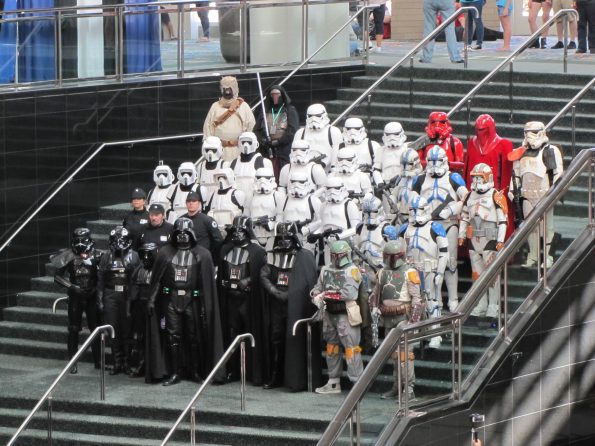
IMG_8762
Photo by Crystal Nageli

Salt Lake’s biggest party returns September 1, 2, 3, as Salt Lake Comic Con opens at the Salt Palace Convention Center, 100 South West Temple. The anticipation grows with today’s big announcement that Mark Hamill, aka Luke Skywalker, will be in attendance on September 1.

Hamill will take photo ops with fans and provide autographs. He’ll also be at a panel with 4,500 excited attendees. For more information about registering, click here.

Dan Farr, Salt Lake Comic Con Founder and Show Producers says, “Star Wars is one of our fans’ favorites and the fact that Mark is making his only U.S. comic con appearance in 2016 at our show is huge for us. For fans that felt a disturbance in the Force, it was Salt Lake Comic Con fans catching their breath when they heard Luke Skywalker is coming to Salt Lake City.”

Bryan Brandenburg, Salt Lake Comic Con Co-Founder and Chief Marketing Officer, is also feeling the excitement. “We promised our fans that there were more guests to come and we’re delivering on that promise in a big way. It says a lot about our attendees and the reputation we’ve built amongst celebrities that a star as big as Mark Hamill would make Salt Lake Comic Con his only United States comic con appearance in 2016. To bring in the movie’s top star of a film so successful is a tribute to how far we’ve come in a few short years.” (From Salt Lake Comic Con Press Release.)

But Hamill and other celebrity guests aren’t the only reasons to be excited. Each year Salt Lake Comic Con features an outstanding Artist Alley, where local artists and near local artists come to show their talent. Utah Stories has written about some of the artists they found at Comic Con.

Beth Trott - Urgency Over Caution
“Urgency Over Caution” by Beth Trott – courtesy of Beth Trott

Beth Trott brought her fantasy art, populated by fairies, unicorns, fair maidens, brave warriors, and of course, dragons to the first Salt Lake Comic Con in September 2013. She is a freelance illustrator and did a great cover for Utah Stories.

Superman commission 2 (2) (1)
Superman by Tyler Kirkham – courtesy of Tyler Kirkham.

We also met Tyler Kirkham at Comic Con. Tyler is a local artist who is able to work from home on comics for DC and Marvel, as well as other comic publishers. He also created his own series, Screwed,  for Zenescope. When starting out he took his work around to various conventions to get feedback from established artists. He is now happy to be on the other side of the table to help new artists.

Billy_Robot-5963
Photo by Dung Hoang


Billy Wells, a local machinist, was also at the first Comic Con and brought along his custom designed robots that he builds from old parts he collects. He said that he found he core audience; “People who fondly remember robots from The Jetsons and Lost in Space.”

Another favorite down the Alley is artist Ben Byrd, who sells whimsical illustrations of Disney characters, comic book heroes, Harry Potter characters and dragons. His booth is always crowded as attendees lineup to see his new creations and purchase a piece of art to take home. He will be at the Salt Lake Comic Con this September.

So, it is great to come for the big name celebrities and try to catch a glimpse of your favorite Power Ranger, but take time this year and explore the hall. You may just find a new favorite artist and take home some art to remember your experience.




Join our newsletter.
Stay informed.


  • Artist Kate Kilpatrick Brings Utah’s History to Life Through Murals

    “I think we’re all interconnected; as individuals as well as societies,” Kilpatrick notes. Her work showcases those connections exuberantly, and whatever scale she’s working on, you can bet that in terms of energy and spirit, she’s painting large.


  • Dyslexia and ADHD in Kids: Why Some Students Struggle to Read in School

    That’s what led to my conversation with Donell Pons, a Utah-based dyslexia expert who has spent more than two decades working with students who struggle to read. What struck me right away is how often we get the problem wrong from the start.


  • Why Most People Stay Stuck in Business and What It Takes to Move Forward

    Every so often, you meet an immigrant who came here with almost nothing and managed to build something exceptional.

    Prakash Shah is the kind of man who has spent enough time around risk that he no longer treats it like an interruption.

    Today, he works in business brokerage and advisory, helping owners sell companies, helping buyers decide whether they should step in, and, when the fit is right, helping connect those buyers with private equity. He works in a world of valuations, leverage, due diligence, and hard questions that most people would rather postpone. He also operates in Utah real estate and has built a career around seeing value before it is obvious to everyone else. That is who he is now. What makes him interesting is how early that instinct started to form, and how little his life resembles the way most Americans are raised to think about comfort, career, and security.

    He grew up in Nepal in a boarding school system that would feel severe to many Americans. He was an only child, yet he saw his parents only twice a year for twelve straight years, until high school graduation. He lived inside routine. He shared space with boys from different social classes and different family circumstances. The school was structured enough that money did not buy you any special standing once you were inside. Everyone followed the same rules. Everyone was subject to the same discipline. In his case, it was an army school. Everything was measured. Everything was scheduled. In that kind of environment, you do not build your life around preference. You build it around adaptation.

    That contrast matters.

    A lot of American children are raised to search for what fits them. What are you passionate about? What do you enjoy? What feels right? Those are not bad questions, but they can create a habit of waiting for life to align itself before action begins. Prakash learned something else much earlier. He learned that life often does not align itself first. You enter the room as it is, you deal with the people in it, and you figure out how to function without making your comfort the center of every decision. He said that one of the biggest lessons from those years was tolerance, the ability to live with people from all walks of life and genuinely learn to get along with them. That is not a soft value. In business, it turns into resilience. In negotiation, it turns into patience. In career terms, it turns into range.

    When he came to the United States over 25 years ago, he did not arrive with the kind of runway that allows for a prolonged identity search. He came with two suitcases and enough money for one semester. He went to Hunter College in New York City, then to NYIT near Central Park, studying media and then media and technology management. He also studied psychology. Those details matter because they show something about his mind. He was interested in people before he built a career around deals. Even then, what attracted him was not technical prestige. It was understanding motives, behavior, and how people reveal themselves.

    But New York is merciless toward vague ambition. It demands payment in rent, transit, food, and time.

    Prakash worked constantly. He took multiple jobs. He paid tuition, paid rent, and skipped most of what Americans imagine as college life. There were no romantic years of drifting from café to concert to self-discovery. He talked about not having the luxury of dates, travel, or finding himself. He was working. Even laundry was not a small detail. In New York, he pointed out, you do not just throw clothes in a machine at home. You haul them to the laundromat, count quarters, and measure what is necessary. He also described distraction in a way that most native-born Americans probably do not think about. For immigrants, distraction is not always pleasure. Sometimes distraction is the constant pressure of competing needs. Tuition or rent. Food or savings. A better coat or another month of making do. He was not romanticizing the struggle. He was describing the arithmetic of it.

    That arithmetic did not make him cautious. If anything, it did the opposite.

    While in college, he had the option of safer analytical work. Instead, he took a sales job with Time Warner Cable that sent him into the South Bronx from 6 p.m. to 10 p.m. to knock on doors. He is not a physically imposing man. He knew exactly what kind of neighborhoods he was walking into. He described apartment buildings where people kept pit bulls, where tension was normal, where one mistake in tone or timing could end a conversation immediately. For most people, that kind of job would have been something to survive and forget. For him, it became a school in human behavior. “It’s not about talking… it’s about listening,” he said.

    One story from that period says almost everything about how he operates. He knocked on a door one night around 8:45 and found himself facing a huge man with a gun on the table, pit bulls nearby, and a half-eaten pizza in front of him. It had all the ingredients of a very bad scene.

    Continue reading and support independent Utah journalism with a purchase of Utah Stories (Digital + Print) or 3 month free trial (Digital).


  • Ancient Pyramid Discovered in Sugar House Park, Salt Lake City

    A Salt Lake City resident says he may have uncovered what he believes to be a buried structure beneath a well-known hill in Sugar House Park, raising questions that have drawn both curiosity and skepticism.