Utah Stories

Babs in the City

Babs explores Utah’s water rights.

|


image002Utah’s Water World

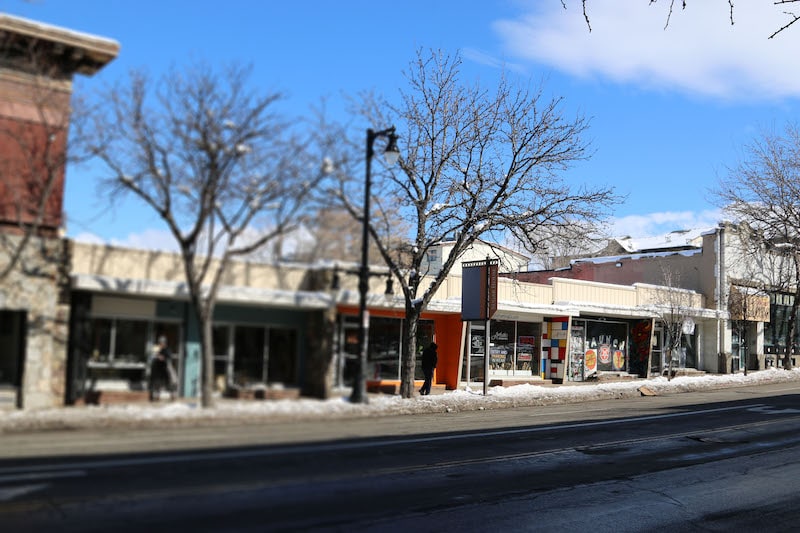
How many movies have you seen at Utah’s favorite arty theater complex, The Broadway? Have you ever read the 2’ X 3’ plaque mounted on granite between the box office and the sidewalk? It’s a simple little monument to the “Beginning in America of modern irrigation in this vicinity on July 23rd and 24th by the Mormon Pioneers.” And here’s the rest of the story:

Precious desert water didn’t just come out of faucets when ol’ Brigham Young and his followers came to the capital city. It did, however, come flowing out of streams from our then-to-be-named canyons surrounding the valley floor. City Creek was the closest water source to where the white settlers camped and, “On July 24th this forenoon commenced planting our potatoes after which we turned the water upon them and gave the ground quite a soaking.” Here was the first garden and the first way to water as ditches were dug and the flows were trained and diverted downhill.

During the first decade in Salt Lake, the new Utahns figured out a logical distribution system to get the liquid gold to the best producing gardens and farms. You see, no one actually owns water rights in Utah. After all, it’s the State that oversees individual uses. Until recently, Utah law forbade us from legally collecting rainwater for our urban patches of tomatoes and cilantro.

In the early days, local bishops of the LDS Church throughout the state became the stewards of water control. In 1852, the territorial legislature (later the Utah State Legislature) granted authority to local courts to control and distribute water, then later authorized irrigation districts. Our water laws were fine-tuned in the 1880s and haven’t changed much since.

Water rights and water shares are extremely valuable for many reasons. You may or may not know that many of the world’s largest banks are slowly buying up water rights? Water is more precious than gold, and we only have so much of it to last.

 

Babs De Lay: Broker Urban Utah Homes & Estates

Join our newsletter.
Stay informed.


  • How I Lost 120 Pounds and Changed My Relationship With Food

    Throughout most of my life, I used food to cope with chaos, depression, and pain I did not yet understand. By my early twenties, I weighed over 320 pounds and felt trapped in a body that limited every part of my life. This is the story of how learning about food, mental health, and habit-building helped me lose 120 pounds and rebuild stability.


  • Highway 6 and the Midland Trail: Utah’s Transcontinental Highway History

    From Price Canyon to Delta’s desert stretch, Utah played a central role in building the Midland Trail, one of America’s earliest transcontinental highways and the foundation of today’s Highway 6.


  • When Main Street Burned: The Aftermath of the Salt Lake City Fire That Hit Downtown Bars

    Fire doesn’t respect zoning, property lines, or even the most popular block on Main Street. On the evening of Monday, August 11, 2025, a blaze that began around 8:40 p.m. on Main Street. It moved quickly through a row of aging, interconnected buildings that had become the heart and soul of Salt Lake City’s fledgling bar district. By the time firefighters brought it under control, multiple businesses were damaged, dozens of workers were displaced, and one of the city’s most active stretches went dark.

    The fire started at London Bell and spread into neighboring structures, severely damaging Whiskey Street. White Horse never caught fire, but smoke, water, and a partial roof collapse caused extensive interior damage, forcing a full rebuild. Other nearby businesses were affected as well, including some that had helped turn this part of Main Street into one of its most active and economically stable stretches.


  • Utah Acquires US Magnesium Assets in $30M Deal to Protect the Great Salt Lake

    Utah leaders announced the state has successfully won the bid to acquire key assets of the defunct US Magnesium facility on the Great Salt Lake, including its associated water rights and property.