Utah Stories

10th International University of Utah Screendance Festival: VideoDanza

Join the University of Utah’s Departments of Modern Dance, Film & Media Arts and the Center for Latin American Studies for the 10th Annual Screendance Festival.

|


Community Press Release

10th International University of Utah Screendance Festival: VideoDanza!
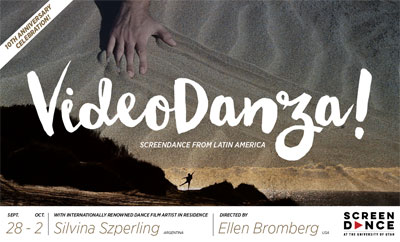
Videodanza-Poster

Presented with award winning Argentinian Dance Filmmaker Silvina Szperling 10th International Screendance Festival Curated by Silvina Szperling with Guest of Honor, Douglas Rosenberg


August 10, 2015 – The University of Utah’s Departments of Modern Dance, Film & Media Arts and the Center for Latin American Studies are pleased to announce the 10th International Screendance Festival, VideoDanza! Screendance from Latin America. The Festival consists of two free events with different films shown at each screening.

Founded in 1999 by Distinguished Professor Ellen Bromberg, the festival was an annual event until 2002, after which it has continued on a bi-annual or tri-annual basis.Throughout these years Professor Bromberg has hosted visiting artists and scholars from across the country and around the globe to screen their films, teach workshops and engage in symposia and critical analysis of this hybrid art form. Guests have included Douglas Rosenberg (the first four festivals), Victoria Marks, Ann Daly, Naomi Jackson, Brian Patrick (Dept. of Film & Media Arts) Bob Lockyer (England) Laura Taler (Canada), Katrina McPherson (Scotland), Simon Fildes (Scotland). In addition, Professor Bromberg has curated screenings that range from historical works to the most contemporary innovations in film, video and animation.

Videodanza! will run September 28 – October 2, 2015 and welcomes Ms. Silvina Szperling, Argentinian dance filmmaker, curator, journalist, and Professor at Universidad Nacional de las Artes (UNA) in Buenos Aires. During the week of Ms.Szperling’s residency, she will teach classes including Screendance, (Dance & Film & Media Arts) Spanish Literary Theory (Languages & Literature/Center for Latin American Studies), and more.

“Through these classes Ms. Szperling will illuminate the nature of cultural difference as practiced in the field of screendance, and will clarify and articulate the many ways in which dance, screendance and the arts in general provide a different dimension of understanding to students in a variety of academic disciplines,” said Bromberg.

Free Public Screenings

Thursday Oct 1, 2:30-3:30pm, Student Union Auditorium (U of U Campus)

A screening of shorts from throughout Argentina including CHÁMAME, the award winning film directed by Ms. Szperling and performed by sister Susana Szperling. Filmmakers and choreographers include Carla Schillagi, David Farías, M. FernandaVallejos, Mariano Ramis, Andrea Servera, Karin Idelson, Claudia Sánchez, Néstor “Polaco” Pastorive, and more …

Friday Oct 2 ,7:30pm Dumke Auditorium, University of Utah Museum of Fine Arts

An evening of contemporary screendance shorts from throughout Latin America including Cuba, Argentina, Brazil, Ecuador, and Paraguay. The screening will be followed by a discussion and Q & A with Silvina Szperling, Douglas Rosenberg and Festival Director, Ellen Bromberg.

Join our newsletter.
Stay informed.


  • Highway 6 and the Midland Trail: Utah’s Transcontinental Highway History

    From Price Canyon to Delta’s desert stretch, Utah played a central role in building the Midland Trail, one of America’s earliest transcontinental highways and the foundation of today’s Highway 6.


  • Whiskey, Bullets & a Buried Town: Archaeologists Reveal Alta’s Wild Past

    Before Alta was known for powder days and lift lines, it was a silver mining town clinging to the side of a narrow canyon. In the late 1800s, men lived at 8,000 feet, went underground each day, and endured winters that regularly buried buildings in snow. This past summer, that mining town resurfaced — literally — during construction at the Alta Ski Area.

    To understand what Alta really looked like, you don’t begin with legend. You begin with its trash — and this time, that happened almost by accident.

    Alta Ski Area was installing underground water reservoirs to support snowmaking. Because the project sits on Uinta-Wasatch-Cache National Forest land, an archaeologist was required to monitor the excavation. No one expected the trench to produce much.

    But, It did.

    Artifacts began surfacing almost immediately. Enough that the Forest Service contacted the Utah State Historic Preservation Office for help. Lexi Little, who coordinates the Utah Cultural Site Stewardship Program, helped mobilize nearly 30 volunteers to assist with what quickly became a focused two-week excavation.

    Winter deadlines were approaching. The pipes for the reservoirs had to go in the ground. There wasn’t time for a slow, extended dig.

    “It was two weeks of digging in the dirt and helping figure out exactly what we were looking at,” Little said.

    Most of the people screening soil weren’t professional archaeologists. They were trained stewards from around Utah — part of a statewide volunteer network that now approaches 500 people. They poured dirt through shaker screens, scanning for fragments that could piece together a town long buried.

    “Archaeology is human trash,” Little explained. “Archaeologists are very into trash.”

    Alta had left plenty behind.

    https://youtu.be/hzIHzx3OGoo?si=dKcl2CEz-t6FZzYw

    Victorian-style ceramics appeared first — the kind typically used in hotels. Medicine bottles followed. Ink bottles. Hand-blown glass. A porcelain doll’s foot surfaced from the soil, a small detail that shifted the mental image of the town. Families were here. Children were here. This wasn’t only a camp of miners.

    The bottles helped establish time. Manufacturing details — whether glass was hand-blown or mold-made, whether a maker’s mark appeared on the base — allowed archaeologists to date many of the artifacts to the 1870s through the 1890s, when Alta was booming as a silver mining town.

    “That gives you that range of dates for when Alta was really booming,” Little said.

    One reusable soda bottle clearly stamped “Salt Lake City” connected the canyon to the valley economy below.

    Then something unusual rolled out of a dirt pile.

    A corked bottle. Intact. Liquid still inside.

    To access this post, you must purchase Utah Stories (Digital + Print) or 3 month free trial (Digital).


  • The Only Full Bottle of Alcohol Ever Found in Utah Was Unearthed in Alta

    When a backhoe rolled a corked bottle out of the dirt at Alta this summer, no one immediately grasped what they were holding. It wasn’t empty. It wasn’t shattered. It was full. “The bottle that was discovered up at Alta is the only bottle of alcohol ever discovered in an archaeological excavation in the state…


  • How Horses Help Kids Heal: Inside Utah’s Equine Therapy World

    Kelty Johnson trains horses for a living, but her deeper work happens in the quiet space between animal and human. On the Utah Stories podcast, she explains how equine therapy helps children regulate emotions, build confidence, and reconnect through presence rather than pressure.