Moab

Moab Ziplining – Raven’s Rim Zip Line Adventures

For real adventure and the best in ziplining go to Moab, Utah.

|


Raven's Rim Zip Line Adventures resized
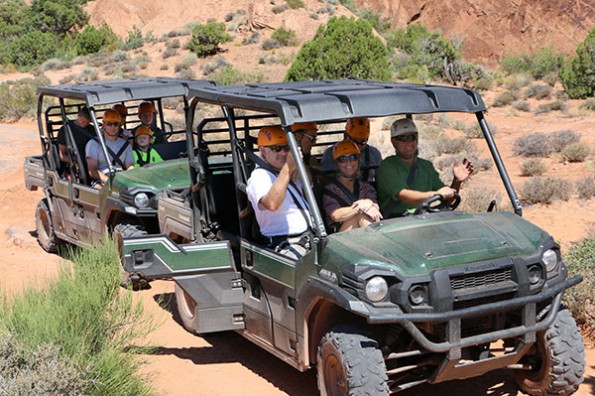
Travelling to the start of the zipline course. Photos by Richard Markosian.

Raven’s Rim Zip Line Adventures is a marvel for the novice zipliner like myself.

I’ve never ziplined. But I’ve certainly benefited from the great modern marvels produced using strong cable. Such as elevators, trams, chairlifts and suspension bridges. Ziplining is more raw and simple.

Ziplining was actually invented for bird watching. The concept is to travel on a cable using just a body harness attached to a small trolley. The trolley can handle extreme amounts of weight and travel at very high speeds safely. It’s essentially a carbon neutral method of travel. The only rule is that point B is lower in elevation than point A. Gravity is doing all the work.

Most ziplining rides are not intended for birdwatching unless the birds were large hawks or condors traveling at high speeds. I find that a zipline ride is a combination of skydive, roller coaster, a base jump and a James Bond trick.

Deciding whether or not I want to try this, with Raven’s Rim Zipline Adventures in Moab, Utah, I witness families of all ages in a semicircle following instructions as they gear up in full-body harnesses and have a helmet, handle bar and trolley attached to their harness in preparation of their zip line adventure. The equipment brings forth feeling of excitement, animosity and intrigue.

To reach the zipline course we hop in side by side UTVs and travel over big rocks and boulders on a very narrow, very steep road. I don’t believe I’ve ever traveled on a more gnarly road. After 20 minutes of dust, rocks, boulders and some local information along the way … we arrive at the first of 6 different ziplines. At 280 feet “Sneak Peek” is the shortest zip line providing a great introduction to zip lining and finishing with “Homerun” the longest zipline at nearly 1,400 feet or roughly a quarter mile.
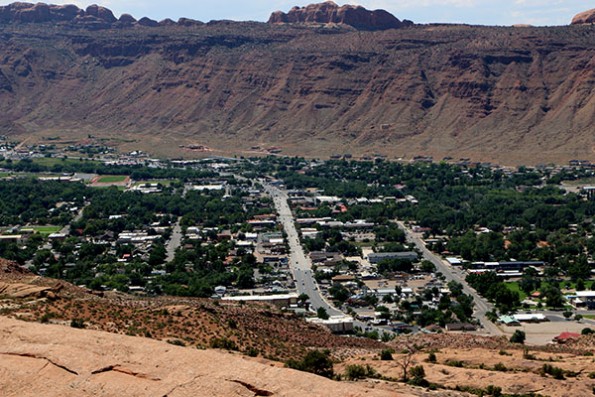
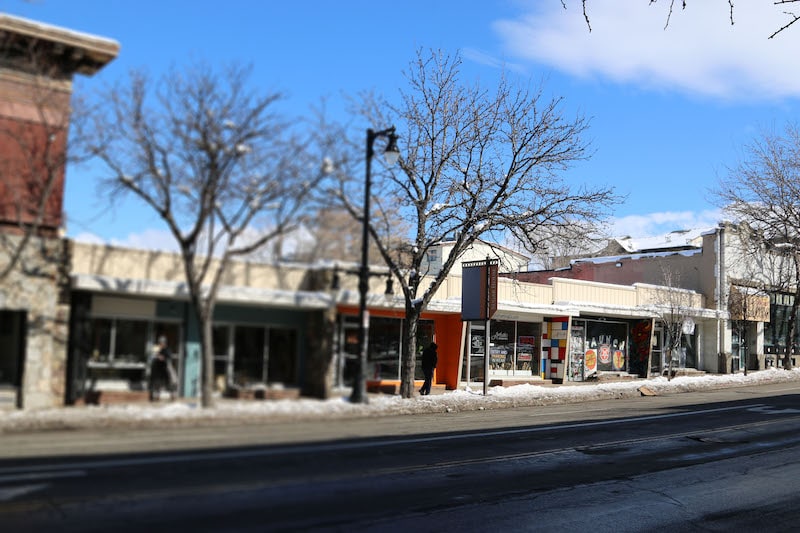
moab town resized
View of Moab from the middle of the zipline course.

I find my eyes glued to the rock we will be jumping off and soaring over. I trust that the zipline is well anchored into the rock. As I inspect the course, everything is overbuilt. Still my nerves have the best of me. This has been done by many people, many times, but part of be fails to understand why my feet should leave earth and fly over the canyon below. My feet tell me they are very happy being planted securely on the ground. I’ll need to find some convincing evidence to overrule my feet.

First up is Rick, he has his trolley clicked on the cable. Then he’s given the go ahead. Rick runs then leaps into the air, and zips away… like this is no big deal. Then Rick’s wife and in-laws go. Then nine-year-old Liam goes. Then his twelve-year-old brother John zips down the line. These kids aren’t even scared. I can’t wuss out now.  
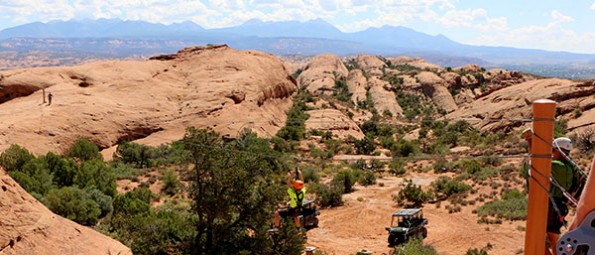
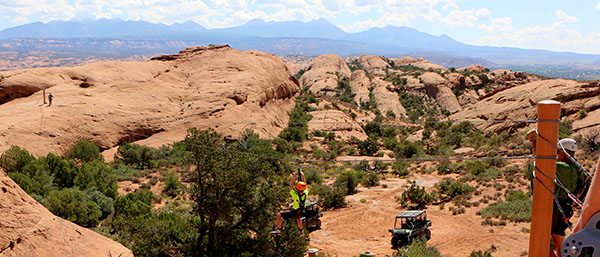
zipliner resizedIt’s my turn. For my first leap of faith I feel a fast sensation of freefall. Then I feel the trolley and wire rope softly catch me from a death plunge. The two wheeled trolley whizzes on the compressed steel cable and the harness allows me to rotate as I pick up more and more speed on the descent. I look down and see cacti, juniper trees and boulders flying through my view, “You don’t need to even hold the handle if you don’t want to” I’m informed. I want to, but others like traveling with their arms out and soar like birds.

The next canyon is deeper and longer. The next is longer still. The third canyon is 450 feet long and we traverse most of them lengthwise from one fin to another. The fourth zipline is 1300+ feet, “Holy Zip!” You are zipping along for what seems like minutes of flying. On the final run I begin to really enjoy the flight sensation. The slow up and down of my weight and the smooth zip across, along with my letting go of the handle produces a zen-like peaceful state of mind. The wind resistance and acceleration on the descent as well as the deceleration on the ascent — now I begin to know how a raven must feel. Those black soaring birds are prolific in the canyons in Moab, and this is the closest sensation I’ve felt relating to them.

After the final and longest line “Home Run” the zippers adrenaline, excitement and happiness is tangible! A short walk back to our UTV’s and for the finale, another 4wd trip back down from the ridge to the office where we remove our gear and to end the tour we get cool wet towels with peppermint essential oils… a very nice touch.

Michael and John, our guides, conduct two of these tours in the hot sun per day.  Our tour lasted a total of around three hours. These guides are so pleasant and happy the entire time. “Does the thrill wear out?” “Does ziplining become a ‘been there done that,’ type of activity?” “Does a raven decide to walk rather than fly?” “I can’t wait to go again!”  I’m hooked.MOAB view resized
Raven’s Rim Zipline opened three years ago, making them one of the newer exciting outdoor adventure activities. The land is leased from the Charles Steen family, whom Charles A. Steen is known as the “Uranium King the World.” The Steen’s previous home is now “The Sunset Grill”, a restaurant perched way up on a hill offering great food and a “Million Dollar View.” We zipline several hundred feet higher than the restaurant.

The rest of the group I ziplined with included a mom and dad with their three boys from New Jersey. Why Moab? John tells me, “If you Google outdoor adventure and sports, Moab is at the top of the list!” They have never been to Utah and they spent just a 1/2 day in Salt Lake and went and saw the Great Salt Lake. They flew across the country to enjoy Moab because this place is an outdoor wonderland full of adventure and discovery.

“They have it all here.” A father of three rambunctious boys says he found the perfect trip. He said their stay was, “A great decision.”


,


Join our newsletter.
Stay informed.


  • Artist Kate Kilpatrick Brings Utah’s History to Life Through Murals

    “I think we’re all interconnected; as individuals as well as societies,” Kilpatrick notes. Her work showcases those connections exuberantly, and whatever scale she’s working on, you can bet that in terms of energy and spirit, she’s painting large.


  • Why Most People Stay Stuck in Business and What It Takes to Move Forward

    Every so often, you meet an immigrant who came here with almost nothing and managed to build something exceptional.

    Prakash Shah is the kind of man who has spent enough time around risk that he no longer treats it like an interruption.

    Today, he works in business brokerage and advisory, helping owners sell companies, helping buyers decide whether they should step in, and, when the fit is right, helping connect those buyers with private equity. He works in a world of valuations, leverage, due diligence, and hard questions that most people would rather postpone. He also operates in Utah real estate and has built a career around seeing value before it is obvious to everyone else. That is who he is now. What makes him interesting is how early that instinct started to form, and how little his life resembles the way most Americans are raised to think about comfort, career, and security.

    He grew up in Nepal in a boarding school system that would feel severe to many Americans. He was an only child, yet he saw his parents only twice a year for twelve straight years, until high school graduation. He lived inside routine. He shared space with boys from different social classes and different family circumstances. The school was structured enough that money did not buy you any special standing once you were inside. Everyone followed the same rules. Everyone was subject to the same discipline. In his case, it was an army school. Everything was measured. Everything was scheduled. In that kind of environment, you do not build your life around preference. You build it around adaptation.

    That contrast matters.

    A lot of American children are raised to search for what fits them. What are you passionate about? What do you enjoy? What feels right? Those are not bad questions, but they can create a habit of waiting for life to align itself before action begins. Prakash learned something else much earlier. He learned that life often does not align itself first. You enter the room as it is, you deal with the people in it, and you figure out how to function without making your comfort the center of every decision. He said that one of the biggest lessons from those years was tolerance, the ability to live with people from all walks of life and genuinely learn to get along with them. That is not a soft value. In business, it turns into resilience. In negotiation, it turns into patience. In career terms, it turns into range.

    When he came to the United States over 25 years ago, he did not arrive with the kind of runway that allows for a prolonged identity search. He came with two suitcases and enough money for one semester. He went to Hunter College in New York City, then to NYIT near Central Park, studying media and then media and technology management. He also studied psychology. Those details matter because they show something about his mind. He was interested in people before he built a career around deals. Even then, what attracted him was not technical prestige. It was understanding motives, behavior, and how people reveal themselves.

    But New York is merciless toward vague ambition. It demands payment in rent, transit, food, and time.

    Prakash worked constantly. He took multiple jobs. He paid tuition, paid rent, and skipped most of what Americans imagine as college life. There were no romantic years of drifting from café to concert to self-discovery. He talked about not having the luxury of dates, travel, or finding himself. He was working. Even laundry was not a small detail. In New York, he pointed out, you do not just throw clothes in a machine at home. You haul them to the laundromat, count quarters, and measure what is necessary. He also described distraction in a way that most native-born Americans probably do not think about. For immigrants, distraction is not always pleasure. Sometimes distraction is the constant pressure of competing needs. Tuition or rent. Food or savings. A better coat or another month of making do. He was not romanticizing the struggle. He was describing the arithmetic of it.

    That arithmetic did not make him cautious. If anything, it did the opposite.

    While in college, he had the option of safer analytical work. Instead, he took a sales job with Time Warner Cable that sent him into the South Bronx from 6 p.m. to 10 p.m. to knock on doors. He is not a physically imposing man. He knew exactly what kind of neighborhoods he was walking into. He described apartment buildings where people kept pit bulls, where tension was normal, where one mistake in tone or timing could end a conversation immediately. For most people, that kind of job would have been something to survive and forget. For him, it became a school in human behavior. “It’s not about talking… it’s about listening,” he said.

    One story from that period says almost everything about how he operates. He knocked on a door one night around 8:45 and found himself facing a huge man with a gun on the table, pit bulls nearby, and a half-eaten pizza in front of him. It had all the ingredients of a very bad scene.

    Continue reading and support independent Utah journalism with a purchase of Utah Stories (Digital + Print) or 3 month free trial (Digital).


  • Ancient Pyramid Discovered in Sugar House Park, Salt Lake City

    A Salt Lake City resident says he may have uncovered what he believes to be a buried structure beneath a well-known hill in Sugar House Park, raising questions that have drawn both curiosity and skepticism.


  • Utah Fits All Scholarship Applications Open Through April 30 for K–12 Students

    Utah families have more learning paths than ever and, increasingly, more ways to make those paths affordable. This spring, the Utah Fits All Scholarship opened  for new family applications on April 1, and the application window stays open for one month. The program is a public K–12 scholarship that provides $4,000 to $8,000 per student,…