“People are surprised when we tell them we have a Hawaiian Canoe Club in Utah. Then we tell them we are based out of the Great Salt Lake, and they are even more surprised,” says Darren Medeiros, Hawaiian native and President of the Hui Paoakalani Outrigger Canoe Club.
“Part of what we love is a little bit of Hawaii in the state of Utah. There are a lot of Polynesians here. We are trying to get them to come and participate and teach their children how to paddle. Many don’t have an opportunity to get back to Hawaii to learn about their culture. Outrigger canoes are a big part of any Polynesian culture.That’s the way our ancestors traveled, hunted and fished,” said Medeiros.
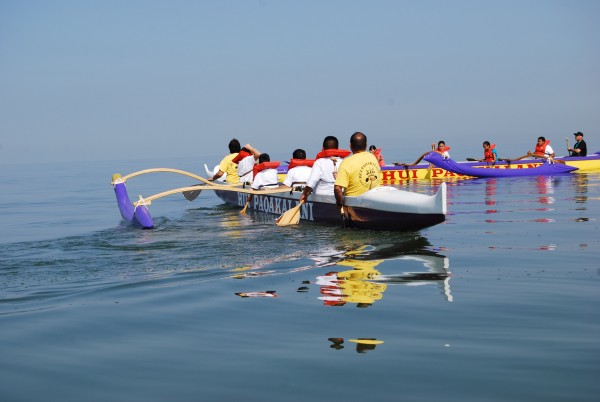
Club members paddle on Saturdays from March through September. Their club is named after the Hawaiian five-time Olympian swimmer Duke Paoa Kahinu Mokoe Hulikohola Kahanamoku, who was a friend of Medeiros family. “Hui” means group or club in the Hawaiian language.
Outrigger canoes have an “ama float” attached to the left side of the canoe to help stabilize it in the water. The ama also keeps the canoe from sinking. The Hui uses two fiberglass, six-person, 43-foot long, 16-inch wide racing canoes, and is retrofitting a third one to be a sailing canoe. The sailing canoe is a little bit wider and shorter. “It’s got to have a mast, a boom and a spar, a sail and all the rigging in it,” says Medeiros. “In Hawaii, they race between the islands, the Big Island to Maui, Maui to Molokai and so forth. That is what we are trying to do here so we can sail around the Great Salt Lake.”
“Originally the boats were carved out of koa wood. They were very expensive and because of the weather they got beat up. They are kept in the shade when they are not in use to protect them,” says Medeiros. “Ninety-eight percent of canoes are now made out of fiberglass so they can withstand the conditions.”
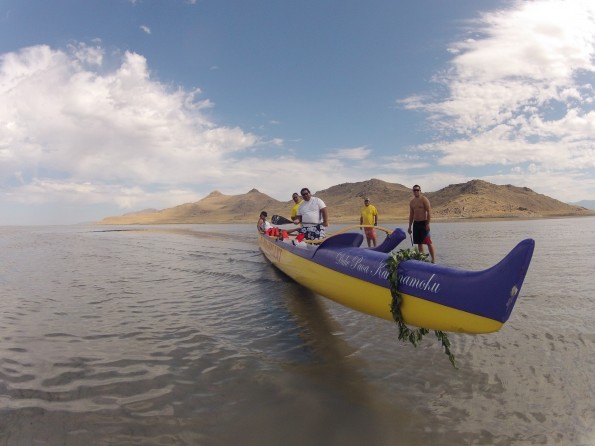
Butch Porter is the team’s coach. A native of Hawaii, he has been paddling and coaching since he was eleven years old back in Oahu. “I was this kid barking orders to all these big guys, and they listened to me,” says Porter. Wanting a change of scenery in the mid ‘80s, he transferred with his job at Western Airlines to Salt Lake City with his wife and two children. He was excited to start paddling again when the “Hui” started eight years ago.
“Butch taught me how to paddle on a bench in the middle of the kitchen,” says Becky Porter, Butch’s wife.
Racing conditions on the Great Salt Lake are ideal due to the dense water, with fifteen percent salinity compared to an ocean’s three percent. The high altitude also makes for really fast paddling. Locally, the lake has the reputation of being smelly because of dead brine shrimp on the shores. “When I first moved here I all heard about the lake was its smell. The more I am out here, the more it grows on you, not the smell,” says Medeiros. “It’s a very unique lake, we enjoy it, and it is perfect for sailing and paddling.”
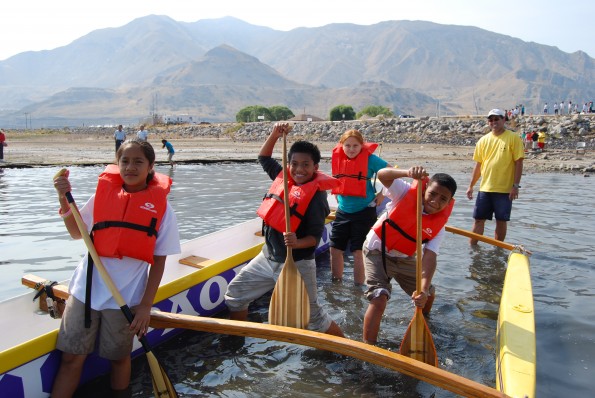 Groups from the University of Utah, Brigham Young University and other local schools have visited the “Hui” to learn the custom of Hawaiian paddling. One of the highlights for a Tahitian paddlers club visiting America was to paddle on the Great Salt Lake. A more efficient paddling technique used by the Tahitians has been adopted by the Hawaiian paddlers; it is a shorter, quicker stroke that stops at the hip instead of past the hip.
“We encourage people to bring their kids; it is fun and family oriented. This is like a home away from home. We have our canoes, we have water, even though the water is different, we have each other and we have our Hawaiian favorites that we bring out here for the potlucks. It is a different world out here,” says Medeiros. “The afternoons here have beautiful sunsets. When you are on the water it is kind of hard to realize you are in Utah, you think you are on the Pacific Ocean. It’s really nice.”
For more information visit www.utah.com/stateparks/great_salt_lake.htm