Examine the terrain on Google Maps and you see almost nothing but dirt and salt and a few dusty roads.
Do people live here? If so how do they earn a living? It turns out that even north of Willard, even past the turn-off for Bear Lake, east along the shore of the Great Salt Lake – there is some incredible beauty to behold. There are also some amazingly innovative people with skills. This area is a hundred times more scenic than it appears on Google Earth. I’ll hear this place called “paradise” twice in four hours.
I continue on a dirt road past the Golden Spike National Monument. The Great Salt Lake is to my left as I drive through no-man’s-land, shotgun shells litter the road. I’ve heard there are jackrabbits in abundance here, but I see only crows.
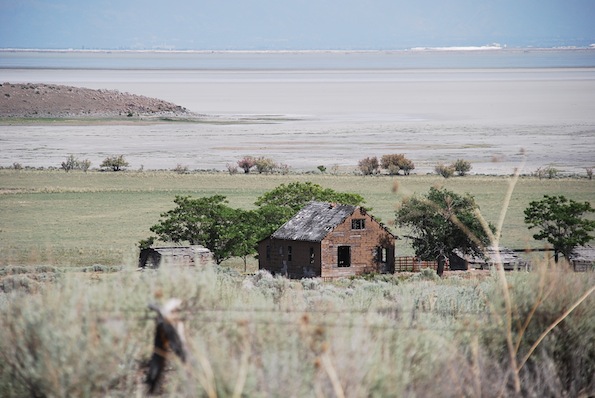
“No Trespassing” signs, barbed wire, and slanting old structures are the only man-made visuals. Further north toward the outer rim of Spring Bay, the landscape changes to fairly lush cattle pasture and a massive valley surrounded by low hills. Two million people could live here, and there would be no impact on the rich farm land they are building on top of in Davis and Box Elder Counties. But instead, the area is vacant and inhabited only by cows. It stretches as far as the eye can see—desolate. I get a bit antsy with the realization that if my two-wheel-drive Toyota broke down, here with no cell service, dirt road and a vast expanse of open spaces—my dogs and I would be doomed. I’m beginning to feel like I might not find the podunk people, only the evidence that they exist and do inhabit this remote region.
The fear of being caught off guard by a redneck believing I’m after his cattle sends me back toward civilization—Highway 84.
A stop in Tremonton to get my bearings. I get reoriented to where I might actually find the podunk people. I hear about Promontory from the editor of the Tremonton Leader. I describe to her what I’m looking for. She gives me a few leads. A one-hundred-year-old man who just renewed his driver’s license. Judy Smith who maintains a gravesite for Hindus who were not allowed to be buried in the cemetery in Fielding. I follow up on Winnie Richman, who writes a column for the Leader and who is a cattle rancher herself. She tells me about her town:
“There are twelve families who live in Promontory,” Richman says, ”who live as ranchers and live raising cattle. The families out here are very much into their family their work and their church.”
This time I take a left before the Golden Spike monument and I’m driving along the east coast of the Great Salt Lake. The Wasatch Front is now far away. The road again turns to dirt, but it’s well-graded and wide. Here there is a clear gradient coastline of hard dirt with sparse sagebrush and grass followed by sand and salt. Apparently enough flora for cattle to survive. I see a man working on his barbed-wire fence out of his truck. It’s about 100 degrees and my dogs need some shade. I stop to talk with him. Outside of the car the horse flies start getting tangled in my forearm hair.
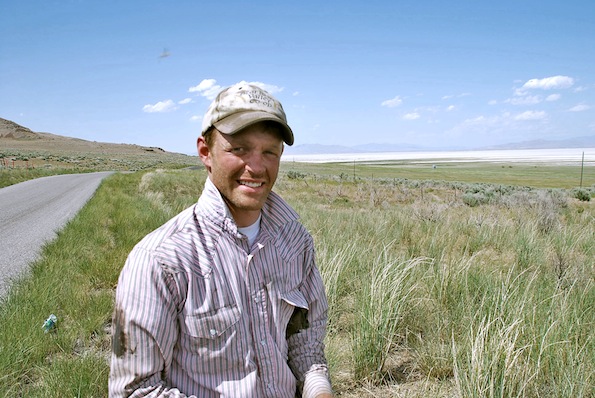
I have finally found podunk Utah, and someone who has a great passion for working here. Jed Shannon has a warm smile, a very natural demeanor and he doesn’t at all fit the sterotype of a podunk farmer I imagined.
“I like being a farmer first of all because I like to work hard, and I like living out here. It’s not something that’s very lucrative. But I want to teach my kids to work hard.” He looks off in the distance and adds, “But I first need to find a woman willing to live out here.”
This is probably a main concern of Jed’s right now, as the horse flies start biting my skin and the extreme heat soaks into my bones. “You better put some bug repellent on.” The nasty creatures draw blood in seconds. When I explain the “podunk” concept of the issue Jed informs me:
“Some people assume that only dumb people go into farming. First of all you could never be successful at farming if you aren’t smart. It’s one of the most challenging things a person could do to make a living. You need to know how to fix things, figure things out on your own. You need to know such a huge variety of things. Farming is baptism by fire.”
Despite already undergoing his heat-scorching baptism, Jed is getting his higher education studying agricultural science at Utah State. “Some cheesy dick was trying to teach us how to farm, but this guy had never done any farming in his life. So I transferred from agricultural techniques to ag science.” Jed says he studies economics, statistics, math, botany and many tough subjects.
While we were standing there, a pickup truck with a horse trailer pulled up, and a skinny man with a big smile waved to Jed. “Now that man there is who you ought to talk to, he’s a stellar farmer, and he probably owns more acreage than anyone in Utah,” says Jed.
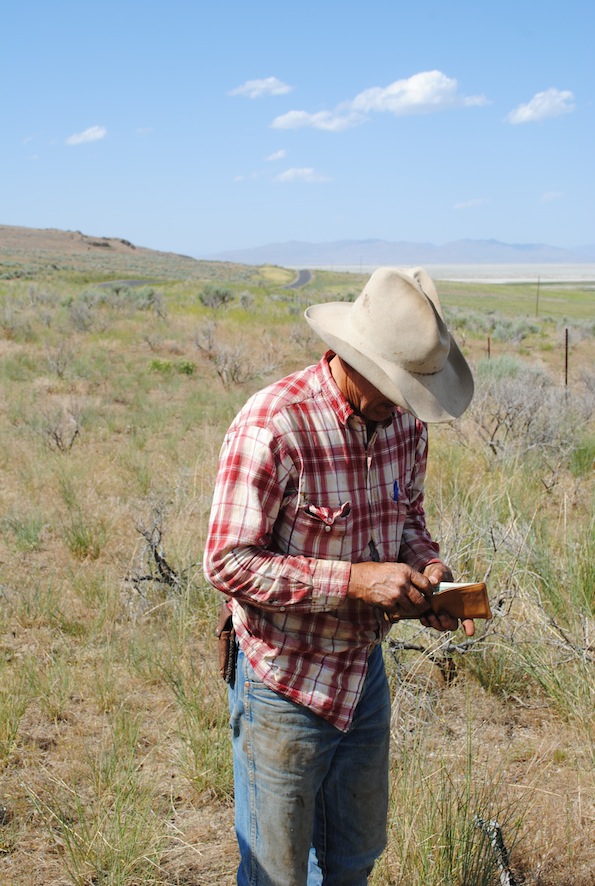
That man happens to be John Young. His daughter, Chessy, tells me that this morning she was “workin’ with calves.” This season they have had 63 new calves; 60 survived, Chessy says. “It’s been a great season.” I learn that the Youngs are fourth generation farmers in Promontory, UT. It’s extremely rare that farm families last these days.
So why did you choose to be a cattle rancher? I ask John.
“First of all, I primarily raise sheep. But this place is a paradise for raising animals.”
“Paradise?” I question, as a horsefly bites my flesh and the scorching heat burns my face. “How’s that?”
“Because you don’t need to provide feed or warmth for the animals in the winter. It’s incredibly mild here in the winter,” says Young.
I can see that John’s kids share his opinion.
“I don’t know what I would do with myself if I lived in a city,” says Chessy.
John has recently changed over his operations to raise more cattle and fewer sheep. “Because the beef prices are so good?”, I ask. I thought I might finally sound like I know what I’m talking about.
“No, it’s because there are a lot of complications with sheep right now.” The nature of the complications he obviously didn’t want to go into. John hands Jed a $100 bill. “Does this square us away on those clips?” He asks Jed.
“Yes.”
Jed explains further why he enjoys raising cattle and farming, “Every day is a new challenge. When I went on my mission, my companions thought that it was so hard waking up early and walking around long distances. For me, those were the easiest two years of my life. The physical challenges of that kind of work were nothing compared to farming.”
Jed has six siblings but just one brother who still lives in the area working at the shrimpery down the road. Jed’s father is a war veteran with health problems. Jed is working mostly alone. This short interaction with just a hard-working guy, studying, killing himself to raise animals, stuck with me long after our brief conversation.
How many people live as connected to the land and animals as this guy? How many people value this lifestyle like Jed rather than filling a home full of toys? Promontory, UT is my podunk find of the year. I only explored Indian Cove and Bear River Bay. I found much more while I was here, but space in this little pamphlet doesn’t permit me to write more about the brine shrimper nor the wood trellis (salt- baked) wood company.
If you are of a curious nature, visit our website and download for $3, “The rest of the story” and five years of Utah Stories’ Off the Beaten Path and small town stories.