Two Local Businessmen Discuss the Growth of Utah’s Popular Small Town
Should Moab grow or should it remain a quaint small town? Many people believe that this is truly an either/or question. The editor of Moab’s Zephyr newspaper decided to leave Moab for Montecello because he determined the city had already been overdeveloped and overpopulated. There are hundreds of Utah towns that are underdeveloped and rural Utah is shrinking. Residents struggle to make a living, politicians struggle to attract investors and more people begrudgingly move to cities. However, Moab has the opposite problem. It has plenty of tourists and investors, but local government leaders have worked more to quell growth than encourage the process.
[showtime]
To understand the mindset of both sides we spoke to two Moab businessmen. One man is deeply connected with the red rock desert around Moab. The other is also connected to the environment, but he is now a large part of developing Moab’s future growth.
A Traditionalist Viewpoint
The first is John Williams who has deep roots in Moab. He is the grandson of Moab’s first doctor. His office also serves as a family history museum decorated with photos from his grandfather and parents who started one of Moab’s first adventure companies. One photo is of his parents after World War II–a beautiful couple, his mother smoking a cigarette, his father drinking a beer. “You can see how happy they were.”
Williams says that if he could go back in time he would prefer to live in the Moab of 50 years ago. “We have got to have a way to make a living in this town,” he says. “There’s a lot of different things going on: hotels and restaurants, vehicle rentals, and my touring business. We have enough to live on with tourists.” I had assumed Williams would prefer the absence of development in Moab, but he adds, “I think that a couple of more motels is not going to make a big difference.”
The town is taking off. In the past 10 years, the population has increased by nearly 40 percent. Tourists worldwide have discovered Moab. Each time I visit the area I hear more foreign languages spoken. This time of year, in the middle of February, businesses are coming out of hibernation to restart their season.
Williams says he would describe himself as an environmentalist, but the reason he would choose to live in the Moab 50 years ago doesn’t have to do with the growth and development, but rather the increase of restrictions and red tape his business, Navtec, is suffering.
Navtec offers 4×4 Jeep expeditions and river rafting trips. Years ago, he says, “It was easier to go into the backcountry. Now it is very event oriented. A lot of the roads that we used to have—the jeep trails—they have closed, which I personally don’t like unless there is a really good reason for it.”
“I don’t want to deal with that.” Williams’ son is following in his great-grandfather’s footsteps instead of his father’s and was recently accepted to attend the University of Utah’s medical school. His daughter has also chosen not to take over the family business. It seems that fighting the feds is taking the fun out of the recreation and adventure business.
A Developer’s Viewpoint
The other businessman is Preston Paxman. Twenty-five years ago he decided to follow his mother’s advice. She had told him her favorite thing to do was to go on the Colorado River tour at night. When she saw that the night tour company was for sale, she said, “You should buy that company.” The good son followed her advice. Paxman bought the business and has slowly acquired more land around the area. He bought water shares to the Colorado River and has built what looks like a small motel, but he says it’s limited accommodations for employees.
The adventure company’s success allowed him to move with his family to Moab. A tall, thin man with a pleasant smile and easygoing nature, Paxman “is a real mover and shaker,” says his daughter. “He built some of Salt Lake City’s tallest buildings.” Twelve years ago he retired from the construction business. His plan was to fulfill his dream of sharing the beauty of the Moab area to tourists from around the globe. He now owns Canyonlands by Night. He says he never imagined that he would move to Moab permanently, but he is in love with the people and the land.
Paxman’s kids are involved. His son Rory sits on the Moab City Council. Over the years, Paxman has successfully continued to improve a truly unique experience: Dutch oven-cooked dinners followed by a slow moving river boat tour at sunset on the Colorado. The float is accompanied by a live oral history of the area, starting with the inhabitants who drew the pictographs that are in plain sight on the cliffs. “You have to love people,” he says with a grin, “and we really love people. And I just have the best people in Moab working here.”
Paxman says that back as far as 1987, he had a survey done and found that the city of Moab needed accommodations for at least three more motels. “We are still turning away groups,” he says. “I do tours on the river and we can’t get in all of the tours that want to come to Moab. They cannot book rooms. Even with this one and the new one that went in, there still is a shortage.“
Paxman has been attempting to grow and develop the northeastern side of Moab for the past 20 years, “but the city was unable to get me water,” he says. It’s clear that Paxman is very careful and courteous when choosing language to describe his difficulties.
He says 10 years ago he finally gave up trying to convince the city to provide him utility lines for his structure so, he says casually, “I went back and got a degree, so I could run a water treatment plant. And then we put our water treatment plant ??? Is there a fact missing here?. I own shares of the Colorado River and I take water out of Colorado River and we treat it.”
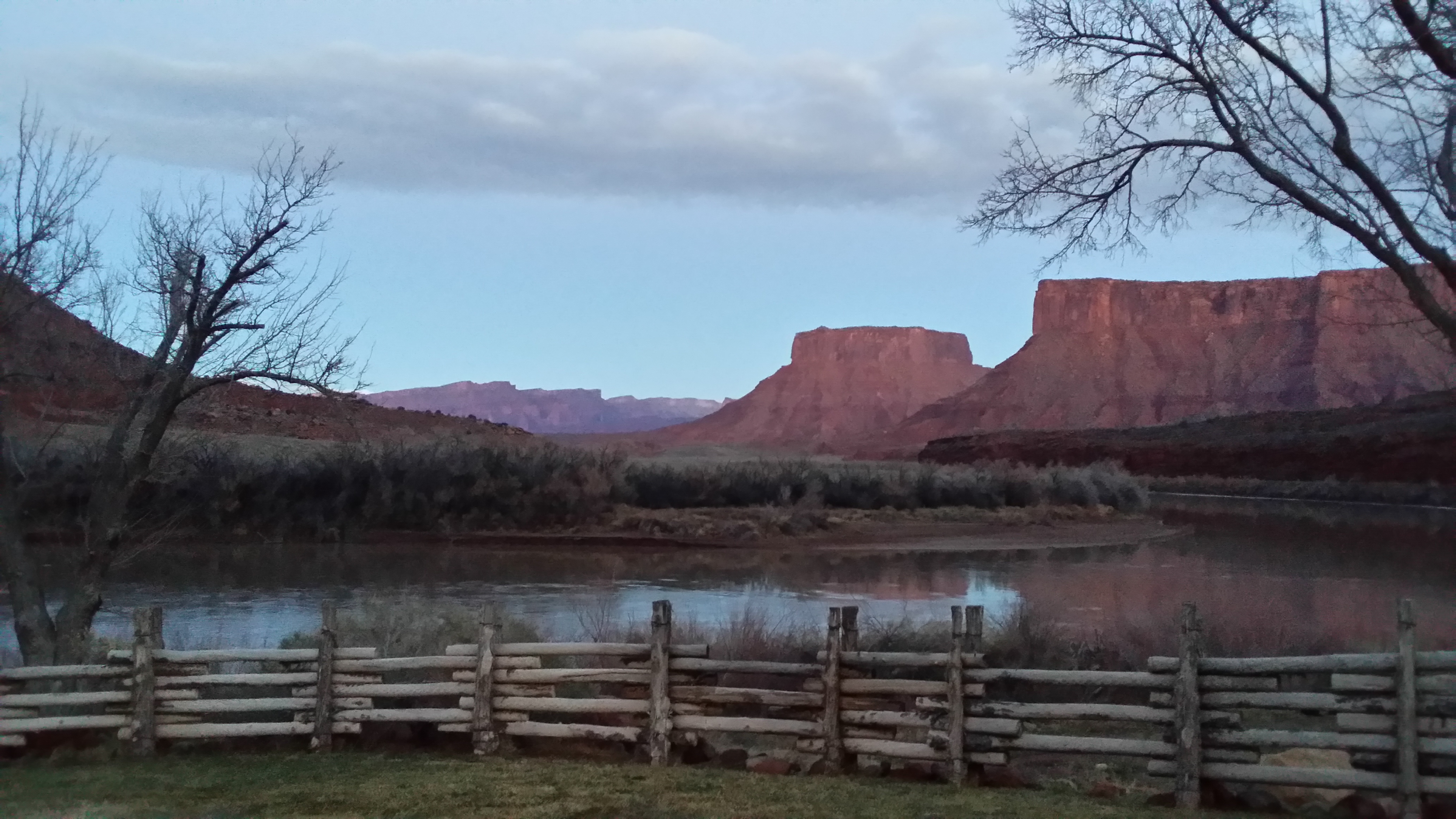
An enormous building is under construction beside the motel that is simultaneously being framed. The structure will contain pipes and pumps that will constantly circulate a huge quantity of water through a series of filters. Paxman partnered with AquaTech for the engineering. “Once this water is treated,” he says, “it will be even cleaner than the water residents can get in town.” Paxman is one partner of four who are investing into two large Marriott Motels which will be less than 100 feet from the banks of the Colorado. The views from the motel will be spectacular.
The water treatment facility will have more than four times the capacity than the needs of the two hotels. “So if there is any new development here on the north end,” Paxman says, “we can handle that. We are putting in a big enough water supply and a big enough sewer treatment, and it’s state of the art.” Paxon wouldn’t disclose the exact cost of the treatment facility, but he said it’s going to be “lots of millions.”
So how much more development will this new area provide? “We will have enough capacity for at least four more motels and three more restaurants,” Paxon says. The expansion will provide for at least 100 new jobs. The current construction effort has about 32 men working on sight.
Paxon says that while his desire to expand has failed to received everyone’s support, it’s clear the benefit it will provide the community in terms of jobs, tax dollars and additional visitors who will patronize plenty of other Moab businesses.
In a quick survey of business owners who operate outdoor adventure companies, Utah Stories did not find anyone who was opposed to the project. The 50 year evolution of Canyonlands By Night has been steady growth, but Paxman says that for the past 10 years they have been turning away larger parties due to the lack of accommodations.
The river run bike trail has just been completed. Traveling about four miles along the Colorado River, there is now an exclusive pathway for bikers and hikers. The trail is wide, resting on piles planted deep into the ground beside the river, making it appear that the path overhangs the Colorado in some areas.
According to BestPlaces.net Moab has a population of 11,889 residents and they have had an increase of population of 35% since 2000. http://www.bestplaces.net/zipcode/utah/moab/84532