Enterprising activity fills the small space at Millcreek Cacao Roasters. Steven Brewster is overseeing the roasting process and packaging. Mark DelVecchio heats and molds the chocolate, and Dana Brewster moves from station to station explaining the whole operation. In the bright space, the enticing aroma of chocolate is everywhere.
“Farm to bar,” is how Dana describes their operation. They use one variety only to produce a flavorful and smooth chocolate bar. The bean comes from a farm in Ecuador and is called the Arriba Nacional. It is an heirloom bean that is used exclusively by Millcreek. The flavor profile ranks as one of the top three in the nation.
The seeds originally came from the Rockefeller Foundation genebank collection, a project with a mission to collect and preserve seeds from around the world. Part of the goal for Millcreek is to help preserve this strain of cacao and keep it from going extinct or becoming diluted. They pay a premium to the farmer to help with production and also so he won’t try other faster growing, prolific strains. The premium allows the farmer to preserve the natural strain without turning to hybrid seeds that would result in a loss of flavor quality.
Preserving flavor quality is critical since “the bars only taste as good as the cacao you use,” Dana says.
The bean pods, which grow on the trunks and branches of trees, are harvested by hand and immediately split open with machetes. The pulp is scooped out to expose the seeds. Before they are shipped, the seeds go through a fermentation process, a forced ripening, to unlock the flavors, and then are dried on concrete patios. While on the patios, workers in Wellington boots walk on them daily, one direction one day and the other direction the next. Dana says, “It is a very organic process.”
Once the beans arrive at the shop, there are several steps to turn the beans into chocolate bars. They are sorted, roasted, milled, winnowed, and heated to a liquid that can be molded into bars. The only other added ingredients are pure cane sugar, cocoa butter and pure vanilla, leaving a bar of 70 percent cacao. They never use filler or emulsifiers to quicken the process.
Mark describe the taste as, “robust, but highly nuanced. Our job is to unlock the flavor of the bean.” To that end they follow an exact growing, harvesting and milling process, all developed to unlock the ultimate flavor.
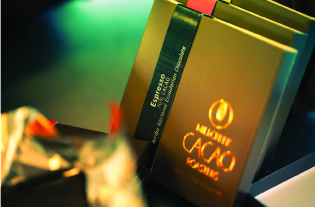
Though minimal ingredients go into the chocolate, they do offer bars with “toppings” added during the molding process. Some of their most popular are coffee, sea salt, mole, ginger and orange peel. For a special Valentine treat they are making some bars with Pop Rocks.
Millcreek Cacao can be found locally at Harmon’s, Liberty Park Fresh, and the Grand America Hotel. If you really want to impress your Valentine this year, think Millcreek Cacao.